Listening to:
Simons Foundation Launches Collaboration To Uncover How Energy Shapes Brain Computation
0:00
/
0:00
Bringing people and ideas together to fund, conduct, and share transformative science.
Our grants advance knowledge and strengthen connections between science and society.
Discover the latest news, research, and updates.
We convene scientists, mathematicians, and thinkers to share ideas and explore new questions.
Founded by Jim and Marilyn Simons, we’re a private philanthropy advancing mathematics and basic science.
Work with us on the frontier of basic science research.
The Flatiron Institute is a research center that uses computational science to advance fields like physics, biology, and astronomy.
Search
The Simons Collaboration on Brain Energetics (SCOBE) will investigate how energy constraints shape neural computation, from molecules to circuits to behavior.
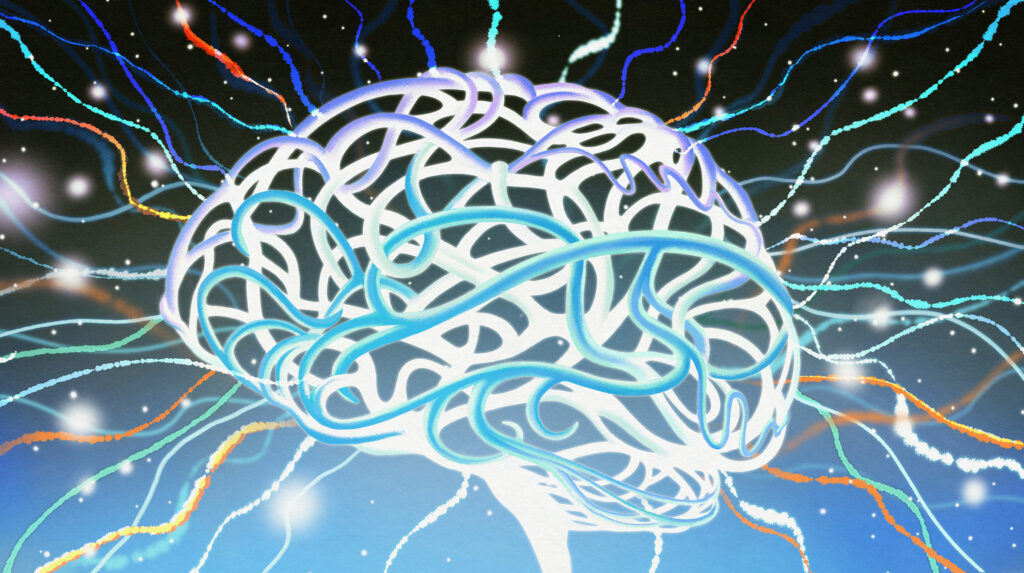
The human brain carries out more complex processes than any other organ, and to do this, it needs a lot of energy — roughly 20 percent of what the body generates. However, we still don’t fully understand how the brain creates energy, rations it out or uses its available supply to execute critical functions.
The Simons Collaboration on Brain Energetics (SCOBE), launched today, will explore these questions and how the brain creates and uses energy, as well as how it functions under metabolic stress. The collaboration provides $80 million over 10 years to a group of 26 investigators across systems and computational neuroscience, cellular and molecular biology, engineering and theory.
“Every thought and action depends on neurons performing computations that are extraordinarily costly in energy terms, yet we don’t understand how those energetic limits shape the way the brain is built and how it computes,” says Kelsey Martin, executive vice president of the foundation’s Autism & Neuroscience division. “This collaboration brings together experiments across species and scales with theory to reveal the principles linking energy supply and demand to how neural circuits compute and how behavior arises.”
“The Simons Foundation’s neuroscience collaborations are designed to understand fundamental principles of brain function, and brain energetics is a critical example of that,” says Alyssa Picchini Schaffer, vice president and senior scientific officer of the foundation’s neuroscience collaborations. “Brain energetics likely impacts everything from how the brain carries out computations to our basic understanding of autism, neurodevelopment and aging. It’s one of the backbone constraints for understanding the brain that we need to address to push the field forward.”
SCOBE will focus on four major topic areas:
To address these areas, SCOBE Investigators will study worms, flies, mice and humans. This diversity will also allow them to determine which principles of brain energetics are shared across species.
Like all the foundation’s neuroscience collaborations, SCOBE will have a strong focus on theory, computation and data sharing.
“Not a lot of past research into brain energetics has taken a theoretical or computational approach, so I’m optimistic about what we will learn by applying advanced modeling techniques to integrate diverse data types,” says Hannah Bayer, a senior scientific officer in neuroscience collaborations. “We are also committed to open data and are looking forward to sharing our findings with the broader research community.”
The following are the team of SCOBE Investigators:
Anton Arkhipov
Allen Institute
Ghazaleh Ashrafi
Washington University
Erin Barnhart
Columbia University
Kwabena Boahen
Stanford University
Thomas Clandinin
Stanford University
Daniel Colón-Ramos
Yale University
Emily Jane Dennis
Janelia Research Campus
Howard Hughes Medical Institute
Anna Devor
Boston University
Gaute Einevoll
University of Oslo
Surya Ganguli
Stanford University
Lisa Giocomo
Stanford University
Chenghua Gu
Harvard University
Balijit Khakh
Cardiff University
Laura Lewis
Massachusetts Institute of Technology
Jonathan Polimeni
Harvard University
Massachusetts General Hospital
Stanford University
Priya Rajasethupathy
Rockefeller University
Vidhya Rangaraju
Max Planck Florida Institute for Neuroscience
Nathalie Rochefort
University of Edinburgh
Tim Ryan
Weill Cornell Medicine
Sava Sakadzic
Harvard University
Massachusetts General Hospital
Nirao Shah
Stanford University
Longzhi Tan
Stanford University
Alison Tebo
Janelia Research Campus
Howard Hughes Medical Institute
John Vaughen
University of California, San Francisco
Tim Vogels
Institute of Science and Technology Austria
Gary Yellen
Harvard University