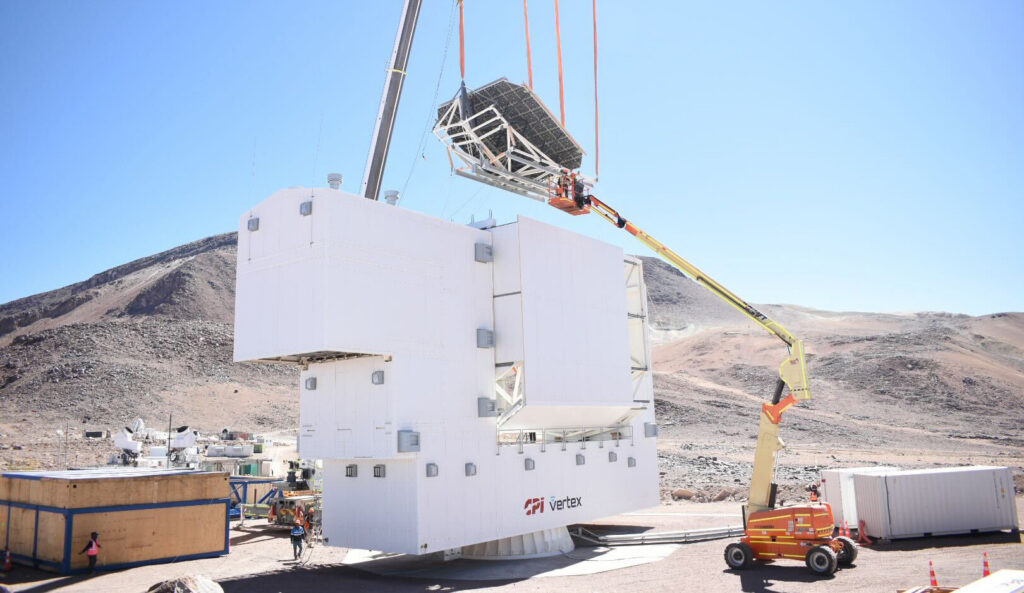
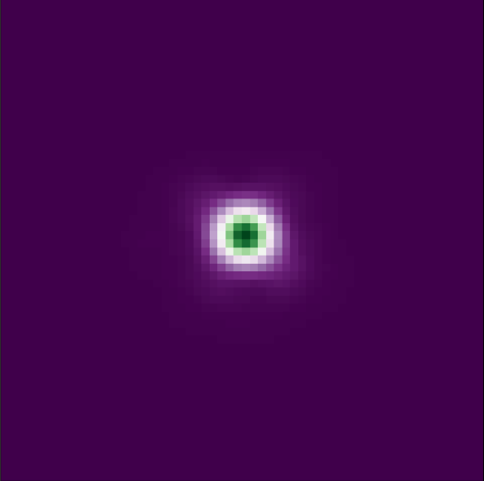
The successful tests led to sighs of relief among the team, says SO Co-Director Suzanne Staggs. “In the space between design and proof of success, there are many sleepless nights, so the LAT’s first light observations are a highly satisfying first step toward proof of the remarkable design,” says Staggs, who is the Henry DeWolf Smyth Professor of Physics at Princeton University. “To achieve the gamut of the SO science objectives, the SO team designed the LAT and its camera to have unprecedented sensitivity and excellent optical quality.”
The LAT and the three SATs will closely measure the cosmic microwave background, which is essentially the afterglow of the Big Bang, as well as observe other targets such as the universe’s most massive black holes and our solar system’s asteroids.
“It’s wonderful to have this last major piece of our observatory in place,” says SO Spokesperson Jo Dunkley, the Joseph Henry Professor of Physics and Astrophysical Sciences at Princeton University. “We are excited to find out what the suite of SO telescopes will reveal to us about the universe.”
With all four telescopes now online, the software behind SO is now hard at work operating the observatory’s mechanics and managing the influx of data. “The LAT coming online means so is the software that runs it,” says SO Data Manager Simone Aiola. “The software is now controlling the movements of the telescopes, analyzing the incoming data and backing everything up to two sites in North America and another in the U.K.”
Future upgrades to the Simons Observatory are already in the works, including enhancing the sensitivity of the LAT and adding new SATs. These upgrades come thanks to funding from the National Science Foundation, U.K. Research and Innovation, and the Japan Society for the Promotion of Science.
The new milestone coincides with the launch of a new Simons Observatory website, which will help communicate the project’s incredible science and technological advances to the public. The SO team also put together a fact sheet chronicling the SO progress through March 2025.