Honing of mission notwithstanding, support of mathematics research has always been at our core. Math is the lingua franca of science, and Jim understood this deeply and personally. His own collaboration with mathematician S.S. Chern from 1969–1970 had led unexpectedly to breakthrough science that would become important in various aspects of physics, including string theory and condensed-matter physics. Progress in math enables new thinking about and understanding of science, and the other way around. Jim and Marilyn were from the beginning generous with elite mathematics centers around the globe, lending support to venerable institutions like the Mathematical Sciences Research Institute, Institut des Hautes Études Scientifiques, the Institute for Advanced Study and Stony Brook University. Sometimes these institutional gifts were for general operations; sometimes they were for large capital projects. But it should be considered that math is the intellectual spine of the foundation.
In those early days, the gifts were larger and fewer, as there were no staff to administer a grant-making program. But that would soon change. Also around 2003, the Simonses had begun to think about funding work in the science of autism. They wanted to invest well, in the right people and projects. Thus was erected another pillar of the Simonses’ approach: Invite the best experts to consult on problems. That year the Simonses held what we now call ‘the Autism Roundtable,’ a daylong discussion among top investigators and policymakers — some already involved in autism, some not — about what was needed to advance the ball in autism science. The discussion that day would plant the seeds and focus the direction of the foundation’s first major funding program: the Simons Foundation Autism Research Initiative (SFARI).
And, big decisions having been made, the foundation would find ways to check in on itself, always. Scientific advisory boards are formed for all major programs. Roundtables and colloquia and meetings are held by grant-making divisions, between staff and scientists, and for scientists alone. Exposure to new outside ideas and the sometimes rigorous questioning of inside ideas, it is hoped, will always lead to earnest reflection and a truer course for the work. This is, interestingly, just another version of the scientific method.
And it’s no secret: The Simonses like to hire some of these experts as well as fund them. The first example of this, of course, was the hiring of Gerald D. Fischbach to run SFARI. Gerry created the model for professionalizing and growing the foundation’s grant-making capacity, thereby turning this family foundation into a family foundation. He brought the first scientists on board as staff and introduced us all to open RFAs (requests for applications) and big strategic projects designed to propel autism science. Indeed, this early recipe of finding individuals expert not only in science but also in the ins and outs of grant-making to run programs — and giving them the flexibility to mold the programs as they saw fit — would be echoed in the hiring of David Eisenbud and then Yuri Tschinkel to run the Mathematics and Physical Sciences (MPS) program along with Andy Millis and Greg Gabadadze; in the hiring of Marian Carlson to run Life Sciences; and then in the recruiting of Louis Reichardt to take over SFARI from Gerry. (Nota bene: The hiring would not stop there.)
Nearly 10 years after the Autism Roundtable, another hugely formative gathering of experts would impact the course of the Simons Foundation in more ways than one. This 2012 meeting we cryptically call ‘Buttermilk Falls,’ after the inn where it was hosted in Milton, New York. This two-day gathering of 18 preeminent scientists from varied disciplines was meant to assess whether goal-driven collaborative research projects were a sensible idea for the foundation, and, if so, what areas of research were uniquely poised for advancement in the next 10 years.
Long story short: It was decided that, yes, the foundation would undertake goal-oriented research by establishing ‘collaborations,’ wherein scientists — sometimes even competitors, sometimes even across disciplines — would work in concert to address topics of fundamental scientific importance. Today, 18 of these Simons Collaborations exist in the life sciences and in MPS on topics as diverse as the Origins of Life, Homological Mirror Symmetry, Principles of Microbial Ecosystems and ‘The Global Brain.’
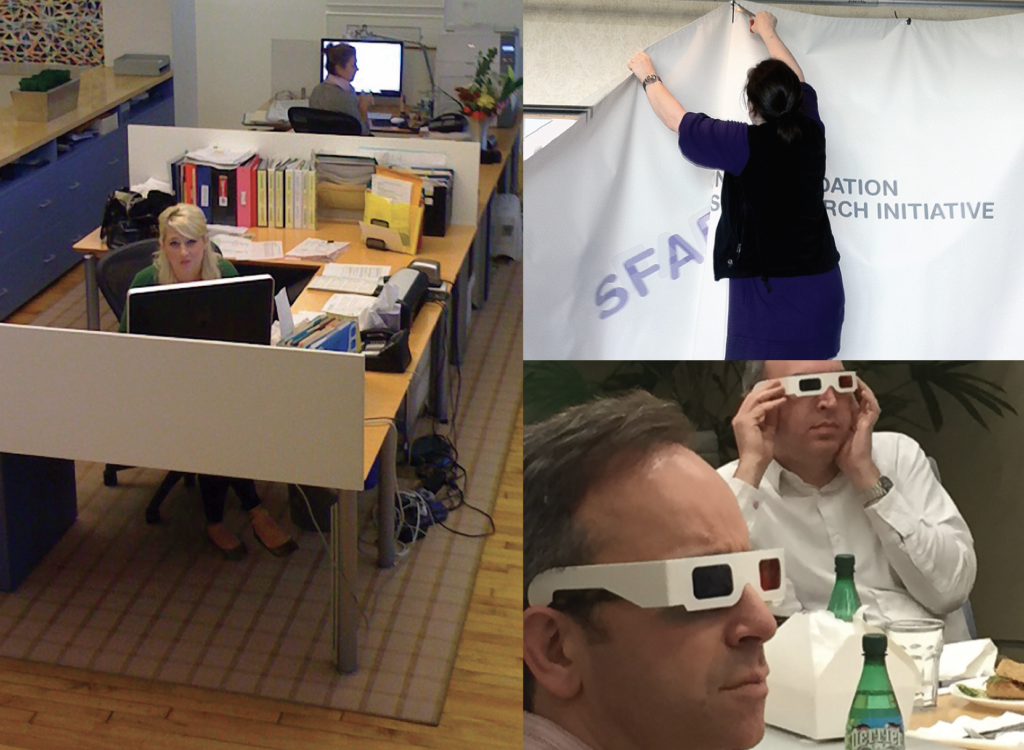
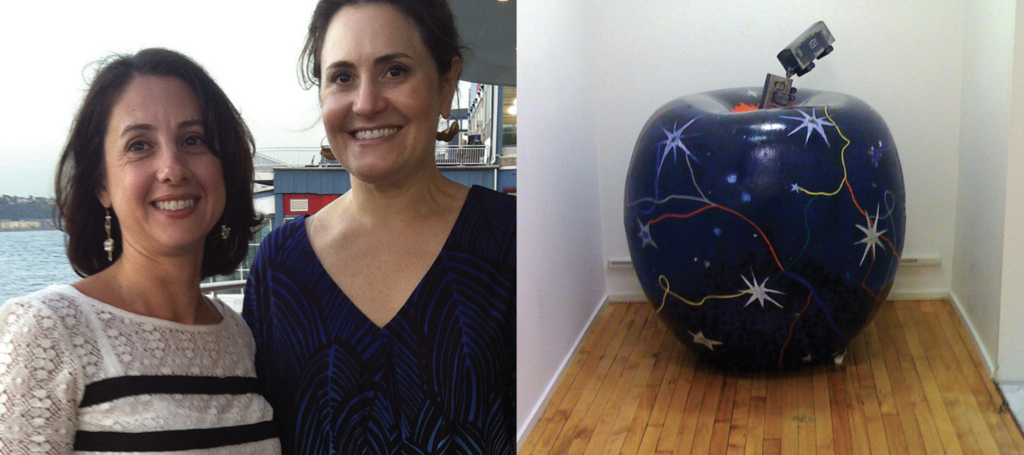

 Stacey Greenebaum is the Simons Foundation’s communications director as well as its first employee. Marie-queg, aka Maria Adler, was the foundation’s second employee, and after having served for years as its CFO, is today director of special projects.
This article is part of the "Five Unique Contributions We've Made to Science" section of the foundation's 25th anniversary book.
Stacey Greenebaum is the Simons Foundation’s communications director as well as its first employee. Marie-queg, aka Maria Adler, was the foundation’s second employee, and after having served for years as its CFO, is today director of special projects.
This article is part of the "Five Unique Contributions We've Made to Science" section of the foundation's 25th anniversary book.