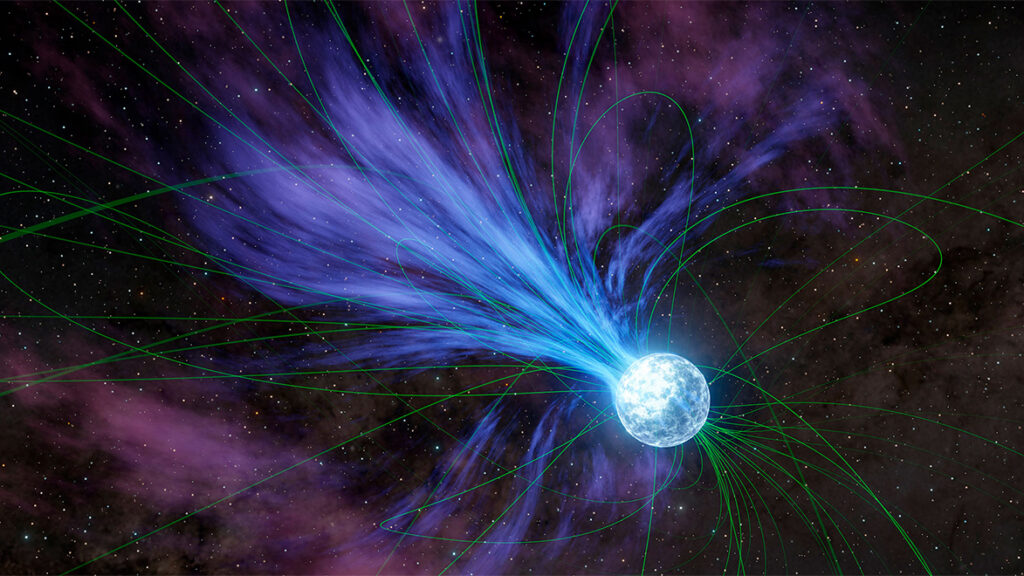
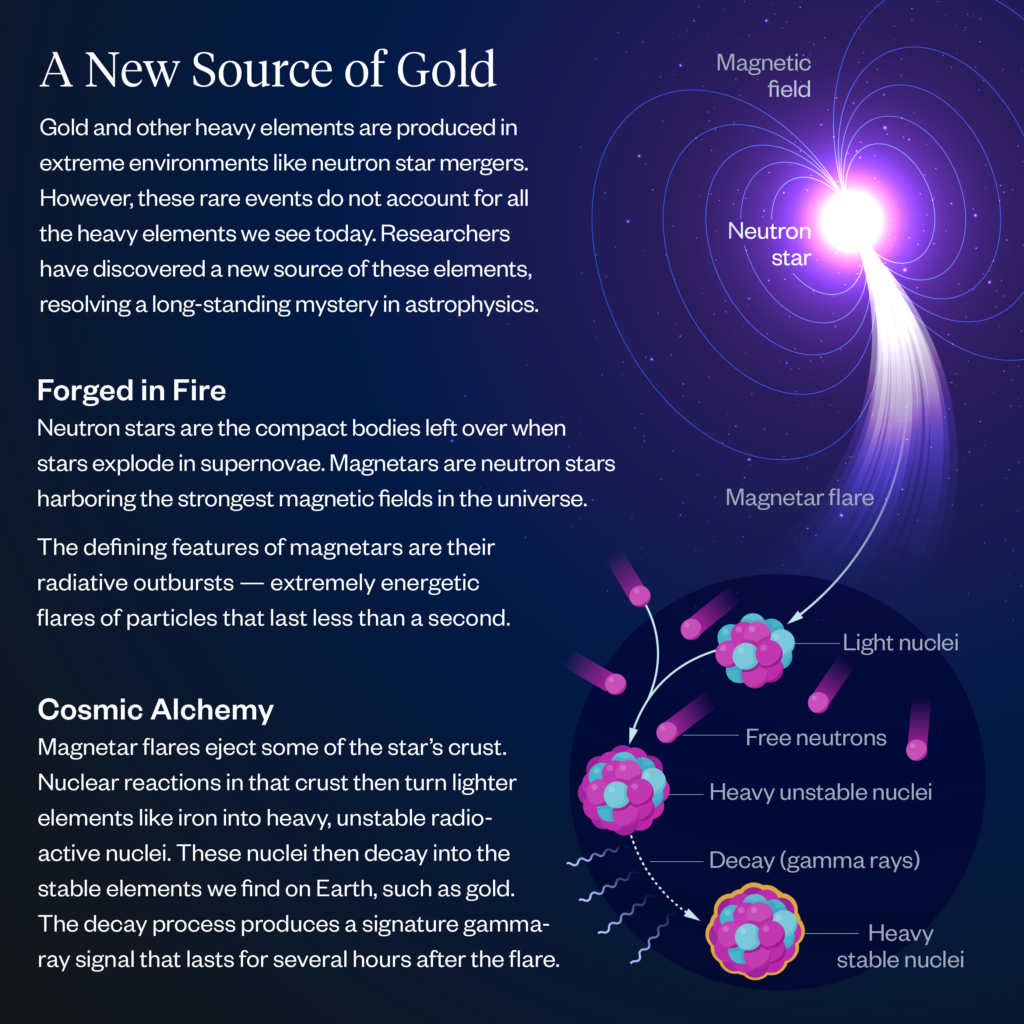
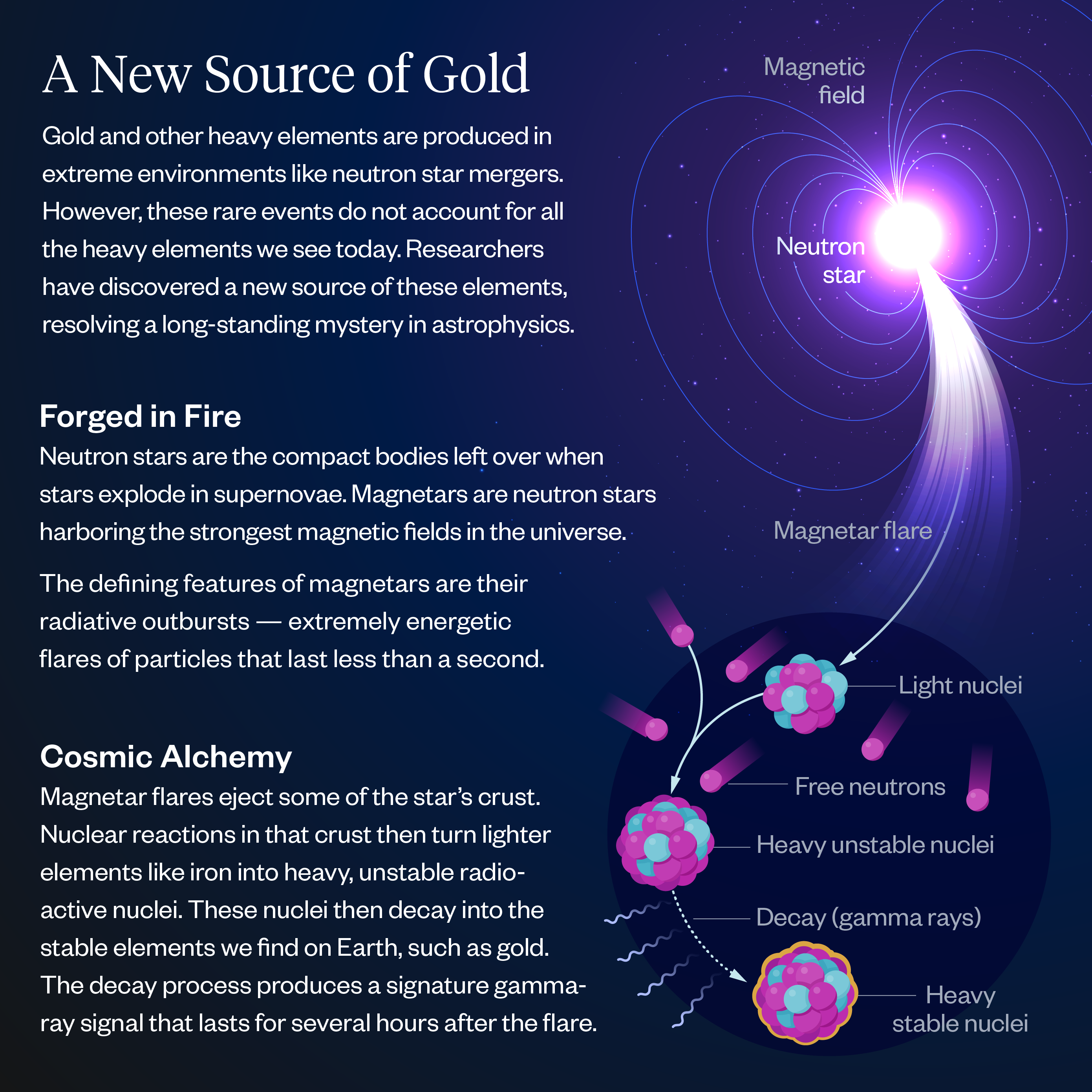
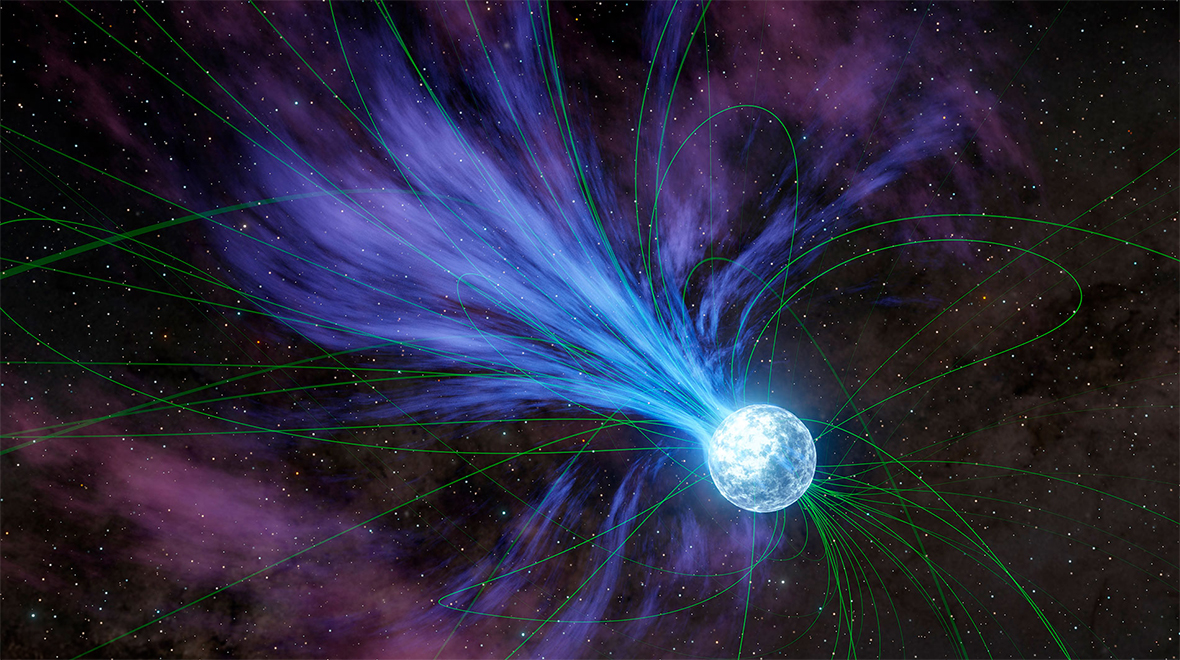
The group’s calculations show that these giant flares create unstable, heavy radioactive nuclei, which decay into stable elements such as gold. As the radioactive elements decay, they emit a glow of light, in addition to minting new elements.
The group also calculated in 2024 that the glow from the radioactive decays would be visible as a burst of gamma rays, a form of highly energized light. When they discussed their findings with observational gamma-ray astronomers, the group learned that, in fact, one such signal had been seen decades earlier that had never been explained. Since there’s little overlap between the study of magnetar activity and heavy-element synthesis science, no one had previously proposed element production as a cause of the signal.
“The event had kind of been forgotten over the years,” Metzger says. “But we very quickly realized that our model was a perfect fit for it.”
In the new paper, the astronomers used the observations of the 2004 event to estimate that the flare produced 2 million billion billion kilograms of heavy elements (roughly equivalent to Mars’ mass). From this, they estimate that one to 10 percent of all r-process elements in our galaxy today were created in these giant flares. The remainder could be from neutron star mergers, but with only one magnetar giant flare and one merger ever documented, it’s hard to know exact percentages — or if that’s even the whole story.
“We can’t exclude that there could be third or fourth sites out there that we just haven’t seen yet,” Metzger says.
“The interesting thing about these giant flares is that they can occur really early in galactic history,” Patel adds. “Magnetar giant flares could be the solution to a problem we’ve had where there are more heavy elements seen in young galaxies than could be created from neutron star collisions alone.”
To narrow down the percentages, more magnetar giant flares need to be observed. Telescopes like NASA’s Compton Spectrometer and Imager mission, set to launch in 2027, will help better capture these signals. Large magnetar flares seem to occur every few decades in the Milky Way and about once a year across the visible universe — but the trick is to catch it in time.
“Once a gamma-ray burst is detected, you have to point an ultraviolet telescope at the source within 10 to 15 minutes to see the signal’s peak and confirm r-process elements are made there,” Metzger says. “It’ll be a fun chase.”