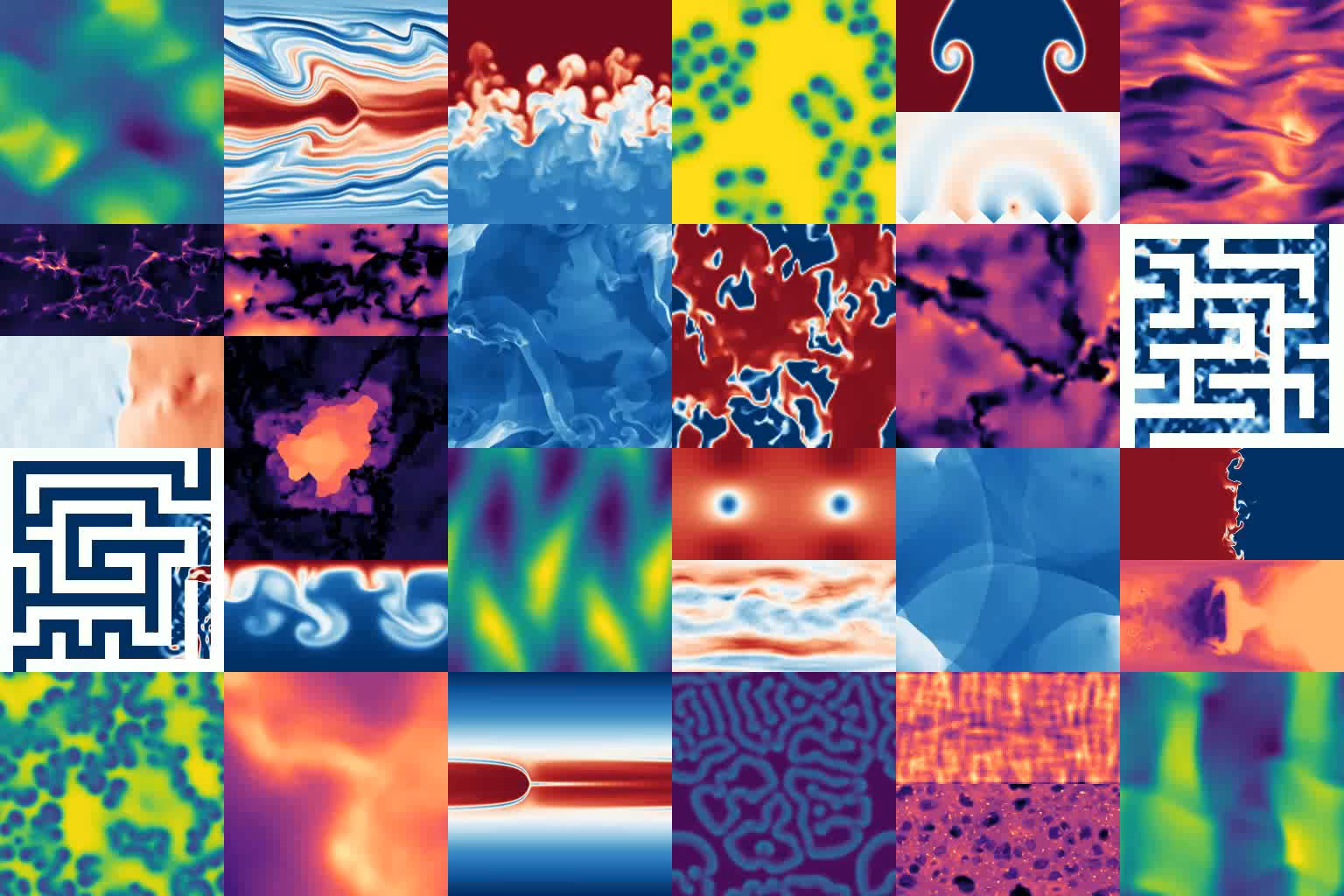
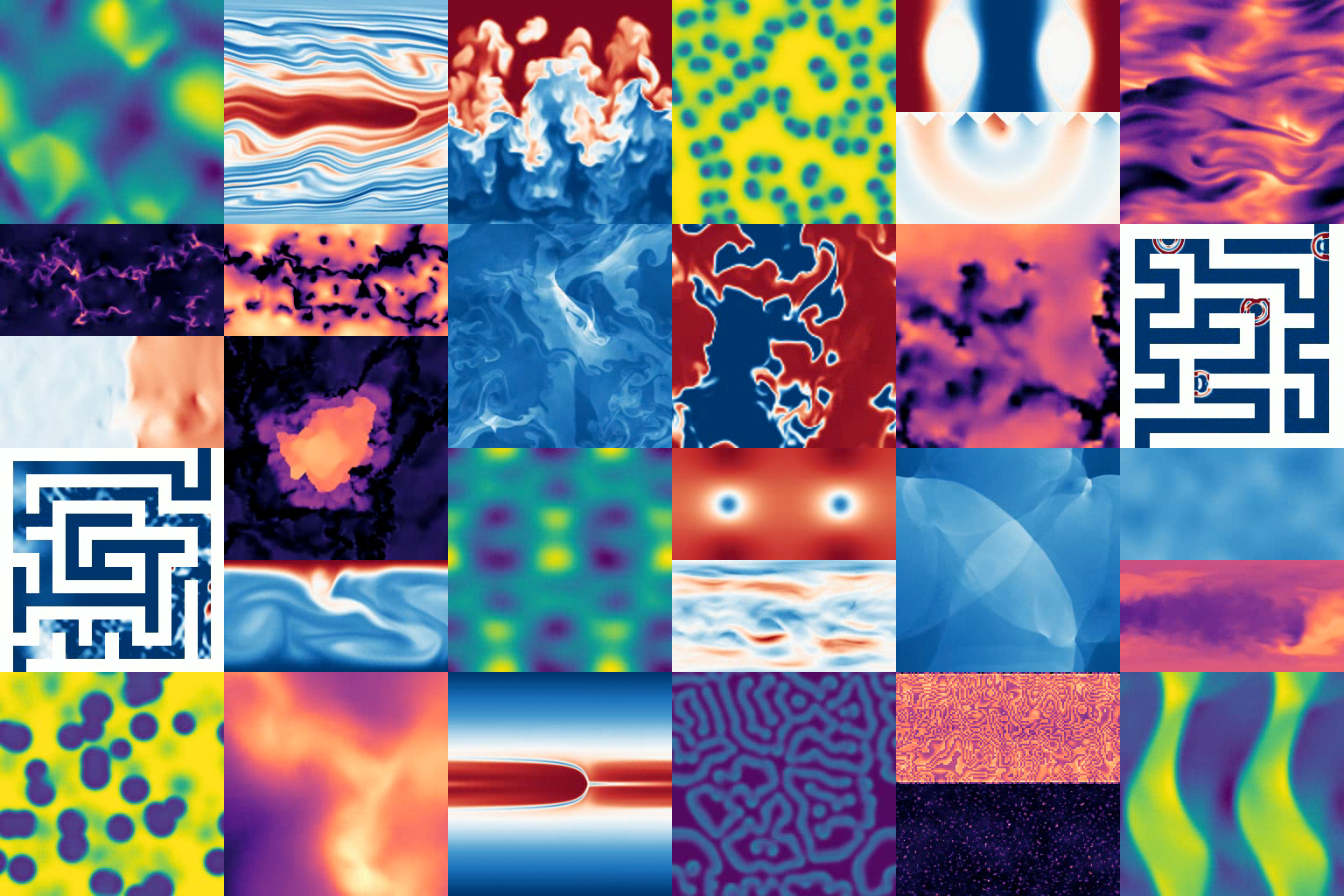
What can exploding stars teach us about how blood flows through an artery? Or swimming bacteria about how the ocean’s layers mix? A collaboration of researchers from universities, science philanthropies and national laboratories has reached an important milestone toward training artificial intelligence models to find and exploit transferable knowledge between seemingly disparate fields to drive scientific discovery.
This initiative, called Polymathic AI, uses technology similar to that powering large language models such as OpenAI’s ChatGPT or Google’s Gemini. But instead of ingesting text, the project’s models learn using scientific datasets from across astrophysics, biology, acoustics, chemistry, fluid dynamics and more, essentially giving the models cross-disciplinary scientific knowledge.
“These groundbreaking datasets are by far the most diverse large-scale collections of high-quality data for machine learning training ever assembled for these fields,” says Polymathic AI member Michael McCabe, a research engineer at the Flatiron Institute in New York City. “Curating these datasets is a critical step in creating multidisciplinary AI models that will enable new discoveries about our universe.”
Today, the Polymathic AI team released two of its open-source training dataset collections to the public — a colossal 115 terabytes in total from dozens of sources — for the scientific community to use to train AI models and enable new scientific discoveries. (For comparison, GPT-3 used 45 terabytes of uncompressed, unformatted text for training, which ended up being around 0.5 terabytes after filtering.)
“The freely available datasets are an unprecedented resource for developing sophisticated machine learning models that can then tackle a wide range of scientific problems,” says Polymathic AI member Ruben Ohana, a research fellow at the Flatiron Institute’s Center for Computational Mathematics (CCM). “The machine learning community has always been open-sourced; that’s why it’s been so fast-paced compared to other fields. We feel that sharing this data open source will benefit the machine learning and scientific communities. It’s a win-win situation — you have machine learning that can develop new models, and at the same time, scientific communities can see what machine learning can do for them.”
The full datasets are available to download for free from the Flatiron Institute and accessible on Hugging Face, a platform hosting AI models and datasets. The Polymathic AI team provides further information about the datasets in two papers accepted for presentation at the leading machine learning conference, NeurIPS, to be held in December in Vancouver, Canada.
“We’ve seen again and again that the most effective way to advance machine learning is to take difficult challenges and make them accessible to the wider research community,” says McCabe. “Each time a new benchmark is released, it initially seems like an insurmountable problem, but once a challenge is made accessible to the broader community, we see more and more people digging in and accelerating progress faster than any individual group could alone.”
The Polymathic AI project is run by researchers from the Simons Foundation and its Flatiron Institute, New York University, the University of Cambridge, Princeton University, the French Centre National de la Recherche Scientifique and the Lawrence Berkeley National Laboratory.
AI tools such as machine learning are increasingly common in scientific research, including being recognized in two of this year’s Nobel Prizes. Still, such tools are typically purpose-built for a specific application and trained using data from that field. The Polymathic AI project instead aims to develop models that are truly polymathic, like people whose expert knowledge spans multiple areas. The project’s team itself reflects intellectual diversity, with physicists, astrophysicists, mathematicians, computer scientists and neuroscientists.
The first of the two new training dataset collections focuses on astrophysics. Dubbed the Multimodal Universe, the dataset contains hundreds of millions of astronomical observations and measurements, such as portraits of galaxies taken by NASA’s James Webb Space Telescope and measurements of our galaxy’s stars made by the European Space Agency’s Gaia spacecraft.
“Machine learning has been happening for around 10 years in astrophysics, but it’s still very hard to use across instruments, across missions and across scientific disciplines,” says Polymathic AI research scientist Francois Lanusse. “Datasets like the Multimodal Universe are what will allow us to build models that natively understand all of these data and can be used as a Swiss Army knife for astrophysics.”