How a Tiny Brain Region Helps You Learn Complex Movements, One Neuron at a Time

From the elephant gripping objects with its trunk to the newt folding leaves around its eggs with a hind foot, animals depend on dexterity for their survival and well-being. As animals practice a new motion, they gradually learn to execute it with increasing speed and finesse. But how does this learning unfold in the brain?
Neuroscientists have long known that the primary motor cortex, a region in the brain’s frontal lobe, rewires itself to learn new voluntary movements. But brain regions don’t act alone — they converse with other regions. How these long-range interactions rewire the brain to produce learned dexterity has been entirely unknown — until now.
A recent study in Nature led by Takaki Komiyama, an investigator with the Simons Collaboration on the Global Brain, has identified how a small structure deep inside the brain called the motor thalamus drives the brain’s ability to learn complex movements by rewiring circuits in the motor cortex.
The research offers a fresh lens for exploring how connections between distant brain regions fuel learning and could help inform new therapies. “We’ve identified a key locus of change during motor learning,” says Komiyama, who also serves as a professor of neurobiology at the University of California, San Diego (UCSD) and the Kavli Institute for Brain and Mind in La Jolla, California. “It’s not entirely science fiction to try to think about intervention strategies based on that.”
Komiyama and co-corresponding author Marcus Benna of UCSD carried out the study with Assaf Ramot, Yun Yang, Yuxin Hu, Qiyu Chen, Bobbie C. Morales, Xinyi C. Wang and An Wu, also of UCSD; Felix Taschbach of UCSD and the Salk Institute for Biological Studies in La Jolla; and Kay M. Tye of the Salk Institute and the Kavli Institute for Brain and Mind.
Tailoring the Circuit to the Motion
Studies of how animals learn often focus on a single brain region, since many tools used in neuroscience experiments — such as electrode recording and imaging — are easier to use in one area than across multiple regions. Komiyama’s team pinpointed which distant brain areas might drive learning in the motor cortex by engineering mice so that neurons connecting other regions to the motor cortex would light up when active, producing a twinkling diagram of neural activity. The team then tracked these signals as the mice gradually learned to grasp and press a lever in response to a sound cue.
In mice new to the task, neurons across many brain regions activated as the animals attempted the task. But as the mice gained skill, the motor thalamus took center stage, sending signals to the motor cortex in close synchronicity with each movement attempt. With each lever push, the motor thalamus shone the brightest.
The researchers next engineered mice in which they could activate thalamic neurons projecting to the motor cortex. Neurons in the motor cortex, meanwhile, would glow when activated. This arrangement enabled the researchers to identify the exact motor cortex neurons activated by the motor thalamus, about 9 percent of all motor cortex neurons. “This was surprisingly few,” says Komiyama. “It indicates that this is a highly selective channel of information.” The makeup of this elite group of motor cortex neurons shifted over the course of the mouse’s learning, the researchers found.
As the mice learned the movement, the researchers observed three parallel shifts. First, cells consistently activated by the motor thalamus got better and better at driving the learned motion. Second, the motor thalamus started activating more neurons involved in the motion and fewer neurons not involved in the motion. Third, the neurons activated by the motor thalamus became mini-influencers — recruiting and activating neighboring neurons to become involved in the motion. After two weeks, the result was a finely tuned circuit capable of producing the motion smoothly and consistently.
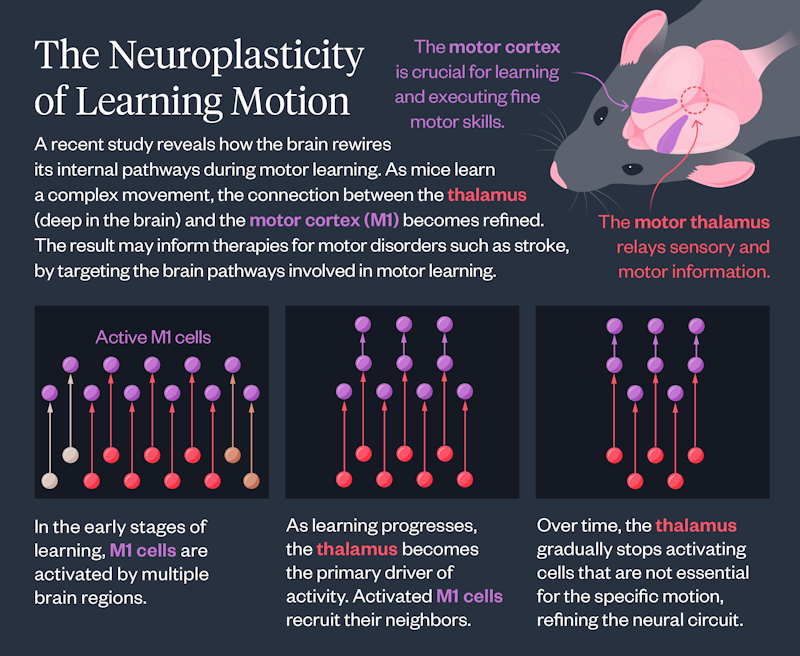
Before this study, researchers thought learning-related changes might be confined to the motor cortex. “Maybe, people thought, the thalamus is always doing the same thing, but the cortex changes how it interprets the input,” says Komiyama. However, the new findings show otherwise: As mice become proficient, the pathway from the motor thalamus to the motor cortex refines itself.
When the researchers inactivated the motor thalamus, the mice lost their hard-won skill. But the same intervention had little effect on beginner mice, suggesting that the motor thalamus’s role in driving the motion grows substantially as mice master the skill.
The study “shows how dynamic and plastic the brain is,” says Ramot, one of the paper’s lead authors. “It dramatically changes over the course of learning.”
Stimulating Learning
In future work, Komiyama and his colleagues aim to uncover how mechanisms that govern synapses (the junctions between neurons through which they send signals) could help thalamus neurons find and connect with the optimal cells in the motor cortex. Earlier this year, their laboratory published a paper in Science showing how neighboring synapses can reinforce each other and potentially help to shape specialized circuits.
Ramot plans to study how environmental and emotional stressors disrupt motor learning. The team’s work so far, by clarifying the mechanisms of motor learning in healthy animals, “has laid the groundwork for studying what goes wrong in compromised states of health,” Komiyama says.
Ultimately, the researchers hope their work will help guide the design of therapies for patients with impaired motor function.
“Now that we know what kinds of connections are getting established or strengthened during learning, we could imagine interventions where we try to force the right neurons to connect to each other by very precise stimulation protocols,” says Komiyama.
Neuroscientists will soon be able to stimulate handfuls of targeted cells in the human brain, Ramot predicts. “The science is almost there.”