Scientists Pinpoint the Moment of Decision in the Rat Brain

Imagine trying to choose between two snacks at a store. Your brain takes in different kinds of information as you consider the possibilities: how hungry you are, the colors on the packaging and your memory of how the snacks tasted the last time you ate them. At some point, you make up your mind and pick one over the other — the decision is made.
What happens in the brain as it shifts from weighing both snacks to choosing one? The neuroscience of decision-making holds many mysteries, but scientists led by Carlos Brody, a Simons Collaboration on the Global Brain (SCGB) investigator at Princeton University, have just uncovered one principle of how brain activity in rats changes as they make up their minds. Their study, published on September 17 in Nature, pinpoints the split-second change in neural activity that occurs when a decision is made.
“We think we’ve found the internal moment when an animal makes up its mind,” says Thomas Luo, an assistant professor at the University of Utah and a former postdoctoral research associate at Princeton. Luo was co-first author of the study with Tim Kim, formerly a doctoral student at Princeton and now a Shanahan postdoctoral fellow at the Allen Institute.
To understand how the brain makes decisions, the researchers trained rats to perform a task. The rats first had to stand still and listen to clicks coming from their left or right side. Then they had to choose which way to turn, and if they turned toward the side with more clicks, they received a reward.
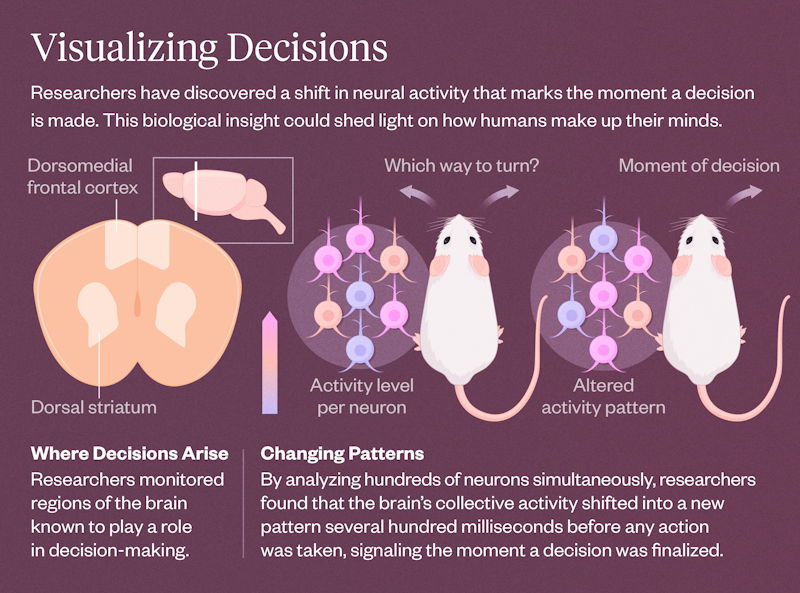
As the rats performed this task, the researchers measured their brain activity using a Neuropixels probe, a thin silicon probe that can capture the activity of hundreds of neurons in a single experiment. They placed the probe in regions of the brain known to be involved in decision-making: the frontal orienting field (a part of the cortex that is involved in mapping the animal’s location in its surroundings) and the dorsal striatum (which is located beneath the front of the cortex and also plays roles in cognition and movement).
The scientists then developed a computational model using machine learning to parse the dynamics of the data they’d gathered. The model gives visual readouts showing how the activity of the hundreds of neurons changes over time, the way a radar map shows changes in wind or precipitation. Using this model, the researchers saw that decision-making neurons were highly sensitive to external input — the clicks — up to a certain point in the task, after which the neural activity rapidly shifted to a very different dynamic pattern.
“We stared at it, and we stared at it, and we thought, ‘Well, it looks cute, but what does it mean that it stops being sensitive to inputs?’” says Kim. “Then we realized: When you’re forming a decision, when is it that you stop being sensitive to the inputs? It’s when you’ve made up your mind.”
Inside the Decision Point
To test whether that sudden change in neural dynamics was the moment the animal had picked one side or the other, the researchers asked whether clicks that happened after that big shift affected the animal’s behavior. If the rat had made up its mind, the scientists expected that any input after that point wouldn’t matter. And that’s what the data showed.
This decision point, which the researchers dubbed the “neurally inferred time of commitment,” happens on the order of a few tens of milliseconds. And it precedes the animal’s actions — it takes another several hundred milliseconds for the rat to turn to one side or the other.
“When you’re recording from hundreds of neurons together, you can reference them to each other. And that lets you see signals that are internal to the brain, not time-locked to anything external like the clicking sounds or the start of the trial,” Brody says. “And that’s exactly what this is.”
The Biology of Changing Your Mind
Next, the researchers want to explore whether a neural activity shift happens in other areas of the brain during decision-making as well. In the recently published study, the scientists used a single Neuropixels probe to measure brain activity. Now they’re conducting similar experiments using eight probes at once to capture neural activity throughout the rat brain as the animal makes a decision. So far, they’re seeing a similar big change in neural dynamics across all the recorded brain regions after that neurally inferred time of commitment. It’s not yet clear why a single decision would have such a broad ripple effect across so many regions of the brain.
Brody also wants to explore the neuroscience of changing one’s mind after making a decision.
“The first thing I’d want to know if I want to change your mind is: How is it that you made up your mind? What is it that I need to undo?” he says. “What this study tells us is that changing your mind isn’t merely gathering new evidence. It’s changing the state, going back to that initial state where you’re receptive to input.”
The biology scientists have uncovered in rat brains could one day help us understand how people make up their minds. Although it’s not yet known whether the same process occurs in the human brain when we’re choosing between snacks, it’s intriguing to speculate that there’s a similar shift from being receptive to becoming closed off to new inputs, Brody says.
“Are the mechanisms in humans the same as those in rats? We don’t know,” he says. “We hope to find out more about the basic science that could one day inspire similar understanding in humans.”