Celebrating Mathematics: ICM2026 in Philadelphia

Mathematicians from around the world will gather in Philadelphia from July 23–30, 2026, for the International Congress of Mathematicians (ICM). To learn more about the meeting and to register, visit www.icm2026.org.
Over the last couple of years, around 250 mathematicians from all over the world have been contributing to preparations for the next International Congress of Mathematicians (ICM), to be held in Philadelphia in July 2026. They have assembled a lineup of distinguished speakers and are finalizing decisions about prestigious awards, including the Fields Medals and other significant honors, to be presented at the congress. The organizers are also curating a festive program to showcase mathematics and its connections with science, culture and the arts.
At the center of the planning are the thirteen U.S.-based members of the ICM2026 Organizing Committee. Their work has coincided with a period of uncertainty triggered by actions of the new US administration that began in January this year. The changed circumstances have sparked wide-ranging reactions within the mathematical community. The AMS, through its policy committees and its office in Washington, D.C., has taken a leading role in promoting discussion and advocating support of mathematics and research more generally. For the ICM2026 Organizing Committee, though, there is just one purpose: making the congress an outstanding event.
The congress organizers “are dedicated to the success of the ICM,” said committee cochair Jalal Shatah of New York University. “They are putting in a lot of effort and personal time. We are all moving forward enthusiastically, committed to creating an extraordinary congress.”
Eyes Open, Watching Everything
Held every four years, the ICM is an event created by and for mathematicians. As the world’s most important gathering spanning the full frontier of mathematics, it tells a story about where mathematics is, how far it has come, and who has brought it this far. Transcending political and geographic borders, the ICM is an expression of the unity of the mathematical spirit.
Guided by this idealistic mindset, the ICM2026 Organizing Committee remains vigilant in ensuring that the ICM will be an inclusive event facilitating broad participation and fostering a strong sense of unity within the global mathematical community. “We are keeping our eyes open, watching everything — funding, visas — and trying to adapt, to adjust our planning so we can make the ICM a successful occasion,” said Shatah.
The Organizing Committee has pledged to make participation possible, one way or another, for all who register. Registered participants will receive from the committee a letter that they can take to their local U.S. consulate to apply for a visa; the committee encourages early registration and prompt visa applications.
Shatah said he does not expect any speakers to be denied visas, but if denials do occur the Organizing Committee is prepared to reach out to US consulates and embassies around the world and to mobilize additional support from institutions such as the National Academy of Sciences, philanthropic foundations, and prominent science leaders.
Amid the challenges, “the good news is the existence of the Simons Foundation,” said Organizing Committee member Susan Friedlander of the University of Southern California. Simons is providing much of the support, financial and logistical, for ICM2026. Along with substantial resources and an excellent staff, the foundation has the advantage of operating independently. “There is no other foundation that is as committed to science and mathematics as the Simons Foundation is,” said Friedlander. In the current climate of uncertainty, “that is a great boon.”
Outreach Program
The planning for ICM2026 is proceeding apace, and the enthusiasm of the organizers is high. Jonathan Block of the University of Pennsylvania is cochair, with John Morgan of Columbia University, of a subcommittee for outreach events. “It’s been a real pleasure to be involved with the local organizing,” said Block. “I am having fun. This has actually been really amazing.”
One of the projects he has been working on, starting this fall and running over the academic year, will bring top mathematicians to the Philadelphia area to give two talks: one in a college or university mathematics department, and one in a high school. In conjunction with the talks, a local ICM organizer will give a pitch about the congress and try to recruit volunteers — mainly high school and college students — who would act as helpers during the congress and get free registration in return.
Other planned outreach events at the congress include the art-and-math collaborative exhibit called Mathemalchemy and a two-day math fair organized by New York City’s Museum of Mathematics. Also in the works is a math movie series, with screenings of recent films with mathematical themes, such as Le Théorème de Marguerite (2023).
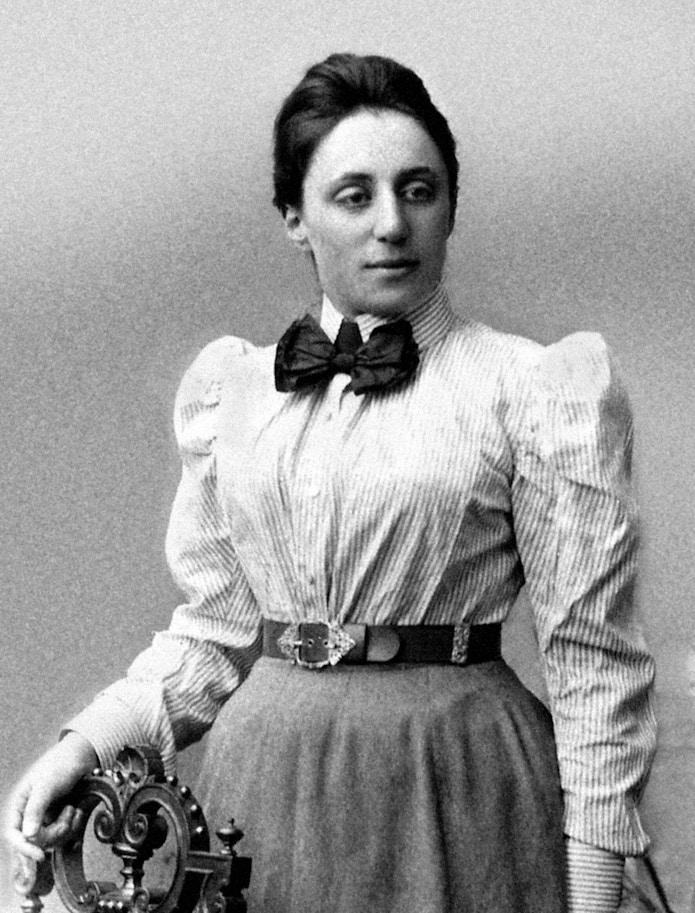
One project especially close to Block’s heart is a celebration of the life of Emmy Noether. In 1933, she fled Nazi Germany and joined the faculty at Bryn Mawr College, which is a half-hour train ride from Philadelphia. Block and his co-organizers are planning an exhibit about the history of American mathematics that will include a segment on Noether, as well as a trip to Bryn Mawr to see her grave, which the college recently renovated.
In addition to being an Emmy Noether fan, Block is also a baseball fan. He has been in contact with the Philadelphia Phillies baseball team, who he said are “very excited” about the idea of holding an event at the ICM. One possibility is to have people from the Phillies enterprise speak about how mathematics and statistics enter into their work. Block is also hoping that the Phillies’ schedule will include a home game that ICM participants can attend. “Baseball is a great game to just chill out and watch,” he said.
“The atmosphere in academia isn’t very good right now,” said Block. “It would be nice to have some reason for optimism. I think the ICM could be a mechanism for that. … I love the mathematical community, and I think the ICM will be like a huge love fest for mathematics.”
Scientific Program Comes into Focus
In 2014, Christoph Sorger of Nantes Université attended the ICM in Seoul, South Korea. He enjoyed meeting colleagues from all over the globe and attending talks in areas far from his own. What’s “spectacular” about the congress “is to see all these extremely well-known and good mathematicians talking about their work,” he said. “You get an introduction to these areas that you can’t get on other occasions. I really learned a lot.”
In 2023, Sorger was appointed secretary general of the International Mathematical Union (IMU), the worldwide confederation of mathematics organizations that oversees the ICM. One of his main responsibilities is to keep the process of assembling the ICM2026 scientific program on track.
That process started not long after the close of ICM2022. In 2023, the IMU appointed the 12-member Program Committee, chaired by Claire Voisin of the Centre National de la Recherche Scientique in France. The Program Committee then appointed chairs and core members of the panels for the 20 ICM sections covering the various branches of mathematics. The section chairs and core panelists, in turn, chose three or four additional section panelists for each section. The panels selected the invited section speakers, while the Program Committee chose the plenary lecturers. Altogether about 160 mathematicians were involved in selecting a total of about 220 speakers. Apart from Voisin, the names of the Program Committee members and section panelists are not made public until the congress begins, to shield them from lobbying and pressure.
Sorger’s job is ensuring the entire selection process runs smoothly, needed coordination happens, and deadlines are met. He also works closely with the IMU Executive Committee, including IMU president Hiraku Nakajima of the University of Tokyo. In April, the completed list of speakers was sent to the Organizing Committee, which is the body that issues the formal invitations. The full program of speakers was posted on the ICM2026 website in July.
Another group central to the scientific program is the Structure Committee. First appointed in connection with ICM2022, this 13-person committee is chaired by Terence Tao of the University of California, Los Angeles. It sets the number of sections and adapts them to the current frontier of research by adding newly blossoming topics and pruning those that have become less central. The committee also determines the number of plenary lectures as well as the number of talks in each section.
Another major responsibility of the Structure Committee is “to think about the ICM and its future,” Sorger said. “Should the fact that we have plenary and sectional speakers be written in stone? Should we think about other ways to communicate about mathematics?”
One innovation that originated in the Structure Committee and began with ICM2022 are the Special Lectures. These serve a variety of aims, such as treating interdisciplinary topics that do not fit neatly into existing sections, and providing a timely expository survey of work in one of the sections. Special Lectures can also experiment with new presentation formats, such as a panel discussion on a hot research topic, or a “flipped” event in which audience members receive a write-up beforehand and the lecture itself becomes a question-and-answer session. About 15 Special Lectures will be on tap at ICM2026.

Public Lectures and Satellite Events
On the border between the scientific and the outreach programs for ICM2026 is a collection of five public lectures, organized by Gigliola Staffilani of the Massachusetts Institute of Technology and Robert Bryant of Duke University, with help from a subcommittee. Staffilani noted two different kinds of public lectures: One, where an outstanding research advance dictates the choice of speaker; and the other, where research prowess is less central than being an especially effective communicator. “We worked very hard to have a good mix of these two concepts, both of which are extremely valuable,” said Staffilani. One theme the public lectures will touch on is artificial intelligence, from its use in mathematics research to broader questions about its influence on society.
Staffilani also chairs the subcommittee reviewing proposals for ICM2026 satellite conferences. To take place between May and September 2026, these conferences will have an international perspective and be held at universities, research institutes and scientific organizations.
The subcommittee includes representatives from the U.S., Canada and Mexico, as the aim is to have satellite conferences spread across all of North America.
In addition to screening proposals for quality, the subcommittee tries to ensure some coordination. “We want to make sure not all topics are in, say, partial differential equations, that not all the conferences are in, say, Princeton, that not all are, say, two days before the congress starts,” explained Staffilani. The first two rounds of proposals resulted in approval of about 30 satellite conferences; a third round, with a deadline at the end of January 2026, should bring several more.
The satellite conference subcommittee only selects the conferences; it has no funds to disburse. Most of the conference organizers will be applying for support from the Division of Mathematical Sciences of the National Science Foundation. The DMS has agreed in principle to fund satellite conferences, and the ICM2026 Organizing Committee expects this funding to be available despite the uncertainty that has arisen over the NSF budget. As Shatah put it, “We are cautiously hopeful it will be fine.”
Unity is Vital
The AMS has many connections to ICM2026. One example is its administration of ICM travel grants. Another is the service of two AMS officers on the ICM2026 Organizing Committee: past president Bryna Kra of Northwestern University, and Vice President Irene Fonseca of Carnegie Mellon University.
The AMS also supports the ICM organization in more general ways, through such infrastructure as the AMS Office of Governmental Relations, based in Washington, D.C. This office, headed by Karen Saxe, emerita professor of mathematics at Macalester College, has been in high gear, collecting stories of mathematicians affected by the recent government actions, making visits to Capitol Hill, and holding discussions between AMS policy committees and Washington-based decision makers. Saxe sees encouraging signs in the collaborations the AMS has built with other scientific organizations. Among them, she said, “the unity is total.”
Echoing the vital role of unity is current AMS president Ravi Vakil of Stanford University. “The ICM is a celebration of the world mathematical community and has particular value right now,” he said. “By coming together every four years, we reinforce our commitment to our fundamental values, including international cooperation and collaboration, and the free and open sharing of ideas.