Simons Foundation Announces 3 New Scientific Software Research Faculty Fellows
The Simons Foundation is pleased to announce the latest recipients of its Scientific Software Research Faculty Fellowships. These fellowships support the creation of new software-focused positions at academic institutions. In these positions, researchers can develop scientific and mathematical software that will play a crucial role in enabling discoveries through data analysis, simulations, visualizations and calculations.
The fellowships provide the fellows’ home institutions with 50 percent salary and benefits support for the creation of the new positions. In addition, the fellows will each receive a $50,000 research allowance. The fellowships are funded by Simons Foundation International and administered by the Simons Foundation.
Through these fellowships, the Simons Foundation aims to stimulate the development and maintenance of core scientific software infrastructure in academic environments by creating a new, long-term, faculty-level career path.
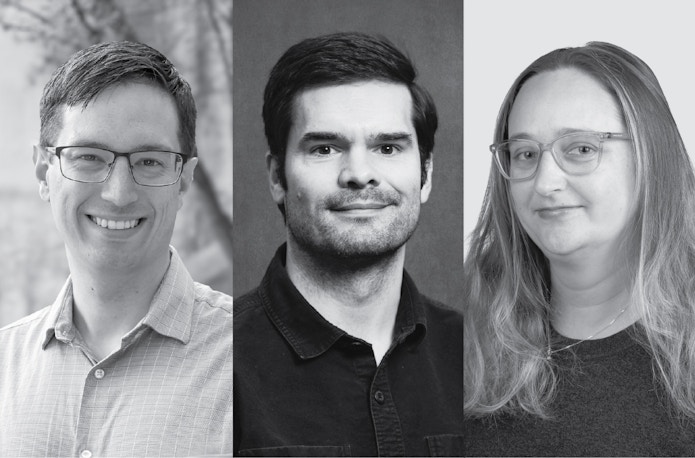
The three new fellows are:
Alex Edison is a research assistant professor at Northwestern University, specializing in perturbative field theories with a particular focus on Yang–Mills and gravity. As a fellow, he will develop a robust, open-source framework for generalized unitarity methods and double-copy constructions in quantum field theory that will bring together various QFT concepts with specialized graph-theoretic manipulations and polynomial and rational algebra.
Christopher Karwin is an assistant professor of physics and astronomy at Clemson University specializing in observational gamma-ray astronomy. As a fellow, he will help develop and maintain cutting-edge software to unlock the potential of a new generation of gamma-ray telescopes, focusing on NASA’s upcoming COSI mission, allowing scientists to probe some of the most fundamental mysteries of the Universe such as how elements are formed in stars, how cosmic rays shape galaxies, and how antimatter is produced.
Meg Millhouse is a research scientist at the Georgia Institute of Technology whose work focuses on flexible methods for modeling both astrophysical signals and noise in gravitational-wave detector data. As a fellow, she will seek to improve the scalability and long-term sustainability of BayesWave, a Bayesian inference tool that jointly models gravitational-wave signals and instrumental glitches using a transdimensional Markov chain Monte Carlo sampler.