A Liver Enzyme Produced During Exercise Might Reverse Memory Loss

Six years ago, scientists discovered that an enzyme produced during exercise could rejuvenate the brain, but how it worked was unclear. Now, new research shows that the enzyme helps maintain the brain’s blood vessels by trimming excess proteins — a process that may underlie its memory-boosting effects.
Working with mice, scientists from the Simons Collaboration on Plasticity and the Aging Brain (SCPAB) found that the enzyme, known as GPLD1, produced in the liver during exercise, helped repair the blood-brain barrier, the membrane separating the brain from its surrounding blood vessels. This repair resulted in improved memory recall and cognition in a mouse model of Alzheimer’s disease, the researchers report in a paper published March 5 in Cell.
The results could help scientists develop treatments to reduce symptoms of Alzheimer’s disease in those unable to regularly exercise on their own and could ultimately reduce some of the side effects associated with current Alzheimer’s therapies, says the study’s senior author, SCPAB Investigator Saul Villeda.
“One of the few interventions that is just tried and true, in that you know that it has an impact, especially on the brain, is exercise,” says Villeda, a neuroscientist and associate director of the Bakar Aging Research Institute at the University of California, San Francisco. But for elderly people with Alzheimer’s, exercise isn’t always an option. “If you can find factors, especially in your blood, that can mimic some of these benefits,” he says, patients could receive the cognitive benefits from the exercise they can’t perform on their own.
The Exercise Factor
Exercise can help the brain age differently, says Gregor Bieri, a postdoc in Villeda’s lab and lead author on the study. “We always think of brain aging as this decline that is almost permanent,” he says. But exercise “actually shows that the brain is still plastic. It can still improve even in late life.”
To better understand how exercise might counteract the effects of aging, Bieri, Villeda and their colleagues had previously transferred plasma from exercised mice into sedentary old mice, showing that the plasma from the exercised animals improved the cognitive abilities of the older ones. They could better remember an object or area they had seen before.
From the plasma, the scientists extracted an exerkine — a molecule produced as a by-product of exercise — called GPLD1.
Enter the Exerkine
This molecule is like a pair of scissors, Villeda says. GPLD1 travels through the blood, finding proteins that are dangling out into the bloodstream from the cells lining the vessels. The enzyme recognizes proteins by the tiny fat tags hanging off them. “It recognizes the fat tag, it’s almost like a barcode, and it’s going to cleave it.”
GPLD1 is quite selective in what it cuts. But even so, it has the potential to trim more than 100 proteins on the bloodstream walls, “mostly [ones] that are expressed on the blood-brain vasculature,” Bieri says.
In the brain, there is a special layer of cells between the bloodstream and the brain tissue. This blood-brain barrier controls what gets in and out of the delicate central nervous system.
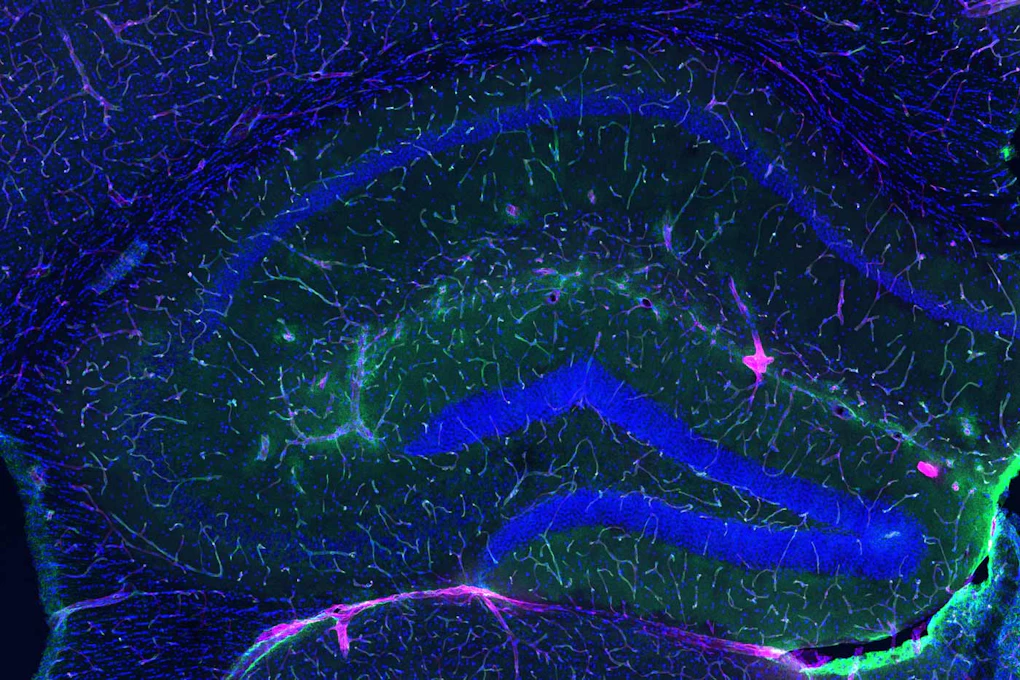
The blood-brain barrier gets degraded with age, and especially with Alzheimer’s disease. But the researchers showed that GPLD1 helped the blood-brain barrier regain some of its former strength. Inserting a gene into aged mice to give them more GPLD1 made the hippocampus — an area of the brain especially crucial for memory — perk up, with cells creating proteins in a manner more like that of a young brain.
The enzyme must trim something that impairs the blood-brain barrier, so the scientists set out to find a candidate. “We were really interested in the ones that go up, that are higher with age,” Bieri says. They hit upon tissue-nonspecific alkaline phosphatase, or TNAP.
TNAP was already known to affect how well the blood-brain barrier functions. “I like to think of it like it’s a bouncer at a club,” Bieri says — one that lets in growth factors and nutrients and keeps out inflammatory signals. But as people age, TNAP behaves differently. Bad things, like inflammatory molecules, get in instead.

The Brain Bounces Back
When the scientists inserted genes to produce more TNAP into young mice, their blood-brain barriers grew leaky, and the young animals’ memories suffered. Reducing TNAP in the blood vessels of old mice, by contrast, restored memory function and hippocampal cell health, producing effects like those of GPLD1.
Next, Villeda, Bieri and their colleagues moved to a mouse model of Alzheimer’s. Exercising the Alzheimer’s model mice caused them to produce GPLD1 and improved their memory function in behavioral tests. The scientists then inserted genes in the Alzheimer’s model mice to make them produce more GPLD1.
With extra GPLD1, the gene expression in hippocampal cells of the Alzheimer’s model mice was altered, with 30 percent of the changes making the cells more like those of healthy mice.
With healthier hippocampi, mouse memories improved, though they didn’t have the same level of cognition as young mice. “I would say probably in the best cases, it’s probably about 80 percent of the way there,” Villeda says. Finally, both increasing GPLD1 and shutting down TNAP in the mice reduced their expression of amyloid beta — a brain plaque that can accumulate in Alzheimer’s disease.
Prescription-Strength Exercise
The enzyme and its target are both in the blood vessels, not in the brain, a boon for drug development. One of the major challenges in treating conditions such as dementia and cognitive aging has been designing therapies that can cross the blood-brain barrier. GPLD1 allows researchers to sidestep this obstacle since they can target it directly within the brain’s vasculature, avoiding the need to penetrate brain tissue itself.
The findings are another win for exercise, which allows the body to produce its own GPLD1 and trim its own TNAP. But not everyone can exercise, and with GPLD1 in hand, Villeda has co-founded a company to make the enzyme into a treatment that can be given to patients, perhaps in combination with other, already approved therapies like the anti-amyloid therapies currently available.
One of the side effects of the current therapies is that they produce something called ARIA — amyloid-related imaging abnormalities. These are “sort of lesions, or micro-lesions, that lead to the leakiness of the blood-brain barrier,” Villeda says. If GPLD1 can benefit blood-brain barrier health in these patients, it could potentially help reduce some of these side effects.
Clinical treatment is probably years away, but the findings show the deep well of possibilities for treatments that researchers can identify just by studying the basic science of aging. “We just asked, in an unbiased approach, ‘What’s happening?’” Villeda says. “It worked because we followed the biology.”


