Axel Saenz Rodriguez on How Mathematics Can Create More Sustainable Energy

Axel Saenz Rodriguez, an assistant professor of mathematics at Oregon State University (OSU), has always been enticed by solving difficult problems. Like many mathematicians, he sought to prove himself by tackling the field’s biggest unknowns. However, as his career progressed, he realized he wanted to use his skills to make an impact beyond the often abstract world of pure mathematics — he’d just need the space and the resources to do it.
In 2025, Saenz Rodriguez became a Simons Foundation Pivot Fellow. These one-year fellowships enable established professionals to pivot into new fields by pursuing critical research projects at the intersection of scientific disciplines. This fellowship enabled Saenz Rodriguez to transition from pure mathematics to applied quantum physics, with the goal of developing more sustainable energy sources.
We recently discussed Saenz Rodriguez’s fellowship year, the benefits of mentorship and interdisciplinary collaboration and the saving grace of having young children amidst a demanding career.
How did you approach mathematics early on in your career?
At one point, I believed that good math was hard math. It was really about bragging rights: Here’s this sophisticated equation, this difficult problem, and I was one of the few people who could solve it.
After a while, this began to feel empty, and my definition of good math began to change. I moved away from difficulty for difficulty’s sake. During my postdoc and as I began my position at OSU, I was reckoning with what my life’s work should be and how I can positively contribute to society. That’s how I want to develop the focus of my math skills today.
Were there specific incidents that helped shift your thinking toward societal usefulness?
It was a combination of things. Becoming a parent was a big factor. I wanted to have a positive impact in society for my daughters to live in a better world. Besides that, there are two specific events that shaped my direction towards societal usefulness.
At the time I was starting my position at OSU, I visited one of my graduate school mentors, Craig Tracy from the University of California, Davis. Ironically, he pivoted in his career in the reverse direction — he was trained as a physicist and then worked as a mathematician. At one point in graduate school, when I asked him about math versus physics, he told me that it is easy for a mathematician to find issues and gaps in physics work, but the more meaningful and harder task is to find what is correct in the output of physicists.
Then, as part of a daylong discussion when I visited Craig before joining OSU, we discussed the possible connections between experiments and our theoretical work on the Heisenberg-Ising spin-½ quantum spin chain. Craig really inspired me to set out my own path and go beyond what was expected of me, to find my own passions rather than follow the norm.
Later on, everything clicked for me when I attended a talk by applied mathematician Michael Waterman, an OSU alumnus who came back to speak on campus. Waterman used math to improve our understanding of how DNA works — in essence, he bridges math and biology. This gave me the motivation to go beyond connections with physics and to seek an impact on society.
What societal problem are you focused on?
I am exploring sustainable ways to produce energy using concepts from quantum mechanics. In addition to the clear environmental impact, I believe that whoever controls energy controls the political agenda, and that this will be a pressing problem in the 21st century as energy needs become more intensive.
The current dominant model for producing energy is via electricity in semiconductors, which involves moving electron particles through a conductor. This process inevitably involves particles bumping into each other, which is energy-inefficient and leads to heat loss.
This is why data centers require large air conditioners or water sources for cooling; otherwise they will become too hot and break down. The problem is only getting worse as everything we use — phones, computers, and so forth — becomes smaller and smaller. This just ratchets up energy demands, leading to ever more inefficiency and heat loss.
I am working on a better, energy-efficient and computationally powerful way to store and process information for next-generation technology.
What approach are you taking to produce sustainable energy?
We hope to use quantum spin, a fundamental property of particles, to transmit information rather than the current mode of coursing electricity through semiconductors. Quantum spin is an intrinsic property of particles that supports magnetism in structures like crystal lattices and is already used in technologies like MRI scanners or audio compression tools.
Every particle has some degree of spin and points in some direction. If you perturb one particle in some way, that particle will affect the particle next to it, creating a wave. You can think of it like plucking a guitar string: That process creates a wave and vibration.
Whenever we perturb a particle’s spin the particle itself does not move; rather, the direction of the spin changes as the particle stays in place. This is inherently more energy-efficient than bouncing electrons against each other and causing heat loss. So, if we could harness quantum spin to store and transmit information, we would have more sustainable energy infrastructure.
During the Pivot Fellowship, I co-authored multiple papers that described how quantum spin could be harnessed in this way.
What was being a Pivot Fellow like?
When I started the fellowship, I underestimated the challenge of interdisciplinary work. I thought it would be easy to use my math training to solve big problems and make a breakthrough right away. It’s a lot more challenging than that — there are many brilliant people already working on these problems.
So, the challenge became how to make connections between my math experience and this new field. Overcoming that challenge was why I pursued the Pivot Fellowship.
A lot of times we can make superficial connections and sell it as interdisciplinary work, but I wanted real connections. And I am continuing that work although my fellowship has ended.
What were your fellowship mentors like?
To my knowledge, I am the only Pivot Fellow who had two mentors — usually there is only one. But I think my two mentors have very complementary skills.
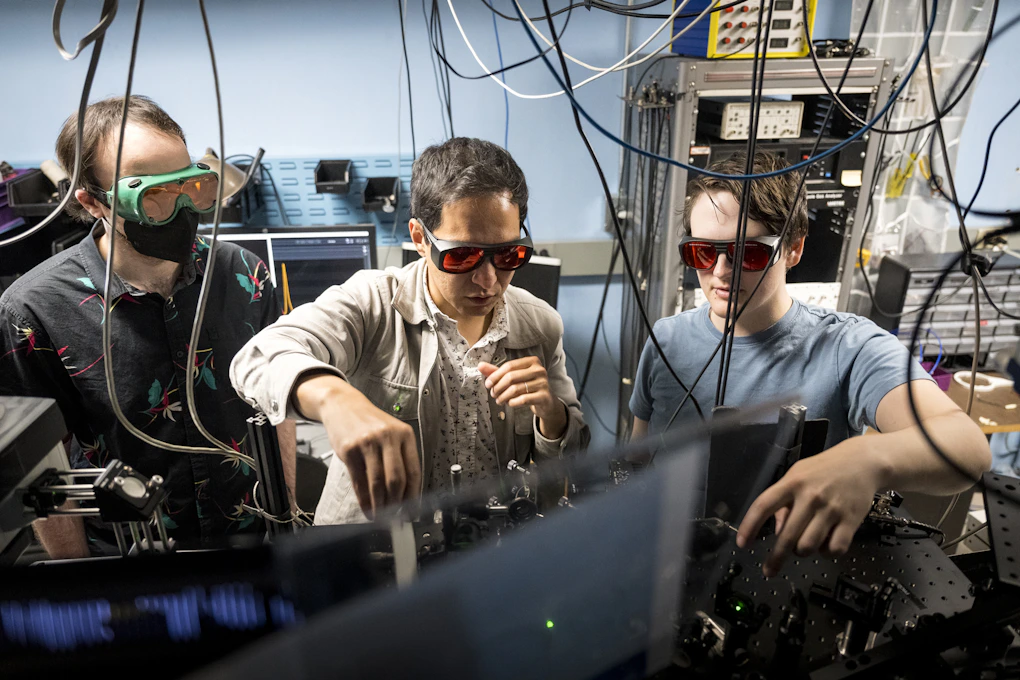
One of my mentors is Okansa Ostroverkhova, a physics professor at OSU. I started building a relationship with her before the Pivot Fellowship. She was starting a new research program on spintronics (technology based on quantum spin waves), and I was starting to think about quantum problems. She approached me to say she would like predictions of how two-dimensional quantum materials would behave under different external forces and controls. She oversees a leading group working on layered 2D van der Waals quantum magnets to develop experiments along these lines.
I said yes, no problem. But at the time, I was working only with one-dimensional quantum systems. So it became clear that there was a big gap between what I could do and what Oksana wanted. She wanted very practical predictions about how these materials would behave under different types of perturbations, but this was out of the depth of my tools at that point. Oksana was a natural mentor, and with her guidance, I could hone insights about using quantum spin to store and transmit information.
My other mentor, Eric Corwin, is a physics professor at the University of Oregon. He works in high performance computing and does large scale simulations related to statistical physics models. He does not work with the quantum materials directly — that’s Oksana’s area. He bridges the gap between Oksana and me. Through high performance, we may realize precise predictions from theoretical work that can be verified experimentally. That is exactly what we have done in one of our recent projects, which is a big achievement for all of us.
Oksana and Eric are both great mentors, and they’ve been very generous with their time. They both have graduate students in their labs who have also been very generous with their time. It’s been great to have access to these communities. In a way, the Pivot Fellowship is like going back to grad school.
What are you working on now?
Oksana and I are both part of a quantum spin research group at OSU that has internal funding. We meet twice a month. It includes electrical engineers, physicists, mathematicians and chemists. There’s a nice mix of faculty and graduate students too.
My long-term goal is to develop a nationwide network and community to address emerging needs on quantum information and technology — to develop the next generation of technology that is computationally powerful and energy-efficient. It would be a comprehensive, three-pronged approach based on theory, experiment and large-scale computation with a variety of researchers and stakeholders representing a wide spectrum of expertise and perspectives.
You are a parent as well. How does this play into your work?
Yes, I have two young daughters, and I always leave work in time for day-care pickup. It’s refreshing for me to go home to my kids and slow down — that’s been my saving grace. I get to not think about work and hang out with them. The next day, I am recharged and ready to go.