AGN & Energy Flows is a workshop aimed at connecting theorists and observers to develop collaborations that can tackle some key questions in galaxy-black hole co-evolution. We are gathering a focused group of astronomers with key expertise in selected areas and hope to use this as a launching pad for more in-depth collaborations and projects.
This workshop (and future projects) will focus on tracing the flow (and observational impact) of energy released by AGN from sub-kpc scales to the intragroup medium. We are bringing together observers across the electromagnetic spectrum with theorists from the CCA and beyond to tackle a set of key questions:
- How does energy from AGN couple to, or escape from, the ISM, CGM and IGrM?
- What is the observational impact of these energy flows on sub-kpc to Mpc scales?
- No current model can replicate all key thermodynamic observables of the IGrM at the same time – how can we make progress to solve this?
We believe these questions will help to unlock a better understanding of how galaxies and black holes co-regulate from the perspective of energy (rather than mass). Theoretically, energy is more fundamental in this regulation process, but harder to quantify observationally.
The motivating goal of this workshop is to spark new collaborations between theorists and observers working across wavelengths and spatial scales. For this reason, we will encourage participants to focus their contributions on open problems and ideas for future directions in their subfields related to tracing AGN energy flows, rather than solely on recent results. The program will include ample time for both structured and informal breakout discussions, with the aim of seeding collaborative efforts that extend beyond the workshop itself.
-
Scientific Organizing Committee:
Samuel Ward (Flatiron Institute)
Greg Bryan (Columbia University)
Rachel Somerville (Flatiron Institute)
Osase Omoruyi (Flatiron Institute)
Doug Rennehan (Flatiron Institute)Administrative support:
Abigail Creem (CCA) -
Wednesday (February 18)
9:00am Breakfast 9:30am Introductions 9:50am Sylvain Veilleux: Fast Energetic Cool Outflows: Observations versus Simulations 10:10am Joseph Choi: Tracing AGN Energy Flow Across Scales with BAL Quasars 10:30am Tim Heckman: Mergers, Jets, and Quenching Massive Galaxies 10:50am AM Break 11:20am Victoria Fawcett: Connecting the dust, radio, and outflow properties in quasars 11:40am Namrata Roy: Turning a page in the AGN feedback chapter: Mapping Multiphase AGN Feedback from powerful jets to weak winds 12:00pm FLASH TALKS Saavik Ford: AGN Disk Lifetimes: Understanding Observational Constraints Emily McPike: Electromagnetic Counterparts to Binary Black Hole Mergers Embedded in AGN Disks Olga Borodina: The role of turbulence in AGN activity Barry McKernan Mysterious Outflows & Where to Find Them? 12:30pm Lunch 1:30pm Yuan Li: Simulating Jet Mode AGN Feeding and Feedback 1:50pm Ena Choi: Compaction, Super-Eddington Black Hole Growth, and the Quenching of Massive Galaxies 2:10pm Jenny Greene: AGN Demographics at High Redshift 2:30pm FLASH TALKS Daniel Piacitelli: Black Hole Feedback Enhancing Dwarf Galaxy Growth Sarah Wellons: Exploring AGN quenching behaviors in different mass and redshift regimes Hyerin Cho: Bridging Scales in Black Hole Accretion and Feedback via the Multizone method Stephanie Tonnesen: SANGRIA in a FLASH: Mocking HI absorption towards AGN jets 3:00pm PM Break 3:30pm Breakouts 4:10pm Discussion 5:00-6:30pm Reception (at Flatiron Institute) Thursday (February 19)
9:00am Breakfast 9:30am Nick Battaglia: Are we observing the impact of AGN feedback on the CGM in the millimeter? 9:50am Colin Hill: Imprints of AGN Feedback in SZ Observables 10:10am Yossi Oren: Using tSZ to probe AGN feedback in CAMELS 10:30am Chad Popik: Constraining CGM/ICM Gas Profiles using SZ Cross-Correlation Measurements 10:50am AM Break 11:30am Breakouts 12:00pm Discussion 12:15pm Group Photo 12:30pm Lunch 1:30pm Mark Voit: Baryon Lifting in Galaxy Groups 1:50pm Megan Donahue: Multiscale Observations of Feedback in Massive Elliptical Galaxies 2:10pm Giulia Tozzi: AGN-driven winds across scales: from the nucleus to the CGM 2:30pm FLASH TALKS Megan Tillman: Constraining AGN Feedback with Large-Scale Statistics Arjun Suresh: AGN Feedback Models and AGN Demographics: Radio-Mode AGN in EAGLE, SIMBA and TNG100 are Inconsistent with Observations Jared Siegel: A multi-wavelength view of feedback: X-ray, Sunyaev-Zeldovich, and weak lensing measurements Shy Genel: On subtle coupling effects between hydro implementations and subgrid models for AGN feedback 3:00pm PM Break 3:30pm Ewan O'Sullivan: Probing Extremes of AGN Feedback at the Group Scale 3:50pn Ben Oppenheimer: Galaxy Groups at the Cross-Section of Astrophysics and Cosmology 4:10pm FLASH TALKS Kung-Yi Su: Bridging Scales: Coupling the galactic nucleus to the larger cosmic environment Chris Carr: Regulating Galaxy Growth through CGM Energetics Sam McCarty: A new view of AGN feedback with FRBs Friday (February 20)
9:00am Breakfast 9:30am Julie Hlavacek-Larrondo: Multiphase Radio-Mode AGN Feedback as Seen by JWST 9:50am Valeria Olivares: The Many Phases of Filaments in Cooling-Flow Clusters 10:10am Mike McDonald: The Long-Term Effects of AGN Feedback on Galaxy Clusters 10:30am Liam Connor: Early results in FRB cosmology 10:50am AM Break 11:20am Breakout 12:00pm Discussion 12:30pm Lunch 1:30pm Free collaboration time / End of programming 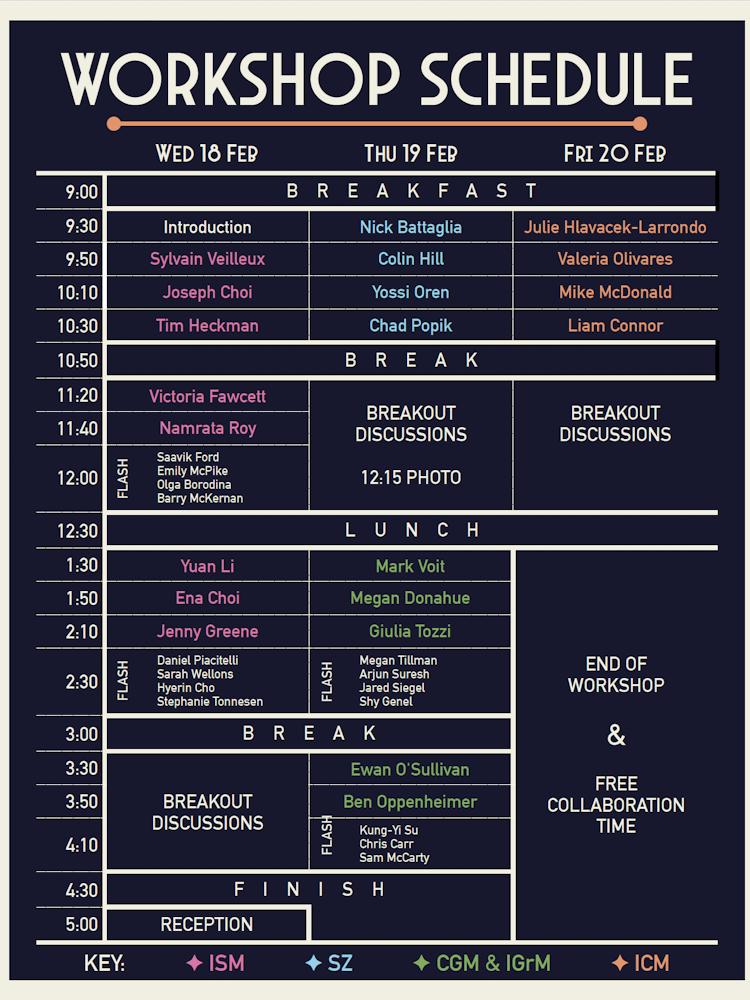
-
Ben Oppenheimer (University of Colorado, Boulder): Galaxy Groups at the Cross-Section of Astrophysics and Cosmology
Galaxy groups 1) contain observationally unconstrained astrophysics that impacts cosmological parameter estimation, and 2) are now being observed in large-scale surveys across different wavelengths and components. CAMELS volumes and zooms are a massive resource that require the latest in Machine Learning methods. Here, I highlight a new project to bring together the galactic component observed in optical/IR surveys with the gaseous component observed in the X-ray. I wish to emphasize the need the the path forward to bring together diverse observational methods spanning these and other wavelengths that use heterogeneous methods, including stacking X-ray and the SZ maps, UV absorption lines probing random skewers through groups, and Fast Radio Bursts. Innovative Machine Learning methods leveraging the power of forward modeling of large simulation suites are essential.
*
Chad Popik (Cornell University): Constraining CGM/ICM Gas Profiles using SZ Cross-Correlation Measurements
Feedback from AGN impacts the distribution and properties of the gas reservoirs surrounding galaxies, adding an extra level of complexity to modeling cosmological observations. SZ observations are used to infer pressure and density profiles of galaxy groups and clusters, therefore probing the effects of AGN. These results can assess the accuracy of simulations and constrain their models of AGN feedback, provided a robust forward model. I will detail the methodology and implementation of the analysis pipeline used to connect measurements made with recent ACT and DESI data with cosmological hydrodynamic simulations.
*
Colin Hill (Columbia University): Imprints of AGN Feedback in SZ Observables
The cosmic microwave background (CMB) provides a “backlight” with which to illuminate structures in the low-redshift universe, particularly via the thermal and kinematic Sunyaev-Zel’dovich (tSZ/kSZ) effects, which probe the line-of-sight-integrated electron pressure and density, respectively. AGN feedback can substantially alter tSZ and kSZ observables through its effects on the distribution and thermodynamic properties of ionized gas in the intracluster and intragroup media. I will discuss our recent measurements of tSZ and kSZ statistics with data from the Atacama Cosmology Telescope (ACT) and Planck, including cross-correlations with weak lensing maps and galaxy catalogs from the Dark Energy Survey. Taken together, these measurements point toward scenarios featuring relatively strong AGN feedback, with significant amounts of ionized gas ejected from group-scale halos. I will conclude with a brief look ahead to data from the now-operational Simons Observatory.
*
Ena Choi (University of Seoul): Compaction, Super-Eddington Black Hole Growth, and the Quenching of Massive Galaxies
Recent JWST observations have revealed massive, quenched galaxies already in place at redshifts z~3-4, posing a major challenge to conventional models of galaxy evolution. Using cosmological zoom-in hydrodynamic simulations, we demonstrate that such systems can form naturally when super-Eddington black hole accretion and momentum-driven AGN feedback are properly captured at high resolution. In our simulations, galaxies first undergo a compaction phase driven by gas inflows or wet mergers, triggering intense star formation and rapid, frequently super-Eddington black hole growth. As the black hole mass increases, strong AGN-driven outflows expel and heat the surrounding gas, leading to efficient and sustained quenching of star formation. These results highlight the critical role of super-Eddington accretion in enabling early black hole growth and provide a physically motivated explanation for the emergence of massive “red and dead” galaxies in the early Universe.
*
Ewan O’Sullivan (CfA): Probing Extremes of AGN Feedback at the Group Scale
Galaxy groups appear to be the critical mass scale for AGN feedback models. Radiative cooling of the hot intra-group medium (IGrM) is efficient and rapid compared to galaxy clusters thanks to X-ray line cooling. Meanwhile the energy available from the central AGN is comparable to the binding energy of the IGrM, meaning that feedback has the potential to unbind gas from the group potential. This means that groups in which feedback is not fine tuned can move out of equilibrium, with the reduced gas fractions of groups suggesting over-heating is common. I will discuss results from the CLoGS and X-GAP samples, showing examples of groups that have suffered past over-heating, or may be in the process of over-heating owing to powerful AGN outbursts. Time permitting, I will also discuss results from a study of AGN jet/cavity offsets, suggesting that a significant fraction of radio AGN reorient their jet axis on relatively short timescales.
*
Mark Voit (Michigan State University): Baryon Lifting in Galaxy Groups
Central black hole masses in halos up to 10^14 MSun are linearly proportional to the halo’s gravitational binding energy, indicating that growth of the universe’s most massive black holes is linked to the original binding energy of the halo’s baryons. And indeed, observations of the baryon distributions around groupscale halos show that the energy required to displace the baryons is approximately 1% of the black hole’s mass-energy. Apparently, fueling of black-hole feedback on sub-kpc scales is connected to baryon displacement on Mpc scales. I will discuss how those features of galaxy groups become connected.
*
Giulia Tozzi (MPE): AGN-driven winds across scales: from the nucleus to the CGM
AGN-driven outflows are widely accepted as a crucial ingredient of galaxy evolution. Yet, many questions remain open, from how AGN energy couples to the ISM and drives winds, to how these outflows affect the host galaxy and the surrounding CGM. To address these questions and test model predictions, it is essential to conduct multi-wavelength observations to trace distinct gas phases of outflows, from the local Universe to high redshift, especially at cosmic noon (z~2), where AGN feedback is expected to be more effective. In this talk, I will present results on multi-phase outflows inferred from observations obtained with groundbased facilities (MUSE, SINFONI, ERIS, ALMA) and JWST, which support the close connection between nuclear and large-scale winds, and the key role of dust in driving outflows, particularly at high redshift. These outflows are powerful enough to affect the galactic ISM up to tens of kpc from the galaxy centre, and also favour the escape of Lyα photons from the galaxy to the CGM, thus leading to the formation of extended nebulae. Future observations with ELT/MICADO and HARMONI will allow us to take the next step to reach a definitive assessment of the actual role of AGN-driven outflows in galaxy evolution.
*
Joseph Choi (University of Michigan): Tracing AGN Energy Flow Across Scales with BAL Quasars
Broad absorption line (BAL) quasars provide some of the clearest observational evidence of energy flow and injection from luminous active galactic nuclei across cosmic time. The characteristic broad, blueshifted absorption features reveal the presence of fast, massive outflows that often carry a substantial fraction of the quasar’s radiative energy, making BAL quasars powerful laboratories for studying the launch and propagation of AGN-driven winds.
Recent advances in observational analyses have revealed that BAL winds are not confined to a single physical scale. Instead, their observationally constrained sizes range across several orders of magnitude, from parsec-scale regions near the dusty torus to kiloparsec-scale and circumgalactic distances. This increasing body of evidence suggests an intrinsically multiscale nature of quasar winds, while multiwavelength studies increasingly reveal that BAL outflows are also multiphase. Together, these findings challenge simple models of wind origin and acceleration and highlight the complexity of how AGN-driven energy flows through the interstellar and circumgalactic media (ICM, CGM).
BAL quasars offer a direct observational link between small-scale SMBH accretion and the launch of powerful winds, providing insights into how kinetic energy generated near the central engine is transported outward. Ongoing progress will be driven by spectroscopic surveys such as DESI and 4MOST, along with targeted multi-wavelength follow-up using facilities such as JWST. In parallel, subgrid models and cosmological simulations that successfully replicate BAL-like winds are becoming increasingly important, as they can produce testable observables and serve as a critical bridge between observations and theory for understanding how BAL outflows influence energy flow and couple to the ISM and CGM.
*
Jenny Greene (Princeton University): AGN Demographics at High Redshift
I will review the shifting landscape in high-redshift active galactic nuclei depending on selection, luminosity, (perhaps) black hole mass. I will also discuss our evolving view of the presence of outflows/winds in these populations.
*
Julie Hlavacek-Larrondo (Université de Montréal): Multiphase Radio-Mode AGN Feedback as Seen by JWST
The best place to study radio-mode AGN feedback is in the hot atmospheres of galaxy clusters, which host the most massive black holes and where we can directly image their impact on the surrounding medium. At cluster centers, supermassive black holes launch powerful relativistic jets that inject vast amounts of energy through shock fronts, sound waves, turbulence, and molecular outflows. In this talk, I will present novel multi-wavelength observations that, for the first time, allow us to trace the entire radio-mode feedback cycle—from heating, to cooling, to feeding, and across scales from kiloparsecs down to parsecs. First, I will present new JWST observations of the archetypal Centaurus cluster, where NIRSpec/IFU data reveal a rotating circumnuclear disk directly connected to the surrounding filament network. This structure provides the long-sought missing link that channels gas from kiloparsec to 100-pc scales and ultimately into the central black hole, effectively closing the feedback loop. I will then place these results in a broader context using the Perseus cluster, where the combination of JWST with state-of-the-art XRISM and SITELLE/IFU observations allows us to map the full multiphase feedback cycle. In this system, I will show that the hot X-ray–emitting gas is deeply intertwined with the cold and warm nebular components, demonstrating that AGN feedback is inherently multiphase and dynamically complex. Together, these findings shed new light on the fundamental mechanisms that drive galaxy evolution, particularly supermassive black hole fueling/feedback and its intricate interplay with the host galaxy.
*
Liam Connor (CfA): Early results in FRB cosmology
FRBs have held promise as a probe of extragalactic astrophysics and cosmology ever since their discovery in 2007. In recent years, increased sample sizes and new techniques have enabled the first observational results in FRB cosmology. I will discuss empirical constraints on the cosmic baryons using FRBs, as well us upcoming instruments that will deliver many tens of thousands of new sources.
*
Megan Donahue (Michigan State University): Multiscale Observations of Feedback in Massive Elliptical Galaxies
One challenge to our understanding of galaxy black-hole feedback is the vast range of scales: energy input at tens of kpc may affect the accretion rate on parsec scales. Two examples are the massive elliptical galaxies NGC4261 and IC4296. In both cases, ~200 pc disks of cold, dusty gas fuel powerful radio jets that deposit feedback energy on scales of tens to hundreds of kpc, while leaving the central, inner ~10 kpc vicinity undisturbed. I will present multi-scale, multi-wavelength observations of these phenomena, including recent data from Chandra’s High Resolution Camera probing the cooling time and entropy profiles of their hot atmospheres in the vicinity of their cold disks resolved by ALMA observations.
*
Mike McDonald (MIT): The Long-Term Effects of AGN Feedback on Galaxy Clusters
I will discuss recent results studying the evolution of galaxy clusters with Chandra and the South Pole Telescope. In particular, the talk will focus on the long-lived balance between heating and cooling, the longlived suppression in star formation in massive galaxies, and the apparent non-evolution of cool cores. Taken together, these results seem to imply that radio-mode feedback is extremely gentle and well-calibrated in the most massive halos.
*
Namrata Roy (Arizona State University): Turning a page in the AGN feedback chapter: Mapping Multiphase AGN Feedback from powerful jets to weak winds
Active Galactic Nuclei (AGNs) are the most energetic phenomena in the universe, unleashing feedback through jets, multiphase outflows, and intense radiation. I will present a new chapter in our understanding of AGN feedback, showcasing recent breakthroughs from JWST’s spatially resolved spectroscopy. I will first show that High-redshift radio galaxies (HzRGs) within the first billion years of the universe are uniquely powerful laboratories, and host violent outflows and radio jets in a younger gas-rich Universe. Using JWST IFU data, I will highlight that these jets pierce through the surrounding gas, inflate enormous cocoons of shocked gas, and launch fast outflows in the ionized phase. I will present spatially resolved empirical constraints on mass, momentum, and energy flow rates across the jet-impacted regions for direct comparisons to clumpy-ISM/wind simulations. I will show that the inferred kinetic coupling of the outflow is tightly linked to the AGN bolometric output, and will provide specific, testable observational signatures to be directly compared to simulation predictions. Towards the end of the talk, I will connect these extreme systems to low-level feedback captured by our MSA-3D program, which effectively turns JWST into a highly multiplexed, IFU machine. I will reveal a population of weak AGN embedded in otherwise normal starforming disks, where modest outflows and disturbed gas can be hidden in plain sight. These systems populate the intermediate regime between violent jet–ISM coupling and gentle maintenance and exhibit different outflow geometry and energetics. I will use this emerging diversity of outflow morphologies across AGN states to pose a model-discriminating question: do compact vs extended jets, and high-power vs low-power AGN episodes, produce systematically different morphology–efficiency tracks in mass, momentum, and energy flow rates (M_dot, p_dot and E_dot)? By combining observational constraints on geometry, duty cycle, and feedback energy budgets with the controllable levers in modern simulations, I will outline how the community can give us valuable information to characterize feedback across phases and scales.
*
Nick Battaglia (Cornell University): Are we observing the impact of AGN feedback on the CGM in the millimeter?
I will present new cross-correlation measurements of the thermal Sunyaev-Zeldovich (tSZ) effect for a sample of local bright galaxies. Within this sample we see statistically significant differences in the tSZ signals between galaxies with AGN and without AGN. These measurement could open a new avenue to understanding the physical processes of energy injection by AGN into the CGM, and the cooling processes and timescales of the CGM. Furthermore, these measurements illustrate that previous tSZ cross-correlation measurements may contain residual radio emission.
*
Sylvain Veilleux (University of Maryland): Fast Energetic Cool Outflows: Observations versus Simulations
A brief review of the observations on fast and energetic cool outflows in starburst and active galaxies will first be presented. These results will next be critically compared with recent numerical simulations of dusty multi-phase winds and outflows. Future avenues of research will be discussed.
*
Tim Heckman (Johns Hopkins): Mergers, Jets, and Quenching Massive Galaxies
The existence of a population of massive quiescent galaxies with little to no star-formation poses a challenge to our understanding of galaxy evolution. In this talk, I will evaluate the idea that quenching of massive galaxies is the result of feedback from radio jets. I will show that the cosmic evolution in the mass in quenched galaxies is tightly synchronized with both the rate of major mergers of massive galaxies and the rate at which jets have transported energy. The key epoch during which this occurs is from z ~ 1 to 2. I will show that the causal connection between these processes is that major mergers trigger the radio jets and also transform the galaxies from disks to spheroids. The radio jets then quench the star-formation. I will show that the jet kinetic energy is more than sufficient to quench star-formation in massive galaxies
*
Valeria Olivares (Universidad de Santiago de Chile): The Many Phases of Filaments in Cooling-Flow Clusters
Galaxy cluster centers are superb laboratories for studying the baryon cycle that governs galaxy evolution and AGN feedback. They allow us to investigate how the intracluster medium (ICM) cools, fuels galaxies, drives star formation, and ultimately triggers feedback from the Universe’s most massive black holes. In this talk, I will present a correlation between the surface brightness of hot and warm gas phases in filamentary structures at galaxy cluster centers, based on MUSE, SITELLE, and Chandra observations. This newly discovered correlation in filaments shows a remarkable similarity to correlations observed in jellyfish galaxy tails, revealing an unexpected cosmic connection. I will further show that AGN feedback plays a pivotal role in shaping the morphology, pressure balance, and metallicity of the filaments, highlighting their dynamic evolution and the impact of feedback on multiphase gas. Finally, I will present new high-resolution ALMA observations of a Perseus filament to assess the impact of the surrounding medium and AGN feedback on its stability and ability to form stars.
*
Vicky Fawcett (ESO): Connecting the dust, radio, and outflow properties in quasars
The most rapid SMBH growth in the Universe has occurred in luminous quasi-stellar objects (QSOs), making them the perfect laboratories for observing galaxy–SMBH evolution. When we have an unobscured view of the accretion disc, which peaks in the UV, QSOs display very blue UV–optical colours. However, there exists an important population of QSOs, obscured by dust, which are typically uncharacterised by optical spectroscopic surveys. These dusty QSOs could represent an important short-lived transitional phase in the evolution of galaxies (a “blow-out” phase). Utilising data from DESI we can now, for the first time, explore a statistically significant sample of these reddened QSOs. Combining DESI spectra with radio data from the LoTSS DR2, we find a striking positive relationship between the amount of dust extinction and the radio detection fraction in DESI QSOs. This demonstrates an intrinsic connection between opacity and the production of radio emission in QSOs which may be due to outflow-driven shocks. In our latest work, we test this scenario by exploring the radio spectral slopes and ionised outflow properties of dusty QSOs, finding evidence that dusty QSOs might reside in a short-lived blow-out phase.
*
Yossi Oren (Tel Aviv University): Using tSZ to probe AGN feedback in CAMELS
The tSZ signal is mostly influenced by the baryon contents of the CGM, which in cosmological simulations are very sensitive to the way AGN feedback is implemented. As AGN driven jets kick in they drive significant fractions of the CGM out of the halo, and the integrated tSZ signal drops accordingly. In this work we use the CAMELS-IllustrisTNG suite of cosmological simulations to find how variations to the subgrid recipes implemented within affect the integrated tSZ signal compared to recent observations. We explore variations to the full set of subgrid parameters — both those directly related to AGN feedback and those that are not — and the impact they have on existing observational constraints for the simulation alongside new constraints set up by tSZ observations.
*
Yuan Li (UMass Amherst): Simulating Jet Mode AGN Feeding and Feedback
Supermassive black holes’ feeding and feedback cycles play a vital role in galaxy formation and evolution. It is widely accepted that today’s massive galaxies stay quiescent mainly due to jet mode (radio mode) feedback. In this talk, I will review how jet mode AGN feeding and feedback are typically modeled in state-of the- art galaxy-scale simulations. Over the past few years, several groups have also bridged the gap between galaxy scales and GRMHD scales, following the accretion flow all the way down close to the event horizon of SMBHs. I will also discuss how feedback energy is coupled to the host galaxies in successful numerical models, via shocks, turbulence, and adiabatic processes. In particular, I will discuss the apparent tension between the inferred level of turbulent heating based on X-ray observations of the intra-cluster medium and the measured level of turbulence in numerical simulations. Lastly, I want to point out the possible flaws of existing models and what may still be missing in simulations.
*
Arjun Suresh (NYU): AGN Feedback Models and AGN Demographics: Radio-Mode AGN in EAGLE, SIMBA and TNG100 are Inconsistent with Observations
Barry McKernan (CUNY / AMNH): Mysterious Outflows & Where to Find Them?</i>
Chris Carr (Princeton University): Regulating Galaxy Growth through CGM Energetics
Daniel Piacitelli (Rutgers University): Black Hole Feedback Enhancing Dwarf Galaxy Growth
Emily McPike (CUNY): Electromagnetic Counterparts to Binary Black Hole Mergers Embedded in AGN Disks
Hyerin Cho (Harvard University): Bridging Scales in Black Hole Accretion and Feedback via the Multizone method
Jared Siegel (Princeton University): A multi-wavelength view of feedback: X-ray, Sunyaev-Zeldovich, and weak lensing measurements
Kung-Yi Su (CIERA, Northwestern): Bridging Scales: Coupling the galactic nucleus to the larger cosmic environment
Megan Tillman (Rutgers University): Constraining AGN Feedback with Large-Scale Statistics
Olga Borodina (CfA): The role of turbulence in AGN activity
Saavik Ford (CUNY / AMNH): AGN Disk Lifetimes: Understanding Observational Constraints
Sam McCarty (Harvard CfA) – A new view of AGN feedback with FRBs
Sarah Wellons (Wesleyan University): Exploring AGN quenching behaviors in different mass and redshift regimes
Shy Genel (CCA): On subtle coupling effects between hydro implementations and subgrid models for AGN feedback
Stephanie Tonnesen (CCA): SANGRIA in a FLASH: Mocking HI absorption towards AGN jets -
This event does not have a room block or discounted rates at any hotel. Below are the Simons Foundation’s preferred hotels within walking distance of our office.
The Evelyn Hotel
7 E 27th St, New York, NY 10016Hotel Seville NoMad
22 East 29th Street, New York, NY 10016Freehand New York
23 Lexington Ave, New York, NY 10010Hotel AKA NoMad
131 Madison Ave, New York, NY 10016Travelers should thoroughly research the specific neighborhood under consideration regarding the safety of the surrounding area and modes of transportation. We highly discourage shared properties with the host or other travelers.
*
Nearby Airports
- Newark Liberty International Airport (EWR)
- John F. Kennedy International Airport (JFK)
- LaGuardia International Airport (LGA)
Nearby Trains
NJ Transit and Amtrak: CCA is a 10-15 minute walk from Penn Station. For those on the Northeast corridor, this is the fastest and easiest route. The NJ PATH train also has a station nearby at 23rd Street.Metro North: CCA is a short subway/cab ride away from Grand Central. For those in the Hudson Valley or Connecticut this is the recommended route.
For MTA Subway: There are multiple train lines that run near our office. Please see MTA Info for assistance.
-
Event attendees are required to observe all rules of decorum and show respect for all others present, as befits any professional setting. Conduct that is disruptive, causes discomfort or stress to others, or is highly unusual or disrespectful is grounds for removal from the premises at the Simons Foundation’s discretion.
Please see our full Code of Conduct here.