- Speaker
-
 Karin Öberg, Ph.D.Professor of Astronomy, Harvard University
Presidential Lectures are a series of free public colloquia spotlighting groundbreaking research across four themes: neuroscience and autism science, physics, biology, and mathematics and computer science. These curated, high-level scientific talks feature leading scientists and mathematicians and are designed to foster discussion and drive discovery within the New York City research community. We invite those interested in these topics to join us for this weekly lecture series.
Planets are incredibly common in the Galaxy. Many of these planets are temperate, allowing for the possibility of surface water and perhaps life. Whether such planets typically present the right chemical conditions for the origin of life depends on a chemistry that predates both the planet and its host star. In other words, the possibility of life on other planets depends on astrochemistry.
In this lecture, Karin Öberg will explain how astronomers probe the chemistry that accompanies and shapes the outcome of star and planet formation. Planets assemble in gas- and dust-rich disks around young stars. The chemical abundances and structures in the planet-forming disks constrain what kind of planets can form in different parts in the disk and whether the nascent planetary system will be hospitable to life. Öberg will present the latest astrochemical observations of planet-forming disks and discuss the constraints these observations place on the chemical habitability of temperate exoplanets, such as whether such planets typically have access to water and the building blocks of an Earth-like origin of life chemistry.
About the Speaker
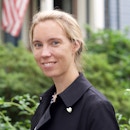
Öberg is a professor of astronomy at Harvard University, where her research group combines laboratory experiments, astronomical observations and theory to explore the chemistry of star and planet formation, and how this chemistry is connected with origins of life. She is an investigator with the Simons Collaboration on the Origins of Life, and her research has been recognized with Hubble, Sloan and Packard fellowships, and the Newton Lacy Pierce Award.