- Speaker
-
 Moon Duchin, Ph.D.Professor of Computer Science and Data Science, University of Chicago
The 2026 lecture series in mathematics and computer science is “Randomness.” Beyond being a source of uncertainty, randomness can also be a powerful tool for discovery. Topics will include random walks and surfaces, randomized algorithms, harmonic and Fourier analysis, and the geometry of complex systems. These lectures will also highlight surprising applications — from shuffling cards to fair voting — and advances in analysis and number theory, illustrating how randomness drives both fundamental insights and practical outcomes.
2026 Lecture Series Themes
Biology – Folding the Future: The Structural Biology Revolution
Mathematics and Computer Science – Randomness
Neuroscience and Autism Science – Brain and Body: Communication and Connection
Presidential Lectures are a series of free public colloquia spotlighting groundbreaking research across four themes: neuroscience and autism science, physics, biology, and mathematics and computer science. These curated, high-level scientific talks feature leading scientists and mathematicians and are designed to foster discussion and drive discovery within the New York City research community. We invite those interested in these topics to join us for this weekly lecture series.
For the last century, the U.S. Supreme Court has sought a manageable approach to ensuring that all voters are weighted equally in elections. When a redistricting plan is challenged for vote dilution, you need to know how a non-gerrymandered plan would be different.In this Presidential Lecture, Moon Duchin will describe a novel use of graph algorithms to build a non-gerrymandered baseline for redistricting. Beyond that, she will discuss new mathematical ideas for the broader problem of understanding electoral systems, including how to measure vote weight. These ideas can help build toward a “science of democracy” for policymakers and lawmakers.
About the Speaker
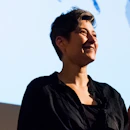
Duchin is a professor of computer science and data science at the University of Chicago. Her background in pure math centers on geometry, topology, groups and dynamics and her applied work uses these tools to build algorithms and models to study the mechanisms of democracy. She runs a multidisciplinary lab that brings math and computing into conversation with law, policy, and geography. Duchin has served as an expert in numerous voting rights court cases around the country, and her scholarly work has been recognized with an NSF CAREER award, a Guggenheim Fellowship, a Radcliffe Fellowship, a Sloan Professorship at SLMath (formerly the Mathematical Sciences Research Institute) and election as a fellow of the American Mathematical Society. She is also an external faculty member at the Santa Fe Institute, which is dedicated to the study of complex systems.