- Speaker
-
 Paul Steinhardt, Ph.D.Princeton University
Presidential Lectures are a series of free public colloquia spotlighting groundbreaking research across four themes: neuroscience and autism science, physics, biology, and mathematics and computer science. These curated, high-level scientific talks feature leading scientists and mathematicians and are designed to foster discussion and drive discovery within the New York City research community. We invite those interested in these topics to join us for this weekly lecture series.
A wide range of empirical evidence supports the notion that the universe has been expanding and cooling for the last 14 billion years. However, the idea that it began with a bang is pure speculation based on extrapolating back in time, assuming equations remain valid under conditions far beyond where they have been tested. In this talk, Paul Steinhardt will explain why it may be time to jettison the Big Bang. Namely, a series of recent advances strongly suggest that the only way to describe the remarkable homogeneity and isotropy observed on large scales may be if the universe first underwent a period of ultra-slow contraction. In that case, it is essential to replace the bang with a ‘bounce’ — a smooth transition from contraction to a dense, hot universe that proceeds to expand and cool. Among possible implications is a novel kind of cyclic theory of cosmic evolution.
Registration is required for this free event.
Further instructions and access to join the webinar will be sent to all registrants upon sign up.
About the Speaker
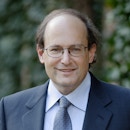
Steinhardt is the Albert Einstein Professor in Science at Princeton University. He received his B.S. in physics from Caltech and his Ph.D. from Harvard University. He was a physics professor at the University of Pennsylvania from 1981 until 1998, when he joined the physics and astrophysics departments at Princeton. His research spans diverse fields, including cosmology, high-energy physics, condensed matter physics and geoscience. He is a fellow of the American Physical Society and the National Academy of Sciences.