Model Systems
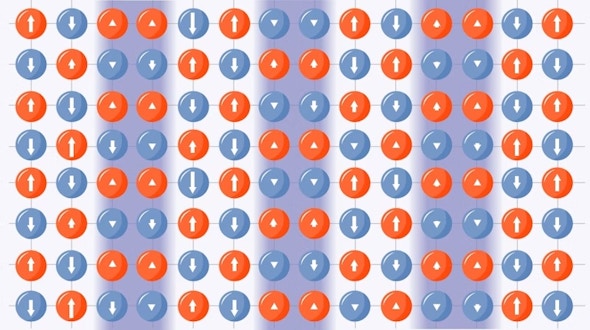
Idealized models of quantum particles interacting together capture the essence of physical phenomena hosted by quantum materials. An outstanding example is the iconic fermionic Hubbard, which is relevant to the description of high-temperature superconductors, moiré materials as well as ultra-cold atoms in optical lattices. Despite its simplicity, this model has a remarkably rich phase diagram.
Because these models also retain the intrinsic computational complexity of the quantum many-body problem, they are prime targets for the methods developed at CCQ. We emphasize a synergistic approach to solving these models, involving an array of diverse computational methods such as tensor networks, quantum embedding and quantum Monte Carlo methods, neural quantum states and more.
Project Leaders: Shiwei Zhang, Antoine Georges
Project Scientists: Andy Millis, Olivier Parcollet, Anirvan Sengupta, Miles Stoudenmire, Joseph Tindall, Samuele Giuli, Chris Roth