Transition Metal Oxides and Beyond
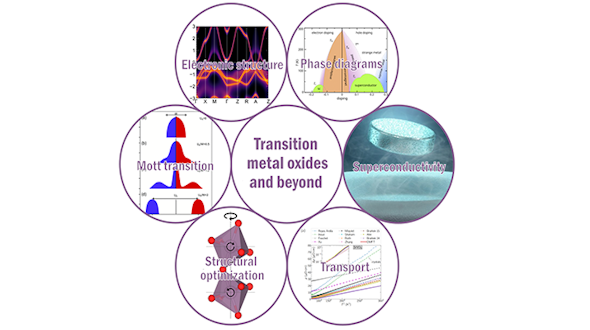
Cuprates: Wikicommons https://commons.wikimedia.org/wiki/File:Cuprates_phasedigagram_en.svg
Mott transition: Hirsch, Doctoral thesis, DOI: 10.14279/depositonce - 3615
Correlated electronic structure: Labollita and Botana, Phys. Rev. B 105, 085118 (2022)
Transport: Kugler et al., arXiv:2412.16363
Structural relaxation: Hampel and al., Phys. Rev. B 104, 035102 (2021)
Transition metal oxides are a class of materials that exhibit a rich variety of emergent quantum states due to the presence of strongly correlated electrons within their partially filled d-orbitals. The interplay between electron-electron interactions, crystal field effects, spin and orbital degrees of freedom and lattice vibrations often leads to phenomena that cannot be captured by conventional band theory. At CCQ, we develop methods tailored to solve the many-body problems encountered in this context, implement them in open-access software and apply them to investigate, uncover and predict physical properties of these fascinating quantum materials.
Our efforts are focused on computing correlated electronic structures, studying quantum phases such as magnetism, pseudogaps, strange metallicity, superconductivity and metal-insulator transitions, calculating transport properties, and investigating the structural optimization of transition metal oxides and beyond. To do that, we develop and employ combinations of first-principles approaches, such as density functional theory (DFT) and the GW approximation, with quantum-many body methods, such as the dynamical mean-field theory (DMFT) or the ghost Gutzwiller approximation.
Project Leader: Olivier Gingras,
Project Scientists: Jennifer Coulter, Antoine Georges, Harrison LaBollita, Andrew Millis, Miguel Morales, Olivier Parcollet, Ina Park, Chia-Nan Yeh