Support for Ukrainian Scientists Keeps Research and Collaboration Alive
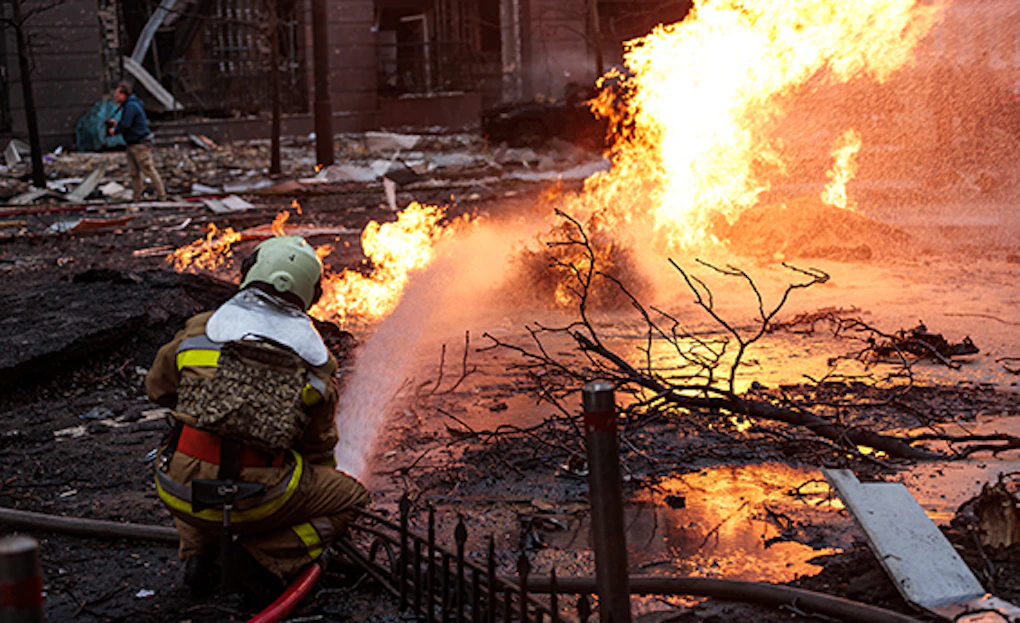
When Russia attacked Ukraine in February 2022, physicist Larissa Brizhik wanted to do something — anything — other than sit at home watching the news and waiting for missile strikes. Brizhik heads the physics department at the Bogolyubov Institute for Theoretical Physics of the National Academy of Sciences of Ukraine. The war made it impossible to concentrate on her work.
“I myself went to the local territory unit … and offered them my assistance,” she says. “I wanted to take up a weapon and go fight.” The unit (gently) turned her down. Brizhik was 70, and Ukraine has an age cutoff of 60 for military service.
There’s a saying in Ukraine, Brizhik says: “Воюй або працюй,” which means “fight or work.” “So I myself and my colleagues, we try to work even more than we used to before the war,” she says. They now work not only to understand the nature of the universe but also to remind the soldiers protecting their country that there is still a country to defend — a country with families, children and theoretical physicists.
Brizhik and many of her colleagues have help from the Simons Foundation and Simons Foundation International (SFI) in maintaining their work. She is one of more than 430 grantees receiving wartime financial support from the foundations’ Presidential Discretionary-Ukraine Support Grants. The grants provide Ukrainian researchers and graduate students monthly stipends to continue working in the country. Their institutions also receive assistance, and the Simons Foundation has co-hosted summer science institutes in Ukraine.
To the scientists in Ukraine, these funds and meetings are a crucial lifeline. They use the money to support themselves and their colleagues and to continue their research. Not only does the program keep math and science alive in a country at war, it is critical for training the next generation of Ukrainian researchers. It’s also a source of hope, Brizhik says, a sign that the larger scientific world hasn’t forgotten them.
Staying In, Hanging On
In the first weeks, then months, of the war, the uncertainty was difficult, says Grygoriy Dmytriv, a chemist and dean of the faculty of chemistry at the Ivan Franko National University of Lviv. “No one knew how the situation would develop, and many people went abroad,” he recalls. His wife, son and mother-in-law left the country for Poland after the invasion. Like Brizhik, Dmytriv stayed.
There was little research happening at that point. “There was a constant risk of air attacks, and the university buildings were closed,” Dmytriv says. So he and fellow volunteers stayed on watch in the chemistry department. Other scientists worked from home, analyzing data from before the invasion. The COVID-19 pandemic provided an ironic upside: Students and faculty were already used to learning and working from home.
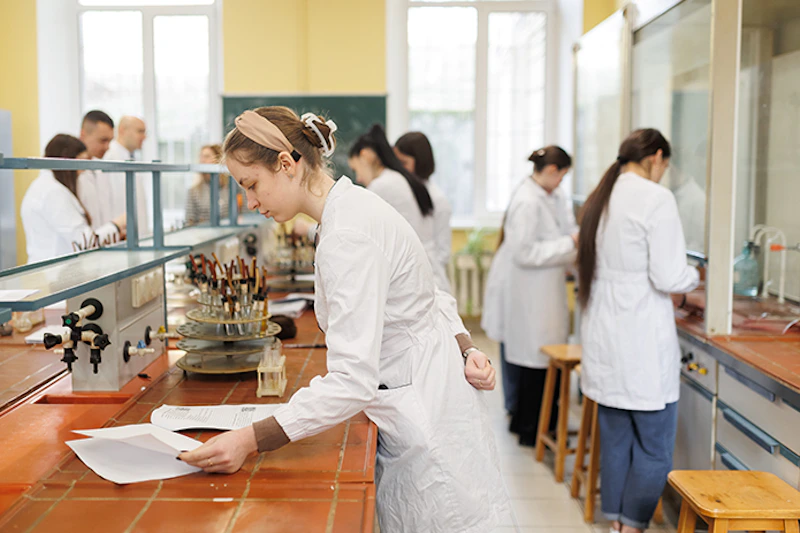
Still, some students understandably left for programs abroad, and others volunteered for the army. The departure of so many early-career scientists, if permanent, could seriously compromise the future of science in Ukraine. The Simons Foundation wanted to provide support for those scientists who remained. “Ukraine traditionally has outstanding scientists and scientific infrastructure,” says Greg Gabadadze, senior vice president of the Mathematics & Physical Sciences division at the Simons Foundation. “It is of paramount importance to preserve continuity in training the younger generation of scientists in Ukraine.”
The funding, provided by the Simons Foundation and SFI and administered by the Simons Foundation, comes at a time when finding in-country support for Ukrainian research has become exceptionally challenging, Dmytriv says. While national grants have been sustained, many local funding sources diverted their money to the war effort. Dmytriv lost a local grant studying biodegradable plastic — though he and his department have had some success in writing grants with a defense focus, such as exploring how to make ultralight armor or better batteries.
Brizhik had a related experience: Two colleagues got funding from the Ukrainian government for fundamental research, but she did not. “There are not so many [sources of] funding to support Ukrainian scientists who work in Ukraine,” she says. Most are offers to go abroad.
Funding Research, Funding Hope
Supporting scientists like Dmytriv and Brizhik was precisely what the Simons Foundation aimed to do when it launched its grant program. However, identifying who might be eligible for the grants was no easy task. Gabadadze worked with other Simons Foundation staff scientists to identify and reach out to productive labs and research groups still in Ukraine.
One of the foundation scientists tapped to help was Stas Shvartsman, a senior research scientist at the Center for Computational Biology at the Simons Foundation’s Flatiron Institute. Shvartsman grew up in Odesa, a city on Ukraine’s Black Sea coast, when Ukraine was still part of the Soviet Union. His interest in chemistry sent him away for graduate school, first to Moscow, then to Israel and then to the United States. He didn’t feel particularly Ukrainian at that time, he recalls.
But when the attacks on Ukraine came in 2022, he felt them deeply. “Probably for the first time in my life, I didn’t feel like [a] Jewish boy from Odesa that just happened to speak Ukrainian, but I felt Ukrainian identity as somebody who grew up there,” he says. “You feel, of course, very helpless, and there is really not much to do.”
Shvartsman was eager to assist in identifying those top scientists still in Ukraine. He reached out to former classmates and, through them, found the right contacts. “I identified people in Lviv, in Chernivtsi, in Kyiv, and I started talking to them over Zoom,” he says.
The practicing, publishing researchers in Ukraine whom Shvartsman and his colleagues found through their networks were sent brief individual requests for proposals for grants. In the end, more than 430 scientists applied. “We reviewed all the proposals and accepted all of them,” Gabadadze says. The funding is ongoing and has been provided to researchers in fields from astrophysics to biology to pure mathematics.
Brizhik and her colleagues were initially wary when they received the email asking them to apply for funding. At first, she recalls, they thought it was spam. But in the end, they took a chance and applied. Brizhik has used some of the funds to pay for internet access, a memory stick for her research, and some power banks, which she keeps with her important documents in case of evacuation. She also got a large thermos for hot water, which is critical when power and water are so uncertain. In her department, 37 scientists and five doctoral students receive grants from the Simons Foundation and SFI. In Dmytriv’s department, 51 scientists and seven doctoral students receive support.
Supporting scientists means supporting careful, analytical, brilliant minds. Every country needs such people, and these are the people who will play a very important part in rebuilding Ukraine, in whatever form it takes.
Stas Shvartsman
To the scientists, the funding means far more than money, though the money means a lot, Brizhik says. “It’s not too big, but when the income is very low, every little bit is very important,” she says. “But there is also another aspect which is not less important”: She and her colleagues don’t feel cut off from the scientific world. “There are other people who understand you, who want to help you, who support you.”
A further sustained connection to the scientific world at large comes through data science summer institutes in Dmytriv’s city of Lviv, co-hosted by the Simons Foundation and the U.S. National Academies of Sciences, Engineering and Medicine. During the annual summer institutes, experts in data science from the United States — including Simons Foundation President David Spergel in 2023 — travel into the country to meet with Ukrainian researchers and discuss topics such as machine learning, Bayesian statistics and data modeling. The institute offers a chance for Ukrainian researchers to hone new skills and stay connected to the international research community even as the war goes on.
Science Under Fire
Even as the fighting in Ukraine drags on, Dmytriv’s situation has stabilized a little. “The university renovated the system of shelters, and we, step by step, continued our research,” he says. His family returned home. But war is never far from anyone’s mind. “Even in Lviv, which is relatively far from the front line, air raid sirens often sound, explosions are heard from time to time,” Dmytriv says. One of the graduate students in organic chemistry, Serhiy Butenko, volunteered for the army and died in combat. Four other chemistry graduates have also died.
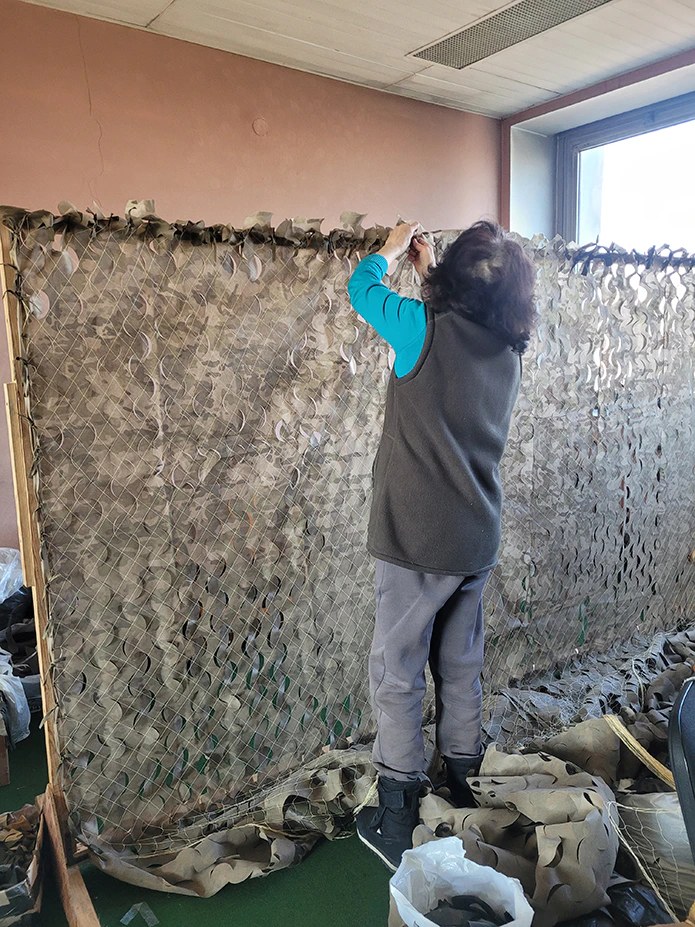
Kyiv, where Brizhik lives, has been harder hit, having been in the crosshairs from the beginning. “We have almost every day — and sometimes several times per day — air raid warnings. Very often, we hear explosions of missiles.” During attacks, she and her daughter stay the night on the hall floor with their (understandably) upset cat. “Some attacks last several hours. The longest one was 11 hours,” Brizhik says. In the morning, missiles permitting, she goes to work to continue her research. During their lunch breaks, Brizhik and her colleagues weave nets for camouflaging tanks at the front.
While the support from the Simons Foundation and SFI helps scientists like Dmytriv and Brizhik continue their research in the face of war, the funding also has a longer-term goal, Shvartsman says: to make sure that a culture of science survives in Ukraine. “Supporting scientists means supporting careful, analytical, brilliant minds,” he explains. “Every country needs such people, and these are the people who will play a very important part in rebuilding Ukraine, in whatever form it takes.”