Leslie Sibener and How Our Brains Choose Which Memories to Keep

All of us have memories that remain for life. Perhaps it’s how the sun shone through the clouds on our wedding day or the taste of a childhood birthday cake. Meanwhile, our recollection of other experiences — say, a lunch from two weeks ago Tuesday — fades away quickly.
Leslie Sibener, a second-year Junior Fellow with the Simons Society of Fellows, studies how the brain decides which memories to keep and which to discard. Sibener is completing a postdoctoral fellowship in Priya Rajasethupathy’s Laboratory of Neural Dynamics and Cognition at Rockefeller University.
We recently chatted with Sibener about her current efforts, past accomplishments and passion for scientific communication. Our conversation has been edited for clarity.
Describe your path towards studying memory formation.
Since an early age, I’ve been fascinated that everyone on Earth has a unique identity. I realized that identity is tied to the brain through individualized experiences and memories. We’ve all had moments when what we remember is very different from that of the person right next to us.
What triggered our set of memories? What triggered theirs? Why did we retain certain events and forget others?
This fascination inspired my interest in neuroscience, although I did not focus on memory right away. During my doctoral work at Columbia University, I focused on motor learning in mice. I recorded neural activity in a brain region called the thalamus as mice learned and refined forelimb reaching movements.
What inspired your interest in the thalamus?
Compared to studying the role of cortex or spinal circuits, the thalamus is understudied in motor research. That imbalance could be due to a few reasons — it’s harder to physically access the thalamus, as it lies deep below the cortical surface. And anatomically, it is a bit of a hodgepodge; there are sub-regions, or nuclei, that have important separate functions, but it can be difficult to define clear-cut boundaries of where one stops, and the other begins.
In the past 15, 20 years, say, researchers have developed better tools, like subcortical imaging techniques and genetic tools to target precise groups of cells anywhere in the brain. I wanted to study the thalamus because it is one of the oldest and most evolutionarily conserved parts of the mammalian brain and is anatomically linked to key motor hubs in the brain, the motor cortex and the striatum. There was still so much to learn about an area we often overlooked.
What was the focus of your doctoral research?
Over the course of our lives, we learn to perform a wide variety of actions that require precise motor control for successful execution. Working with mice, I studied how actions are refined over time by investigating how thalamic circuits contribute to the learning process.
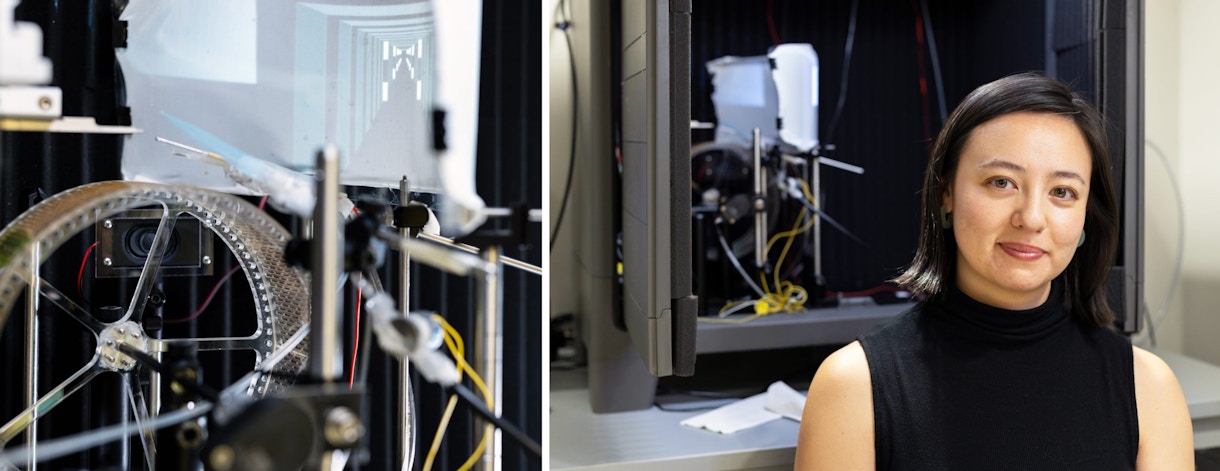
We designed a skilled forelimb joystick target task. The mice were fixed in place and could hold onto a joystick while executing reaching actions. If the mouse moved the joystick into a hidden spatial target, they’d receive a sugar water reward. Over time, mice would execute more precise reaching movements towards the reward target.
As the mice learned this task, we recorded neural activity in the thalamus. We found that two thalamic nuclei played different roles during this task — one nucleus was needed for initial learning and its neural activity encoded the direction of movements, another nucleus was important in later refinement of movement precision and speed. We published this work in Nature Communications.
How did you transition to studying memory?
Near the end of my Ph.D., I was looking for postdoc labs to work in, and I heard Priya Rajasethupathy give an amazing talk with unpublished work on memory. It was an approach to studying memory that I’d never seen before, and it was also about the thalamus!
I was hooked.
Priya presented evidence that neuronal projections from the anterior medial thalamus to the cerebral cortex play a critical role in long-term memory as a kind of bidirectional gate that influences whether we retain or discard memories. Increasing neuronal activity through that pathway in mice raised the likelihood of retaining memories otherwise likely to be discarded. Conversely, lowering activity in that pathway blocked salient memories from being recalled later.
What are you working on during your postdoc?
My work builds on the lab’s findings presented at the fateful conference I just described. The experiment that uncovered the thalamic bidirectional gate involved mice walking through a virtual-reality (VR) corridor, passing through different rooms. Each room is paired with a rich multi-sensory experience, including odors like orange peels, tones played over a speaker and wall patterns in the VR.
Researchers designed the experiment so some rooms would be remembered for about a month after learning and others would be forgotten. They found that neuronal activity in the thalamus in early learning was higher when encountering the more memorable rooms. This was not true for other memory centers in the brain — hippocampus or cortex — in which neuronal activity was similar whether the room would be remembered or forgotten.
I am researching how this bias towards high salience memories emerges in the thalamus. It isn’t inherited from the hippocampus or the cortex – it’s unique. Where does it come from?
One of my hypotheses is that neuromodulators — acetylcholine, serotonin or norepinephrine — may signal salience in the thalamus. Neuromodulators widely fluctuate in the brain and have roles in attention, memory and other cognitive processes. They could be the key to saliency signals emerging in the thalamus, so my first experiments involve recording levels of these neuromodulators in the thalamus during an even more extensive VR memory task for the mice.
The moment that talk finished, I knew I wanted to work in this lab with Priya. I am thrilled to now have the opportunity to do just that.
You are also an active science communicator. Tell us more about that.
With science communication, I want to demystify science for people who may think scientific work is intimidating or elite, thanks to overused tropes in pop culture, like the mad scientist or the one genius who changes the world. Obviously, there are great historical scientists known by name, but the majority of science is only possible through a team effort. Anyone can be a part of that team. So I’ve done shows at venues like Caveat, a theatre on New York City’s Lower East Side where scientists share stories in a relaxed, informal space, often peppered with comedy.
During COVID, I started a blog with other Columbia neuroscientists called Scientist on the Subway, where scientists share their research as well as the challenges they may have overcome along the way. We interviewed scientists from historically underrepresented groups at different career stages, ranging from summer interns to professors, and also scientists outside of academia, to emphasize that you don’t have to be tenured faculty to identify as a scientist. My hope is that people who read our interviews see a piece of themselves reflected and realize they can be scientists too.
Finally, what are your thoughts about the Simons fellowship?
I am so grateful to have stable funding to do my research, particularly when public research funding is in an upheaval, and funding in general is so difficult to obtain. This year, especially, it is important to have a scientific community to lean on.
The senior fellows have been incredibly open with their perspectives and advice, which is very special. It’s sometimes hard to find mentors who will help you navigate professional hurdles, but they have been present and proactive. The junior fellow community has also been such a surprising delight. Since the program is not specific to neuroscience, I’m not just interacting with neuroscientists like I usually do in the lab. Now I get to hear about black holes, the genetics of spider silk and so many mesmerizing things. It reminds me of being a kid and being struck with wonder by wild scientific discoveries. This is a special community, and I’m honored to be a part of it.