Daniel Alabi: Privacy, Computation and Beating the Drum for Mentorship
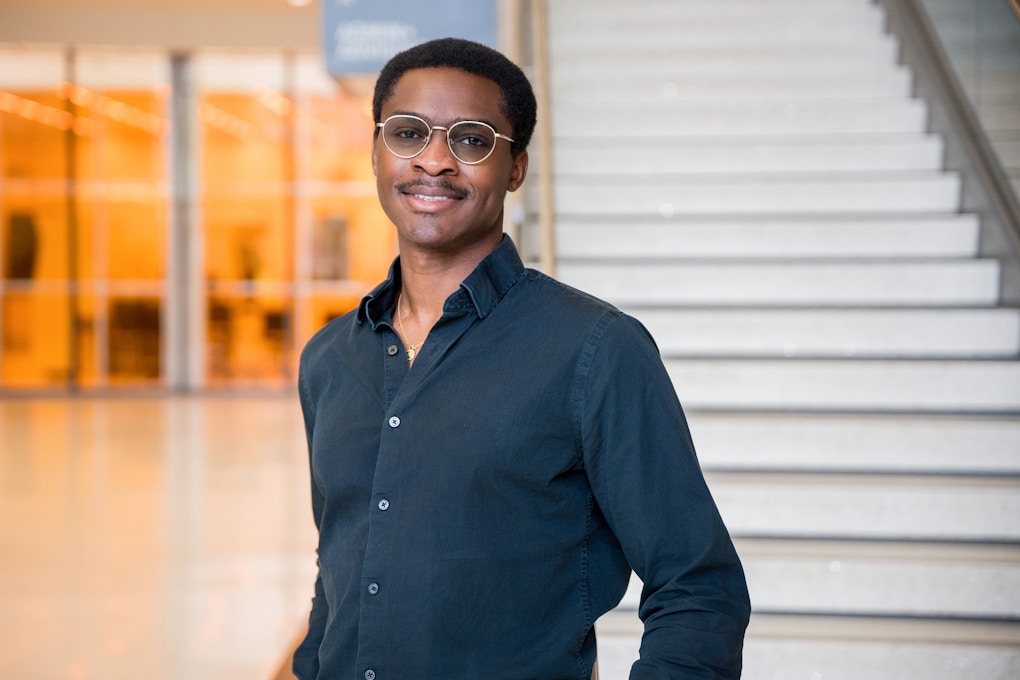
Computer scientist Daniel Alabi sometimes reaches for the back of his office door to grab an hourglass-shaped drum with cream-colored cords lining its wooden frame. He’ll sling it over his shoulder and tap out a lively rhythm. Such talking drums were used throughout the 18th century to communicate between villages in West Africa, and Alabi likens them to his research into privacy and communication.
“You might just hear a talking drum and think, ‘This person is just saying hello,’ but sometimes it’s actually encoded that ‘We’re going to war.’ That’s a form of early encryption,” explains Alabi, an assistant professor at the University of Illinois at Urbana-Champaign, who was born in Nigeria.
An avid drummer since childhood, Alabi is passionate about communication in all forms, which is why his work has focused on privacy in areas ranging from the U.S. census to AI deepfakes. Only three years out from his doctorate, Alabi has already made a significant impact on computer science research. In 2022, Alabi was selected as a Junior Fellow with the Simons Society of Fellows, receiving mentorship, relief from teaching obligations, and research funding for three years.
In addition to the research support, the Junior Fellowship also enabled Alabi’s work on incubating new generations of academics and innovators by giving him the time and financial security to finally start a program he’d been thinking about for years. Shortly after starting his Junior Fellowship, Alabi founded a free two-week computer science summer program called NaijaCoder for high schoolers across Nigeria.
“Teaching some kids can really change their lives and their families’ lives. … I’m an immigrant, and academia has changed my family’s lives,” says Alabi, who started in the Department of Electrical and Computer Engineering at the University of Illinois at Urbana-Champaign (UIUC) this fall. “I really think academia leads to the future. Without academia, you have no industry, and you have no inventions.”

Finding His Way
Alabi was born in Abuja, the capital of Nigeria, where he and his siblings attended public school rather than one of the private schools that prepare students to study overseas. Like the students that he targets with NaijaCoder, young Alabi had no exposure to computer science or academia. Unlike what his career trajectory would suggest, Alabi was a “not-so-serious” student in middle school — he needed a close mentor to bring out his potential.
“My mother literally spent an entire summer prepping me and giving me all these pep talks,” Alabi recalls. “Literally the next semester, I switched from the bottom half of the class to get in the second position. It took someone like her to really push me.”
After graduating early from high school, Alabi joined the yearlong program EducationUSA, which helps high school students around the world apply for college in the United States. Supported by travel funds from the U.S. Department of State, Alabi attended Carleton College in Minnesota with a full scholarship.
For his senior thesis in math and computer science, Alabi implemented a faster algorithm for a graph theory problem, positioning himself at the intersection of the two fields. Around this time, he started his ongoing academic blog Why (and How) Things Work, reaffirming his passion for communication and community. (The blog is subtitled “In Honor of David Blackwell,” referring to the trailblazing Black statistician who received his doctorate in mathematics from UIUC in 1941.)
After spending a year in industry following graduation, Alabi says he realized just how much he had enjoyed his last semester of college, which he had spent researching his thesis. So he applied to graduate school and started at Harvard University in 2016.
It was a fortuitous time to enter the world of math and computers. With the 2020 U.S. census looming, researchers found that previous techniques designed to respect privacy by swapping random individuals were insufficient — the researchers could still reconstruct full names, addresses and other private information. The U.S. Census Bureau announced that it would use new techniques from the burgeoning field of differential privacy, which adds random noise to information without meaningfully changing statistical outputs. Inspired by the census problem, Alabi focused his doctoral work on investigating methods that incorporate differential privacy into statistical analysis.
After completing his doctorate, Alabi became a Junior Fellow with the Simons Society of Fellows, which supported him throughout his postdoctoral work at Columbia University. Established in 2014, the Simons Society of Fellows champions outstanding early-career researchers and professors at schools in New York City. Fellows enjoy weekly dinners, an annual retreat, and regular lectures and conferences at the Simons Foundation. Alabi enthusiastically describes learning about his cohort’s work in materials science, neuroscience, machine learning and other fields, and says he hopes to enrich his own research program with that knowledge.
“For example, we had a lot of talks about quantum engineering and physics, so now I’ve been talking to colleagues at UIUC about the security of quantum communications,” says Alabi, who also credits the Simons Foundation’s Science, Society & Culture division for encouraging him to bring “his whole self” to the fellowship — for instance, he spoke at the public “Presents” series at the foundation. There, alongside a filmmaker from Ghana and an oncologist from Botswana, Alabi reflected on his journey from a public school in Africa to his new job offer at UIUC.
“Teaching some kids can really change their lives and their families’ lives. … I’m an immigrant, and academia has changed my family’s lives.”
At UIUC, Alabi met his collaborator, artificial intelligence researcher Lav Varshney. As a White House Fellow, Varshney had previously helped President Joe Biden craft an executive order on “safe, secure and trustworthy” AI, and he quickly realized that Alabi could help transform the theory there into concrete practicalities.
“When we did the policy work, the technical solutions actually weren’t fully there, so it was something I wanted to work on when I came back to Illinois,” says Varshney, now the inaugural director of Stony Brook University’s AI Innovation Institute, which is partially funded by the Simons Foundation. “And then I met Daniel, and he seemed like the perfect person to work on this because of his background in both cryptography and information-theoretic ideas.”
From previous work, researchers already knew the impossibility of discerning whether short texts are AI-generated. Thus, as established by the executive order, companies must add ‘watermarks’ so that users can determine whether the text was generated by an AI or by a human.
In a new paper, Alabi and Varshney describe and implement an algorithm to add watermarks to AI-generated texts. Unlike previous work, their paper’s procedure is “unforgeable.” Anyone with a public key can tell if something has been watermarked using their procedure, but no one can forge that watermark. Their process changes a few words in the AI-generated text to match a certain ‘unnatural’ distribution, which can be accessed via a public key.
“Traditionally, information-theoretic ideas took a while to get into deployment,” says Varshney. “But once you put this cryptographic spin on those arguments, then they become very directly implementable. That’s what especially excites me about some of the work Daniel is doing.”

NaijaCoder
Just as Alabi’s research into differential privacy and AI watermarking fills knowledge gaps in problems that affect society, his NaijaCoder summer program directly addresses a societal problem, enabling underprivileged students to learn about ‘algorithmic thinking’ from accomplished researchers and scientists who look like them.
NaijaCoder was inspired by a similar program in Ethiopia founded by a professor at the University of California, Berkeley whom Alabi met while in graduate school. Alabi built out NaijaCoder with other Nigerian immigrants as instructors and with a syllabus focusing on algorithmic thinking.
As an example of algorithmic thinking, “imagine I have to search your entire sequence of genes to find a mutation,” says NaijaCoder instructor and organizer Victory Yinka-Banjo. “If you have to search a 3-billion-long string of sequences, if you can go more quickly, that could be the difference between life and death. When you think about diagnosing patients, the quicker you can figure out what the problem is, the quicker you can get them on the treatment.”
Beyond convincing high schoolers of the importance of algorithms, NaijaCoder has to deal with the logistics of running such an international program. With one site in Abuja and another added in Lagos last year, the team must find venues, transportation, internet access and solutions to the daily electricity outages that plague Nigeria. While the Junior Fellowship covered Alabi’s travel in the program’s first years, more permanent funding now comes from many sources, including MIT, Google, Microsoft and the University of California, Berkeley. Some of those funds helped cover inverters, which hold enough backup power to charge laptops, allowing teaching to continue during blackouts.
“Many people who have big dreams or ideas want to leave Nigeria, because the opportunities and the system are against them,” explains Yinka-Banjo, who met Alabi while she was an undergraduate at MIT. “It’s like you’re constantly fighting a battle, whether it’s not having access to electricity or funding, or thinking about how to provide for your family. It’s important that we have these programs locally. I envision a Nigeria where I wouldn’t have to have left Nigeria to get an education here in the U.S.”
In the meantime, Alabi’s program helps students in Nigeria obtain that education, while he pursues research that is also rooted in societal problems. Gratitude for the organizations that have supported him on his journey, especially the Simons Society of Fellows, motivates both of these passions.
“I really benefited from mentors, and specifically my mom really pushing me,” Alabi says. “I feel very lucky to be in my position. A lot of people helped me to get here. I know there’s a lot of people who could benefit from all the resources that I got, so I’m trying to give back in some way.”