Fellows-to-Faculty Awardee Abhilasha Joshi Maps Cognitive-Motor Flexibility Across the Aging Brain
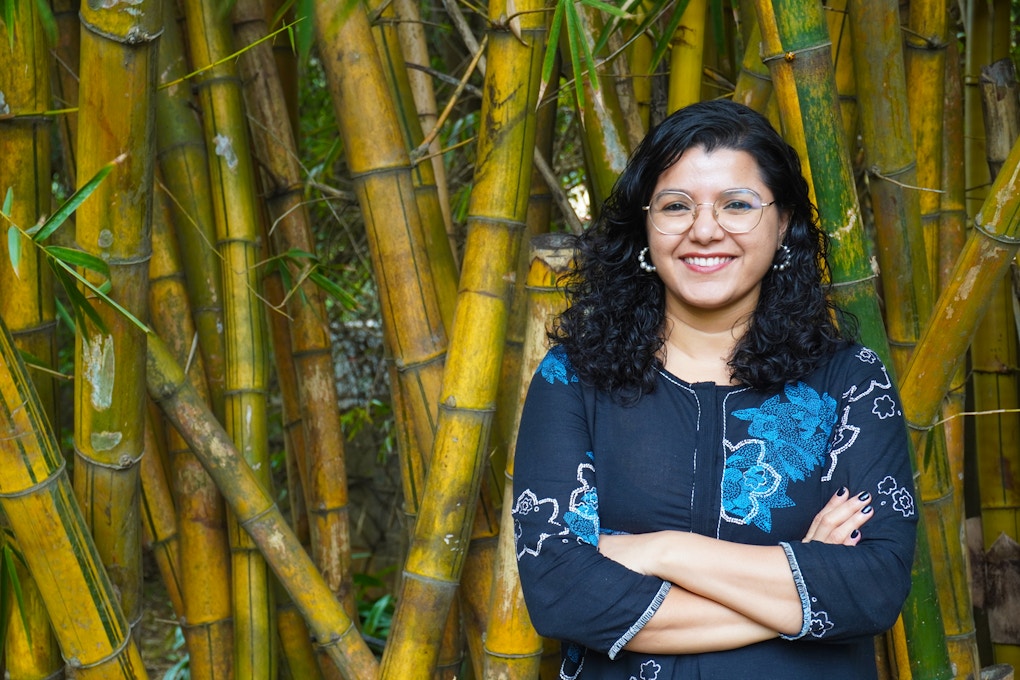
When her academic career took her to England and then California, both far from her native India, Abhilasha Joshi knew she wanted to return home. In 2022, at the end of her postdoctoral work at the University of California, San Francisco, she received the Simons Foundation’s Fellows-to-Faculty Award, which provided $600,000 for her to establish her lab at India’s National Center for Biological Sciences. Joshi’s lab now studies how cognitive representations of space interact with ongoing actions. Her fellowship falls under the Simons Foundation Collaboration on Plasticity and the Aging Brain, which aims to discover mechanisms of resilience and functional maintenance in the aging brain.
We recently spoke with Joshi about how the fellowship helped launch her research group and enabled her to ask bigger, bolder questions.
When did you decide that you wanted your own lab?
I did not know that research was a career until I joined my undergrad at the Indian Institute of Science Education and Research Mohali. Their focus was to train a generation of research scientists, so I basically got sucked into the romance of academia. It seemed that having my own lab would be the pathway to ask interesting research questions.
What does your lab study?
I’m interested in how the internal representation of space is linked to the actions that an animal takes. And one of the ways we’re looking at this is through the lens of locomotion.
We can attribute patterns of activity in a brain region called the hippocampus to an animal’s ability to navigate the environment. Certain patterns of activity represent its current location and, over a very short time scale, the location to which it’s about to travel. This process is rhythmic, at around eight hertz in rats. We know from my Ph.D. and postdoc work that, dependent on the behavioral complexity of the task, this internal representation of location is synchronized to activity representing the animal’s foot falls, which is an external, physiological process.
I’m very interested in this synchronization, both in young animals and as the animal ages. One of the puzzles in our field is that if you record from the hippocampus in older animals, the patterns of activity are quite like those of younger animals, even though cognitive ability declines. So, one of the questions in our field is why some older animals perform poorly in navigational tasks. I believe an understanding of the link with locomotion may be key.
How has this award allowed you to ask new scientific questions?
I had this buffer to explore things. You can think about my research program as bridging two different fields: the cognitive representation of space and the motor experience of the animal as it’s moving around in the environment. I already had worked on the cognitive side, so it seemed very important for me to gain expertise in the motor side of things.
I used the contingency grant to visit two labs, and after my postdoc, because my visa in the U.S. expired, I spent another year of my funding as a visiting scientist in Megan Carey’s lab [at the Center for the Unknown at Champalimaud Foundation]. She is an expert in cerebellar and motor circuits. I stayed for a year kind of osmotically learning about biomechanics and motor systems. That helped finesse my research program.
The thing that I care about most is the behavior of the animal. So for me, it doesn’t matter if it’s the hippocampus or the cerebellum or the prefrontal cortex or the striatum. What’s important is how neural information processing is relevant to an animal’s ongoing actions. Just being in groups that were interested in these different brain regions really helped me put that into perspective.
What got you started down this path?
I was always interested in the behavior of the animals I saw in my surroundings, whether it was birds, bugs or rodents. And I didn’t recognize for the longest time that it was a thing that one could study. But one thing led to the other, and I came to my undergrad university, which has very strong programs in evolutionary biology and animal behavior. When I started reading more, I realized what interested me about animal behavior is how computations in the brain are linked to actions. And so that brought me to neuroscience.
You went abroad for your Ph.D. and postdoc. What made you decide you wanted to return to India?
After I was accepted at [the University of Oxford for my Ph.D.], I felt like people’s responses were like, “Whoa, Abhilasha is so smart because she went to Oxford.” But I felt like there was nothing different about me before and after being admitted to Oxford, or in the scientific and intellectual interactions I had with people in my undergraduate university in India and at Oxford. So why should Oxford have that kind of standing when my undergrad university did not?
A lot of the people that I knew within the Oxford community were also from Global South countries. And I felt like many of us were so driven and motivated, and it just felt like adding to an inequality of opportunities, if I were to stay abroad in a Global North country.
This is a bit personal, but I was the first person in my family to do a Ph.D. and to leave India for education. I didn’t realize that I was now placed in a completely foreign setup until almost six months into starting my Ph.D. And coupled with this feeling, I thought about all the people that are just excellent and want to do great science here, or elsewhere in the Global South.
How did you feel when you learned you had received the Fellows-to-Faculty Award?
It really removed a lot of pressure on me. One of the things that I was uncertain about was how the funding landscape was organized in India or in any of the other countries I was considering. The fact that this was an award that was linked to me, rather than an institution, supported me to act on my thoughts of applying to faculty positions in India and elsewhere.
What else about the Fellows-to-Faculty program was helpful for you?
The community aspect. I got connected with people who were at a similar career stage, where there’s a lot of uncertainty. That’s not a very comfortable place for anybody to be, but suddenly, we had this stress relieving event that brought us all together.
It also helped me navigate the faculty application process. During my negotiations for a faculty position, I did not necessarily know what I should be thinking about. [Scientific officer] Krithika Venkataraman and [program manager] Jennifer Valdivia Espino really emphasized making sure that I accepted the offer best suited for my needs.
What advice do you have for young scientists?
This is advice that was given to me. Every day, when you’re waking up, think about what’s the most creative thing you can do given the circumstances and who you are. Trust that you are enough.