Scientists Map Aging Across the Body of a Short-Lived Fish

Studying aging takes time. That’s why neuroscientists studying how brains age turn to thumb-sized fish called killifish. Within just four to six months, the fish hatch, grow to maturity, spawn and die. Their compressed lifespan has made the fish a favorite for research on this inevitable process.
Now, a team funded by the Simons Collaboration on Plasticity and the Aging Brain (SCPAB) has created a comprehensive atlas of aging in killifish. By sequencing gene activity across 12 tissues at six life stages in male and female fish, they have documented progressive molecular changes in detail as they unfold across the fish’s body.
Their work, described in Nature Aging, reveals shifts in the brain and the immune system relevant far beyond lab aquariums.
“Many of the pathways that become altered as these fish age, they share with mammals, including us,” says SCPAB Investigator and co-senior author Tony Wyss-Coray, the D.H. Chen professor II at Stanford Medicine and director of the Phil and Penny Knight Initiative for Brain Resilience.
The study establishes artificial intelligence–driven tools for predicting the age of the fish’s biological tissues based on their patterns of gene expression. The atlas also provides a benchmark for new studies of neurodegeneration. With the information it contains, scientists will be able to assess whether experimental interventions — such as drugs, dietary changes or genetic alterations — speed up or slow down brain aging in the fish.
Life in Fast-Forward
African turquoise killifish inhabit ponds formed during the rainy season in their native East Africa. The fish’s short lifespan allows them to make the most of this ephemeral habitat before it dries up. Killifish live one-fifth as long as a mouse and one-seventh as long as a zebrafish — two other common animal models for studying aging.
Like humans, mice and other mammals, killifish are vertebrates, meaning they possess a backbone. They also appear to age the way we do. For instance, measures that extend healthy lifespan in mice — including restricting their diets, giving them the drug metformin or altering their gut microbiome — tend to work in killifish as well.
“The killifish’s short lifespan makes it possible to perform experiments that would be much more challenging with other vertebrate models,” says SCPAB Investigator and co-senior author Anne Brunet, the Michele and Timothy Barakett endowed professor at Stanford Medicine. “It takes much less time to follow them through their lifespan or to determine whether an experimental intervention has altered how they age.”
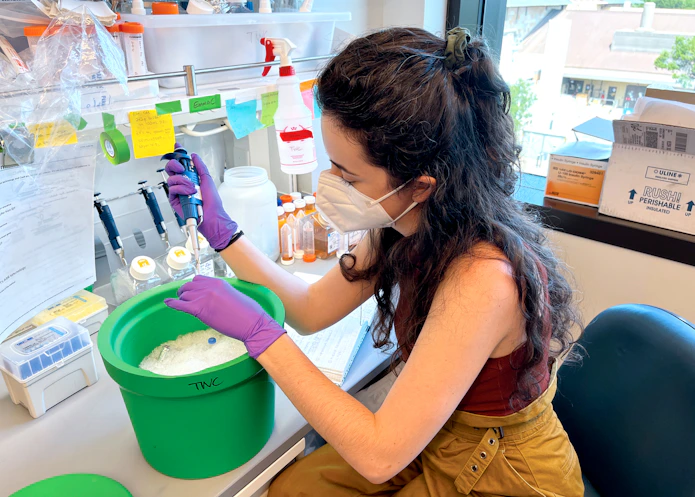
To build the atlas, co-first authors Emma Costa and Jingxun Chen sequenced RNA in the fish’s brain, skin, gut and elsewhere to capture a snapshot of gene activity in these organs. They did this across six life stages, beginning with roughly 50-day-old juveniles and continuing through geriatric fish at about 162 days old. Since evidence in many animals, including humans, suggests that males and females can age differently, they examined each sex separately.
“Ours is the first rich, organism-wide study that looks at multiple organs and compares the sexes to understand aging in this model,” says Costa, who conducted the research as a graduate student in Wyss-Coray’s lab and has since joined the nonprofit biomedical research organization Sage Bionetworks.
The Brain’s Familiar Breakdown
The atlas revealed that aging does not affect all tissues equally. Muscle, skin and the retina showed the greatest shifts in gene activity over time, while the liver, gut and gonads had the least. A close examination of the brain, which fell somewhere in the middle, revealed patterns also seen in mice and humans.
In this organ, they found notable overlap with genes that Wyss-Coray’s lab had used to assess brain aging in mice. The shared genes included those associated with the immune system’s first-line defenses. They also found genes linked to the activation of microglia, immune cells unique to the nervous system. In a young, healthy brain, microglia clear away debris. With age, however, they can become chronically activated and contribute to harmful inflammation.
The killifish brain also showed disruption of the pathways responsible for breaking down and recycling cellular waste. These two signs of deterioration — errant immune activity and a failing waste disposal system — are key features of neurodegeneration in humans, and studies have implicated them in Alzheimer’s and Parkinson’s diseases.
While pathways in certain tissues changed in opposite ways in males versus females, little difference between the sexes showed up in the brain, according to Chen, a postdoc in Brunet’s lab. But because protein production from RNA is disrupted in old killifish brains, as it is in humans, it’s possible that male and female brains may differ at the protein level, she notes.
Tipping the Balance in the Body
The immunological changes weren’t limited to the brain. The atlas documented a fundamental shift in the body’s system for defense.
In humans, immune cells are produced in the bone marrow. In fish, that role falls to the front portion of the kidney. By examining gene activity in this organ, the researchers found a pattern reminiscent of what has been observed in aging mammals, including humans. Markers associated with B and T cells, the immune system’s precision defenders, declined with age. Meanwhile, evidence of immune cells that participate in broader inflammatory responses increased.
Interestingly, this shift was much more pronounced in females than in males.
“This and other sex-specific aging features may help explain why male and female killifish often respond differently to treatments known to affect lifespan,” Chen says. Previously, for example, she and others on the Stanford team found that restricting the diet of killifish significantly lengthened the lives of males but not those of females.
Predicting Biological Age
Drawing on the atlas’s data, the team built a set of artificial intelligence–based tools called aging clocks. These AI models learn gene activity patterns from specific tissues and then predict the biological age of samples based on their molecular data. The researchers tested their clocks by giving them data from prior experiments, including the diet restriction study. Focusing on the fish livers, the clocks determined that the males appeared younger, while the females did not — predictions that aligned with the longer lifespans seen only in males.
By giving researchers a rapid new way to evaluate the effects of experiments, these clocks could be powerful tools for studying aging, according to the researchers.
“We want to use our data to embolden and enable others who are studying killifish,” Costa says.