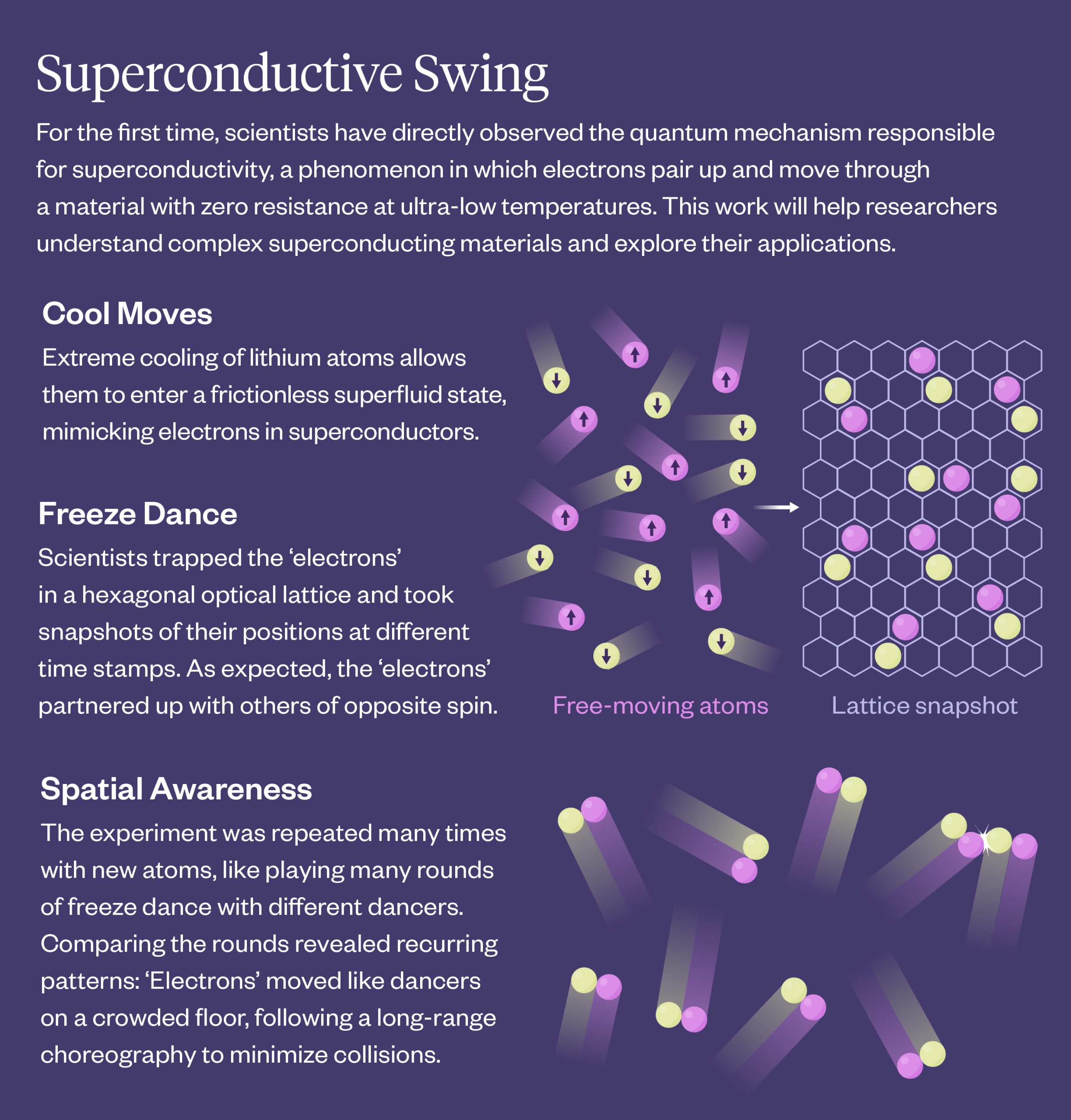
Scientists Capture Superconductivity’s ‘Dancing Pairs’ for First Time, Filling Gap in Decades-Old Theory

For the first time, scientists have directly imaged the quantum process underlying superconductivity, a phenomenon in which paired electrons cause electric current to flow without resistance at sufficiently low temperatures.
The results weren’t quite what they expected.
In the study, published April 15 in Physical Review Letters, the scientists directly imaged individual atoms pairing up in a special gas cooled nearly to absolute zero — the unreachable limit to how cold things can get. The type of gas, called a Fermi gas, allows scientists to substitute electrons with atoms and probe the physics of superconductors in a controlled way.
Surprisingly, the scientists found that after pairing up, the atoms moved in a synchronized dance, with their positions dependent on those of other pairs — a phenomenon not predicted by the 70-year-old, Nobel Prize-winning theory of superconductivity.
“Our experiment showed that something is qualitatively missing from this theory,” says experimental research lead Tarik Yefsah of the Laboratoire Kastler Brossel at the French National Centre for Scientific Research (CNRS) in Paris. Yefsah and other experimental physicists at CNRS collaborated on the new study with theoretical physicists, including Shiwei Zhang of the Simons Foundation’s Flatiron Institute.
The findings add an important new detail to scientists’ fundamental understanding of superconductivity and could aid in the search for room-temperature superconductors, a holy grail of modern physics that would enable ultra-efficient electric grids and electronic devices.
Superconductivity typically occurs in special metals that are cooled to extremely low temperatures — far below any naturally occurring on Earth. After these materials drop below a critical temperature, their electrical resistance plummets to zero due to a quantum effect that pairs electrons like dancers in a ballroom. This basic physics of superconductivity was first described in the 1950s in a theory by the American physicists John Bardeen, Leon Cooper and John Robert Schrieffer.
But the BCS theory — named for its inventors — is only an approximate framework; it can’t describe all aspects of superconductivity, and it can’t explain all types of superconductors. Physicists knew something was missing, but despite years of research, they weren’t exactly sure what.
“BCS theory tells us superconductivity arises because electrons have a tendency to pair,” says Zhang, a senior research scientist and group leader at the Flatiron Institute’s Center for Computational Quantum Physics (CCQ). “But it’s a rough theory, and it doesn’t tell us anything about how the pairs interact.” Indeed, BCS theory posits that the pairs are distributed independently throughout a superconductor, so the probability of finding a pair near a given point isn’t correlated with the presence or absence of nearby pairs.
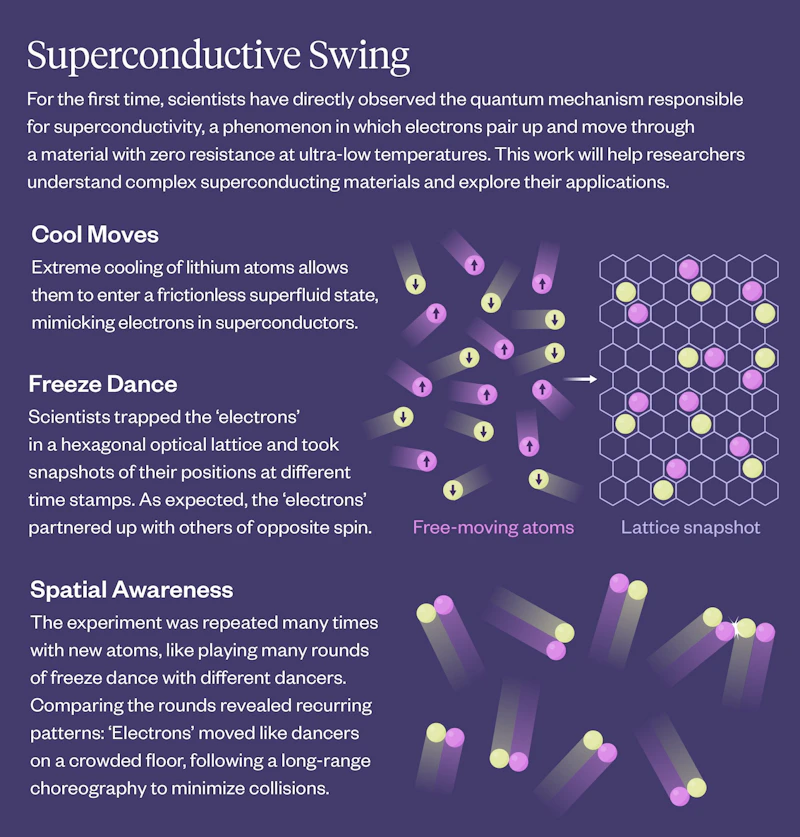
In the new study, a group of experimental physicists from CNRS paired up with theoretical physicists at the CCQ to probe the physics of inter-pair correlation.
Using a newly developed imaging method, the experimental physicists captured snapshots of the relative positions of the pairs. The scientists used a special gas mixture made of lithium atoms, cooled to just a few billionths of a degree Celsius above absolute zero. At these temperatures, the atoms act as fermions, a fundamental class of particles that includes electrons. Since these fermions all follow the same physics of pairing, the atoms are suitable substitutes for studying electron behavior in superconductors.
The imaging revealed that the positions of paired atoms became influenced by those of other pairs. The paired atoms maintained a separation from other paired atoms, just as dancing couples keep their distance from other dancers in a ballroom, Yefsah says. This finding adds a new understanding of these systems that was missing from the historic BCS theory.
“The BCS theory gives us a view from outside the ballroom, where we can hear the music and see the dancers come out, but we don’t know what’s going on in the ballroom,” Yefsah says. “Our approach is like taking a wide-angle camera inside the ballroom. Now we can see how the dancers are pairing up and paying attention to one another, so they don’t bump into each other.”
Zhang and his former postdoctoral researcher at the CCQ, Yuan-Yao He of the Institute of Modern Physics at Northwest University in China, worked to confirm the results. They conducted a numerical simulation using quantum mechanics that precisely models the same system. Their simulation’s output matched the experimental findings and revealed the details missing from the BCS theory, including the separation between the paired ‘dancers.’
The findings expand scientists’ fundamental understanding of superconductors and other quantum materials made of fermions. Such advances in fundamental physics are integral to developing game-changing higher-temperature superconductors.
In the 1980s, scientists experimenting with metal alloys discovered a new class of so-called high-temperature superconductors, which exhibit superconductivity at temperatures around that of liquid nitrogen — still a chilly minus 196 degrees Celsius (minus 321 degrees Fahrenheit). Scientists haven’t figured out why these alloys can superconduct at these relatively high temperatures. But with a better understanding of superconductivity, scientists hope to develop superconductors that operate at temperatures in our everyday environment, which could massively improve the efficiency of power grids and supercomputers.
“By understanding this simple case, we can fine-tune our tools to study more complicated systems,” Zhang says. “And more complicated systems are where we look for new phases of matter, which have driven a lot of technological breakthroughs in the past.”
Information for Press
For more information, please contact [email protected].