Beyond the Cryo-EM Resolution Revolution
In the early 2010s, science entered a new era known as the resolution revolution, powered in large part by advances in a powerful imaging technique called cryo-electron microscopy, or cryo-EM. By bombarding flash-frozen molecules with electrons and analyzing the resulting images, researchers were suddenly able to create atomic-level renderings of everything from enzymes and ribosomes to viruses and antibodies. Cryo-EM turned out new discoveries at such a clip that in 2017, three of its key developers were awarded a Nobel Prize.
Today, the Simons Foundation continues to advance cryo-EM and related technologies in disciplines such as structural biology, biochemistry and medical science. In 2015, the foundation funded the establishment of the Simons Electron Microscopy Center (SEMC) at the New York Structural Biology Center (NYSBC) in Harlem. SEMC is dedicated to training a new generation of scientists, advancing cryo-EM capabilities, and using microscopy to solve pressing scientific questions.
At its core, cryo-EM is a tool powered by math. Researchers start by embedding thousands or millions of molecules they’re interested in imaging into a grid, which they then expose to a beam of accelerated electrons. As the electrons bombard the sample, they produce millions of randomized 2D images that have no consistent angle or orientation. To create a 3D model from that chaotic data, scientists need algorithms capable of reorienting and reorganizing the many slices of the whole, like pieces of bread that, layered together, make a loaf. To do this, mathematical models describe an image by its patterns and details rather than by its pixel locations and match slices with similar properties.
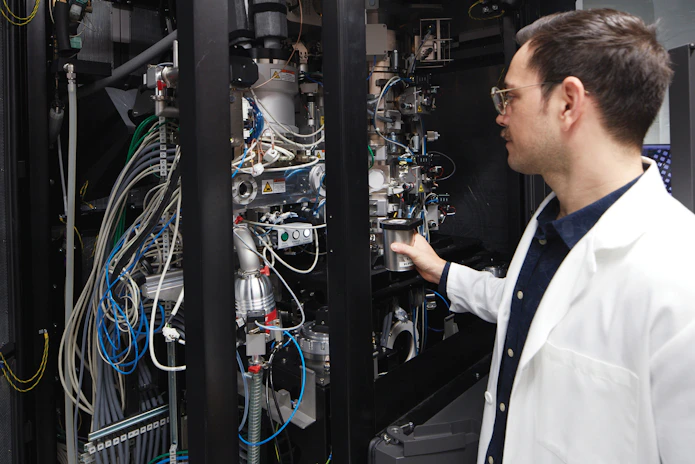
The underlying math is complicated, but the resulting capabilities are unparalleled, and from its first day, the center has helped bring cryo-EM tools to more people, including researchers working in distant fields. The team at SEMC oversees 19 microscopes and a variety of companion machines that would be prohibitively expensive for many labs. Yet the center makes them available — and trains scientists in their use and how to analyze the resulting data — through collaborations with the National Institutes of Health and other groups within the NYSBC and the Simons Foundation’s Flatiron Institute.

“We offer training from the ground up, sometimes spending weeks with a single person or group to help design a protocol for their particular experiment,” says Alex de Marco, SEMC’s director. In 2025, the center supported roughly 1,000 users and was acknowledged in more than 50 scientific publications. “I often think this is where we make the most difference, because this offering just doesn’t exist anywhere else.”
At the same time, researchers continue to refine electron microscopy–based methods, which in turn open new areas of research. Yong Hyun Song, a biophysicist at NYSBC who is also affiliated with the Flatiron Institute, consistently ran into the same problem during his early work studying neurons: High-resolution microscopy provides fine detail within a tiny area, yet neurons have sensory projections that can extend to a meter in length. Song bridged detail and scale by stitching together mosaics of images to create a single, larger picture. Electron beams are typically circular, however, and the picture window is a rectangle, creating a mismatch between the two components. “What that means is that when you want to go right next to the area you just imaged with your rectangular camera, your circular beam will have burned a significant portion of it away,” he says. De Marco and his colleagues solved the problem by creating the first square electron beam, allowing Song to produce beautiful renderings of neurons and reveal how motor proteins help shuttle resources along their length.
As these tools become more powerful, it means that scientists suddenly have a glut of high-quality data to analyze. Increasingly, researchers are realizing that to draw as much information as possible from these resources, we need correspondingly powerful analytical tools.
Debanjana Maji, a postdoctoral researcher affiliated with the NYSBC, the Flatiron Institute and Rockefeller University, is currently utilizing algorithms developed by Flatiron researchers to study RNA — the intermediate molecule that facilitates the translation of DNA instructions into functional proteins. RNA is a complex molecule that changes shape, and that shape, in turn, determines its behavior. Tools like X-ray crystallography image RNA by first trapping it in a single state within a crystal lattice; however, this process obscures the molecule’s dynamic nature.
“Cryo-EM does a better job of capturing all the different shapes, but we still need a good analysis tool to make sense of what we’re seeing,” she says. The algorithm Maji uses, developed by statistical biophysicist Pilar Cossio, operates on a principle called Bayesian inference. A model first predicts all the different shapes an RNA might take based on its composition and chemistry and then gauges the relative importance of each shape based on how frequently it appears experimentally. Common shapes are probably biologically important, Maji says, “but sometimes the rare ones are too, and other structural biology methods often average out that rare fraction.”
Cossio, a joint member of the Flatiron Institute’s Center for Computational Mathematics (CCM) and Center for Computational Biology (CCB), adds that her algorithm is just one of many statistical frameworks that exist to process cryo-EM data. To create the most useful tools, Flatiron researchers brought together an interdisciplinary cohort of investigators to provide input.
Cossio and computational biophysicist Sonya Hanson, who is also a joint member of the CCB and CCM, co-launched a competition in 2023 that invited participants to analyze the same dataset using their own custom pipelines. The dataset included 33,742 cryo-EM images of a protein called thyroglobulin that resembles a dove, complete with “flapping wings” that assume different shapes. Groups were asked to analyze the images and identify all the different shapes, as well as how frequently they appear.

Nine groups participated, contributing a total of 41 submissions, and Cossio says the variety of approaches people used amounted to “a whole zoology of methods.” Some people leveraged Bayesian approaches similar to Cossio’s, but others created machine learning algorithms that differentiate the structure and volume of different thyroglobulin conformations, or conducted principal components analyses that pull out the variables most likely to influence the protein’s shape.
The goal, Hanson says, is to establish a new gold standard for validating the increasingly complex yet meaningful results by comparing the output of each pipeline. That nearly every group currently developing methods in this space participated is a sign of just how invested the field is in moving these tools forward, she says.
“In my experience, methods development has always been a very collaborative space, but it’s rare to see it happen so publicly,” Hanson says. “The fact that we continue to see cryo-EM applied to new problems in new areas all the time really gives you a sense of how much there still is to learn.”