Building an AI That Understands the Universe
Imagine if ChatGPT were trained not on text and images, but on scientific and mathematical reality. That’s the vision behind Polymathic AI, an initiative launched in 2023 and supported by the Simons Foundation and its Flatiron Institute.
Generative artificial intelligence — the powerful form of AI that also underlies large language models such as ChatGPT — has ushered in many scientific advances. But most scientific models are built for specific, singular problems and can’t be broadly applied. The Polymathic AI team is building large foundational models that can tackle a wide range of scientific problems, from astrophysics to molecular biology.
The idea for the initiative came about at a physics conference attended by Shirley Ho, now project lead for Polymathic AI, where there was a lot of buzz about how generative AI chatbots such as ChatGPT and Google Gemini were going to solve major scientific problems. “I thought, ‘How would that work?’” says Ho, who is also a senior research scientist at the Flatiron Institute. “Those models are only trained on large amounts of text, web images and YouTube videos; they’re not grounded in physical reality. What if we built large generative AI models for science instead?”
The name is a nod to the initiative’s wide-ranging potential. Like human polymaths who are well versed in multiple subjects, Polymathic AI’s models cut across individual scientific disciplines.

“If you know seven languages, then the eighth is easy to pick up,” Ho says. “It’s a similar argument here. The physical realities that ground our models are all connected. That transferability makes these models really powerful.”
The Polymathic AI team is building several large models that span different areas of science.
In 2025, the Polymathic team released Walrus, a foundational model for physical dynamics spanning multiple disciplines. Walrus can predict the dynamics of fluids and fluidlike systems, ranging from merging stars and acoustic waves to the movement of bacterial colonies. This was made possible by the team’s previous data release, the Well, which contains 15 terabytes of high-quality simulation data contributed by computational scientists at the Flatiron Institute and elsewhere. The Well contains 19 different physical scenarios across 63 different fields of science.
“Compared to what existed before, this was a huge step forward for data quality in this space,” says Walrus lead developer Michael McCabe, a research scientist at Polymathic AI.
In addition to benefiting from the diversity of data in its training set, Walrus has a design that overcomes some hurdles encountered by previous fluid mechanics models. Namely, it’s better able to make long-term predictions and is more efficient, which is important in a field with such huge datasets whose analysis requires complex computations.
Also in 2025, Polymathic AI released the first iteration of its large foundational model for astronomy, AION-1. The astronomy model is trained on images taken by powerful telescopes, as well as on measurements such as the spectral fingerprints of stars. In collaboration with many other astronomers, the team first built and released a 100-terabyte dataset called Multimodal Universe, consisting of hundreds of millions of data points in a format ready for use in AI training.
The AION-1 model has broad applications. It can estimate the physical parameters of galaxies, such as their distances from Earth, their masses and their rates of new star formation. It can classify galaxies by their shapes, a process that normally must be done manually. It can also infer conclusions from small amounts of data, which is particularly important when data gathering requires powerful and expensive machinery such as space-based telescopes.
Others in the field are now trying to build something similar, says AION co-leader François Lanusse.
“Nobody else has yet been able to do the same kind of exercise at this scale. It’s to the credit of the Simons Foundation that we were able to do this when we did,” he says. “When we began, this was really prospective. We knew that if we gathered good people and thought hard about it, we were going to find interesting applications. But this would not have been possible through conventional funding agencies.”
That’s because of the broad reach of Polymathic AI’s models — most other generative AI models in science are built to tackle singular problems. The Polymathic team is building models that could apply across disciplines, an area in which conventional government funding is sparse.
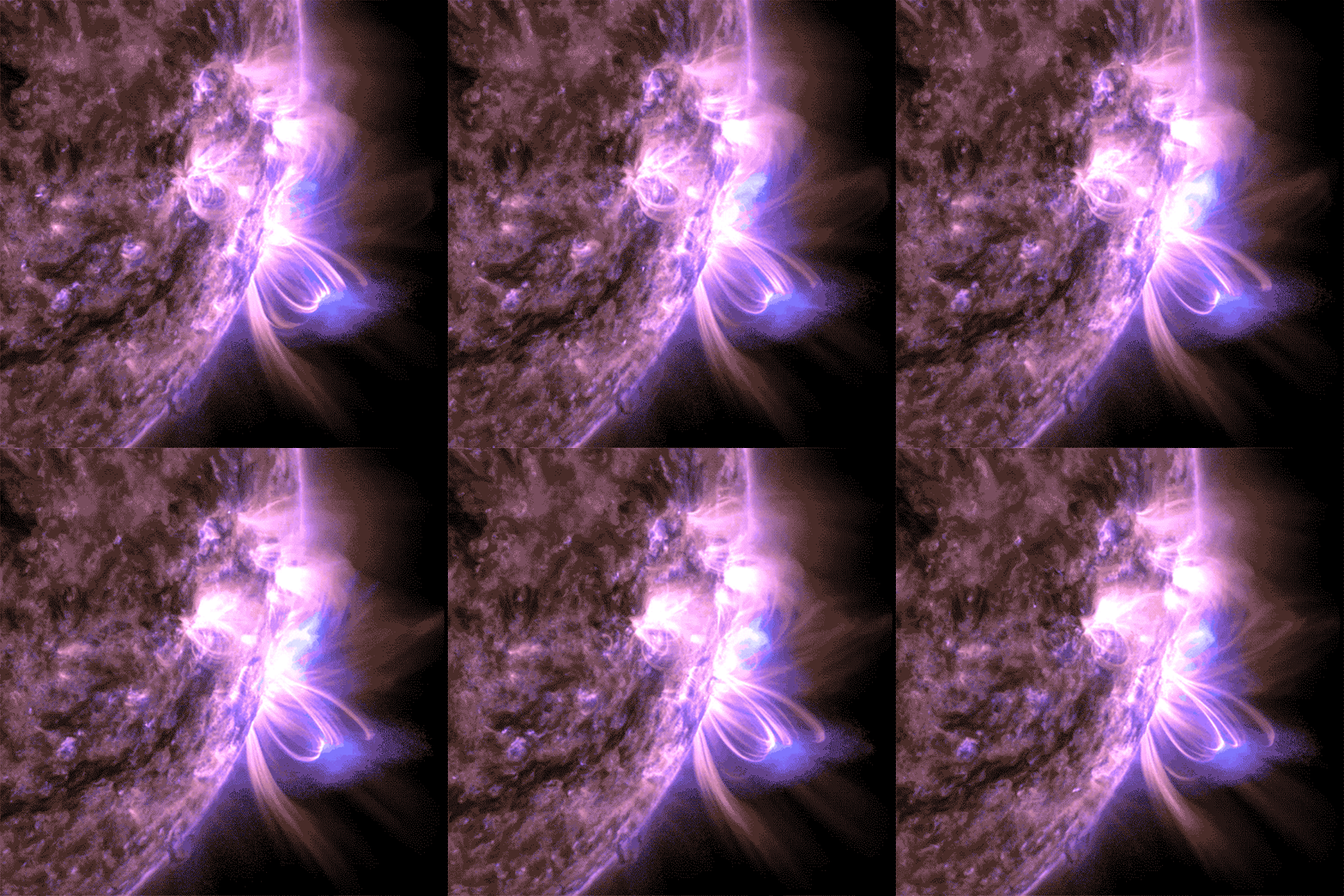
Another model takes aim at a closer celestial entity: our sun. Polymathic AI researchers are modeling the dynamics of active regions on the surface of the sun with data from NASA’s Solar Dynamics Observatory. Solar flares — electromagnetic radiation eruptions on the sun — can disrupt telecommunications here on Earth and even cause electrical blackouts. The ability to predict and prepare for these flares could help governments and businesses protect satellites and other equipment from expensive damage. Other groups have built AI models for predicting the evolution of active regions, but their accuracy drops off quickly over time, whereas the Polymathic AI model remains accurate for orders of magnitude longer, says project leader Rudy Morel. The model could have broader applications across physics for anyone who wants to make predictions on very long timescales.
The Polymathic AI team is also working on complex scientific problems at a much smaller physical scale: biological molecules. Since the Human Genome Project was completed more than 20 years ago, biologists have amassed huge datasets, broadly categorized as “-omics.” These datasets may comprise the full collection of DNA sequences, RNA levels or protein levels in a given cell or organism, among other measurements. But predicting how one type of molecule affects another (say, how a single DNA mutation could have ripple effects throughout the body) remains out of reach for many models. The first iteration of the Polymathic AI model can predict the downstream effects of any mutation and takes meaningful steps toward predicting the structures of RNA molecules, an even thornier problem than the protein structures predicted by DeepMind’s AlphaFold, says project leader Siavash Golkar.
Another group at Polymathic AI wants to understand how AI does what it does. The beauty of, and frustration about, large foundational models such as ChatGPT is that nobody understands how they work — the models’ inner reasoning is not accessible to their developers. The models are built on the backbone of linear algebra and statistical likelihood, but how they arrive at their conclusions remains mysterious. The answers to those mysteries will likely be in the language of math, Ho says.
“Can we turn these models into insight? That insight will probably be in the form of some mathematical equations,” she says. “Math is the basis of all machine learning, and ultimately of everything we’re doing. We are no longer just teaching machines to speak our language; we are teaching them to speak the language of the universe.”