Pivot Fellow Natasha Blitvic Brings Math to Marine Microbiology
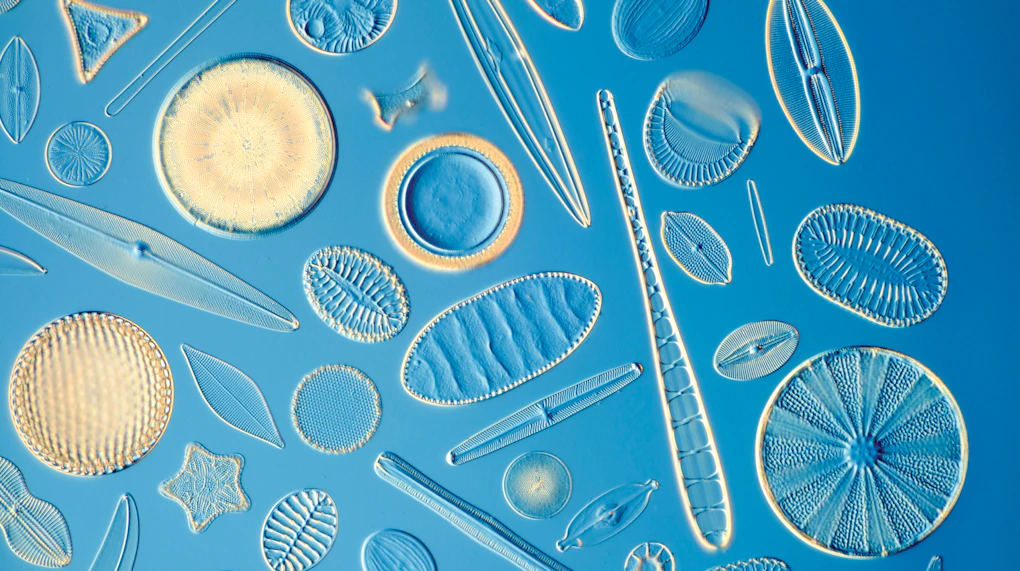
Peer into a single drop of seawater and you’ll find millions of individual bacteria, algae and plankton. Each microbe leads a busy life. Collectively, their behavior exerts an influence far larger than their microscopic size would suggest. Marine plankton account for roughly half of all photosynthesis on Earth, and by breaking down organic materials, microbes help drive the global cycling of nutrients such as carbon, nitrogen and phosphorus.
Teasing apart just how small-scale interactions between microbes influence large-scale processes is a massive question, and it’s one that cannot be answered by any one lab or even a single scientific discipline. Rather, it’s a problem that requires scientists from across fields to bring their knowledge to the task, pivoting from one field to inform another.
Mathematician Natasha Blitvic of Queen Mary University of London recently did just that, completing a 12-month term as a Simons Foundation Pivot Fellow investigating marine microbial systems. First launched in 2022, the fellowship supports researchers embarking on work in a new discipline. Shifting from one field to another can enable surprising breakthroughs, as seen in the work of famous cross-disciplinary pioneers such as physicist-turned-chemist Marie Curie and Louis Pasteur, a microbiologist who began his career in chemistry.
Still, it can be an uphill battle to learn a new field, build a community and convince funders to support your work. The Pivot Fellowship addresses these issues by having each fellow work with a mentor and by providing financial support. After a year of mentoring, fellows may have the option to apply for an additional five-year research award in their new field.
“I’m impressed with this fellowship because it’s one of the rare schemes that really understands what it means to pivot,” Blitvic says. “They’ve thought about the challenges and tried to alleviate them so you can really focus on your best work.”
Blitvic understands those challenges well. Despite a lifelong interest in math and philosophy, Blitvic initially felt she needed to pursue a degree in something with stronger job prospects. She therefore majored in engineering instead of mathematics, taking math classes on the side “for fun,” she says. Ultimately, she committed to math, earning a Ph.D. from the Massachusetts Institute of Technology in 2012 with a thesis in pure mathematics.
Today, Blitvic describes herself as a probabilist — someone who specializes in probability theory and searches for unexpected probabilistic intuition in other areas of mathematics. At its core, her work attempts to pull order from chaos based on the premise that even the most random systems have underlying drivers that mathematicians can measure and model. As an example, you can think of a coin: On any given flip, it’s impossible to know which side the coin will land on. But if you flip 100 coins, roughly half will land heads and half tails. “Randomness becomes predictable if you look at it on the right scale,” Blitvic says.
Making a Pivot
After many years as a pure mathematician, Blitvic began to feel siloed and wanted to apply her work in new ways. She started thinking about systems that could benefit from her expertise and landed on marine microbes. Around 98 percent of the ocean’s biomass is made up of microbes, yet there’s much that scientists still don’t know about their influence on ecosystems and climate. One of the challenges lies in being able to predict large-scale patterns from inherently random microscale behaviors.
For her fellowship, Blitvic partnered with Roman Stocker, a pioneering microbial ecologist at the Swiss Federal Institute of Technology (ETH) in Zürich and co-director of the Simons Collaboration on Principles of Microbial Ecosystems (PriME). Stocker and his team use experimentation to inform their modeling and bridge microscale and macroscale processing in the ocean, including the roles that microbes play in nutrient cycling, harmful algal blooms and coral disease. Having worn a few hats himself — including those of engineer, fluid dynamicist and mathematician — Stocker appreciates the value of inter-disciplinary collaboration.
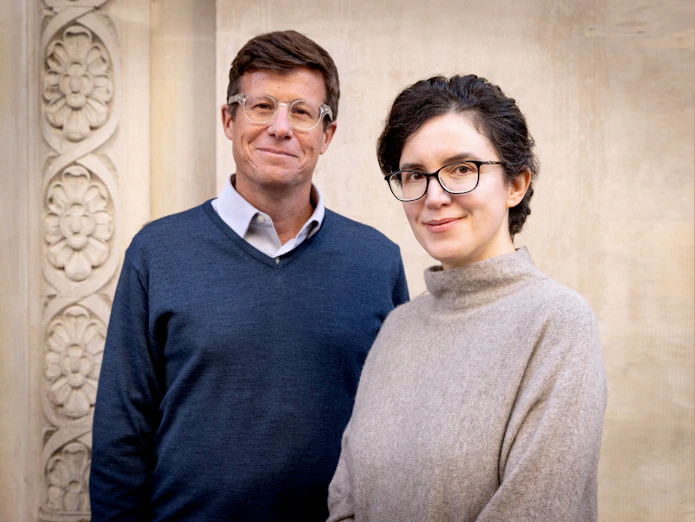
“This idea of pivoting has really defined my career, and I greatly enjoyed and benefited from committing myself to different ways of thinking,” he says. “Natasha and I share this understanding, and simply having her available for others in my group to learn from has broadened everyone’s perspective and helped us design better experiments.”
The Random Factor
Blitvic’s primary focus has been on improving the incorporation of randomness into ecological modeling. Such randomness — also called stochasticity — means that a system’s behavior is explained in part by chance, rather than being entirely predictable. Often, this randomness isn’t accounted for in models, or it’s included superficially in ways that don’t mirror the reality of microbial communities. “You can’t just brush it away,” she says. “My goal has been to introduce stochasticity into our analyses at an intrinsic level, where it’s likely to make an important difference.”
She began by developing a tailored modeling and analysis framework for analyzing the results of a field study to quantify chemotaxis, or the ability of a microbe to sense and follow chemical gradients, that Stocker’s group had collaborated on. With her probabilistic prowess, Blitvic was able to develop a stochastic model for the experiment that enabled the researchers to pull as much information out of the measurements as possible.
Later, as other members of the team came to understand the power of tailored mathematics, Blitvic was brought on to other projects, including an experiment to study how fluid dynamics can create hot spots for bacterial cells to exchange DNA when they touch, a process known as bacterial conjugation. This exchange of genetic material is one of the ways bacteria evolve — by acquiring new genes from their neighbors.
Blitvic co-led a project resulting in a model describing the foraging habits of bacteria that break down marine particles. Many bacteria specialize in feeding on these particles near the coast, where they are common. The assumption is that such bacteria should be less numerous in the open sea, where particles are scarcer. Yet the team’s research suggests that such specialists can still be found even in nutrient-poor environments because the payoff of randomly encountering a particle remains so high. The team dubbed the phenomenon “stochastic resilience” in reference to the idea that so long as some bacteria encounter a particle, the population as a whole survives.
“One of the implications we’re now able to defend is that these bacteria that forage on marine particles are significant enough that we should take them into account in global models of carbon sequestration,” Stocker says. “This is exactly the type of insight I was hoping Natasha would bring to our work.”
Scaling Up
Blitvic finished her fellowship in August 2025 and is now writing up papers and continuing to nurture the relationships she made. Blitvic has since applied to lead a Simons Collaboration — another foundation initiative that funds investigators from different disciplines to work together on a timely problem — to further her work in partnership with other notable researchers in her new field.
“What we’re proposing is really a scaling up of the pivot philosophy from an individual to a group,” she says. “We want to do science differently — as a small team, in a more integrative way, developing both mathematics and experiments in tandem based on a common language.”
Regardless of whether the collaboration becomes a reality, Blitvic says that her time as a Pivot Fellow has been a tremendous success. “I’ve been very pleased with the results this kind of approach can yield,” she says.

Examples of the incredible diversity of diatoms, microscopic single-celled algae that form a significant portion of the world’s bio-mass and produce much of Earth’s oxygen. Credit: Steve Gschmeissner/Science Photo Library

Examples of the incredible diversity of diatoms, microscopic single-celled algae that form a significant portion of the world’s bio-mass and produce much of Earth’s oxygen. Credit: Steve Gschmeissner/Science Photo Library

Examples of the incredible diversity of diatoms, microscopic single-celled algae that form a significant portion of the world’s bio-mass and produce much of Earth’s oxygen. Credit: Steve Gschmeissner/Science Photo Library

Examples of the incredible diversity of diatoms, microscopic single-celled algae that form a significant portion of the world’s bio-mass and produce much of Earth’s oxygen. Credit: Steve Gschmeissner/Science Photo Library

Examples of the incredible diversity of diatoms, microscopic single-celled algae that form a significant portion of the world’s bio-mass and produce much of Earth’s oxygen. Credit: Steve Gschmeissner/Science Photo Library

Examples of the incredible diversity of diatoms, microscopic single-celled algae that form a significant portion of the world’s bio-mass and produce much of Earth’s oxygen. Credit: Steve Gschmeissner/Science Photo Library
Examples of the incredible diversity of diatoms, microscopic single-celled algae that form a significant portion of the world’s bio-mass and produce much of Earth’s oxygen. Credit: Steve Gschmeissner/Science Photo Library