Quanta Books Opens a New Chapter in Science Publishing
Your typical overworked editor considering an idea for a book about a programming language for mathematicians could be forgiven for relegating it to the bottom of the bin. But for those in the know, the story of Lean is a must-read saga centered on a group of mathematical evangelists bringing about a revolution in the field.
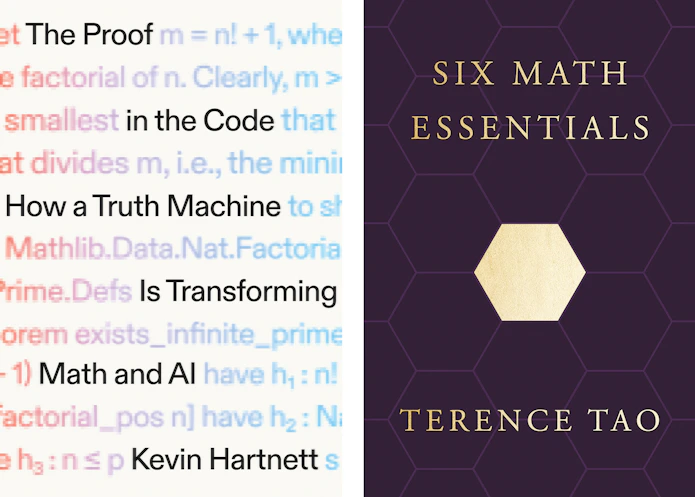
While other publishers might have missed out, a new player in the publishing world, Quanta Books, brings this and other compelling stories in math and science to life for its readers. Its first book, The Proof in the Code, will cover the history and future of Lean and is scheduled for release in June 2026.
“All important scientific discoveries have an inherently dramatic story behind them: There’s always a challenge, there’s always people struggling for a long time, and there’s the conflict that the problem has to be solved,” says Thomas Lin, publisher of Quanta Books, an editorially independent subsidiary of the Simons Foundation. “We never try to avoid what’s actually interesting about the science. That’s the key for us.”
That niche of explaining modern science and math research is one that Lin is particularly suited to fill: The book imprint shares DNA with Quanta Magazine, for which Lin served as founding editor-in-chief. Leveraging the Quanta Books team’s editorial expertise and Quanta Magazine’s dozen years of experience with its science-loving audience, the imprint will craft approachable books that serve as canonical references for their subject matter.
“We want to make things seem more approachable, because these are difficult subjects,” says Lin. “Math is hard for most people, and certainly, areas of theoretical physics can seem inaccessible. We want to be that bridge for people. Ultimately, we want to create the definitive popular book on a subject.”
Lin has led the launch of several publishing initiatives at the Simons Foundation. In 2012, he started an online science news publication, which expanded into Quanta Magazine in 2013 under the oversight of foundation co-founder Marilyn Simons. Today, the award-winning magazine reaches millions of readers and employs over a dozen seasoned science writers. In 2022, it won a Pulitzer Prize for staff member Natalie Wolchover’s 10,000-word feature chronicling the James Webb Space Telescope.
Starting a book imprint “made sense from my perspective, building on what I’ve learned at the magazine in terms of telling amazing stories about science and math and which ones might be worth a book-length project,” Lin says. “The audiences that we were able to draw to the magazine gave me a good sense of the opportunity for producing and marketing books about basic fundamental science and mathematics intended for a popular audience.”
Carrying high expectations from his experience at Quanta Magazine, Lin began laying the groundwork for Quanta Books in late 2022. He officially left the magazine in April 2024 in the capable hands of its new editor-in-chief, Samir Patel, and made the imprint’s first hire, Senior Editor Tisse Takagi.
Quanta Books employs a secret weapon: unusually hands-on relationships with editors. The imprint will publish three to five books a year. Takagi contrasts that with “most editors at trade houses who have to work on 10 to 12 books a year.” By partnering with the 80-year-old publisher Farrar, Straus and Giroux, the imprint can focus on content, with the larger publishing house handling marketing, distribution and production.
"Math is hard for most people, and certainly, areas of theoretical physics can seem inaccessible. We want to be that bridge for people. Ultimately, we want to create the definitive popular book on a subject.”
Thomas Lin, publisher of Quanta Books
“We can devote a lot of attention to the authors and develop a partnership while the author is writing the book instead of sending them off to draft the entire thing on their own and then engaging in a long editorial process,” says Takagi, who has been in the book business for almost 20 years. “The Simons Foundation’s support allows us to really focus and spend time on the thing that matters, which is making each manuscript and each book as good as it can be.”
For The Proof in the Code, which will be released in June 2026, Lin and Takagi worked closely with author Kevin Hartnett, providing feedback on each successive chapter during biweekly meetings. From concept to final draft, Hartnett, a veteran math journalist, wrote the book in just 18 months, taking it on in his free time.
“The book would not exist without Quanta Books,” says Hartnett, who worked at Quanta Magazine as a freelancer, staff writer and then staff editor from 2015 to 2022. “I would remain someone who had aspirations to write a book but hadn’t done it. That changed when Tom called me and said, ‘I’m starting Quanta Books. I want you to write the first book, and it should be about Lean.’”
Quanta Books creates unique books by encouraging first-time book authors or assigning niche topics (or, in Hartnett’s case, both). For instance, one day at the foundation, Lin pitched an idea for a short book to prominent mathematician Terence Tao. Lin bills Six Math Essentials, coming out in October 2026, as a “very friendly introduction to the main areas of math.”
“It’s the perfect combination of having essentially the world’s foremost mathematician, who’s a genius, writing at a level that anybody can understand,” Lin says about the forthcoming book, whose six chapters focus on numbers, algebra, geometry, probability, analysis and dynamics. “In a way, it’s about him welcoming people [to the math community] and his belief that everybody has some innate math ability, but some people get turned off for various reasons.”
Welcoming possibly reluctant readers to math and science aligns perfectly with the Quanta Books mission. In early 2027, it will publish Everything Is Fields by physicist David Tong, on quantum field theory. Lin teases that future years’ book slates include titles on astronomy, geology and biology.
“You hear a lot of people say, ‘I became a scientist because I read Stephen Hawking’s A Brief History of Time when I was a kid’ or ‘I became a scientist because I read [Richard Dawkins’] The Selfish Gene,’” says Takagi. “Books capture your imagination in a way that other media can’t. You can tell people a bunch of facts about science and hope they stick, but if you learn those facts through a really engrossing, evocative story, then you’re much more likely to remember it and to be moved by it and for it to change your view of the world.”