The Twisted Mathematics of Richard Schwartz and Möbius Bands
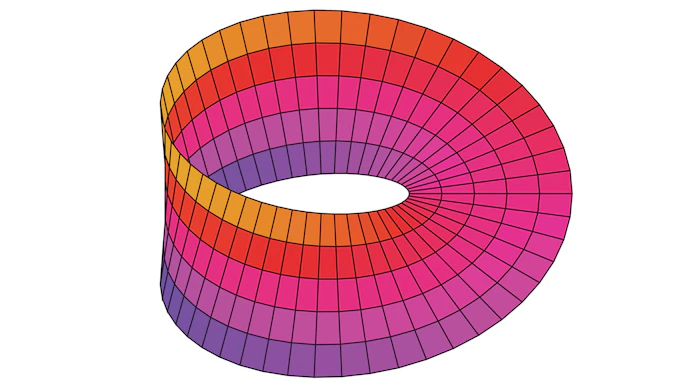
Take a rectangular strip of paper, give it a half twist and connect its short ends to each other. You have made a Möbius band, also known as a Möbius strip or loop. It is a familiar staple of recreational mathematics and a simple illustration of the mathematical concept of nonorientability. (That is, it has no universal ‘up’ or ‘down’ direction.) Plus, it’s just fun to play with.
If you start with a long, skinny strip of paper, it’s easy to make a Möbius band. With shorter strips, it gets harder to twist and connect the ends. You’ll eventually hit the point where you physically can’t make a Möbius band because the ratio between the length and width is too low. There is a clever folding pattern that produces a Möbius band from a strip of paper with an aspect ratio of the square root of 3 (around 1.73) to 1. Even though this construction has been described in papers since as early as 1930, no one was able to prove that it was impossible to twist a strip with a smaller aspect ratio into a Möbius band.
When Richard Schwartz heard about the conundrum, he asked himself, “What’s so hard about this problem? I could do this.” Schwartz is a math professor at Brown University and four-time Simons Fellow in Mathematics with broad interests, from geometry and topology to writing colorful, mind-bending children’s books about math.
His first instinct when faced with the Möbius strip question was to model it on the computer. That exploration gave him some immediate gratification, an improvement on what were then the best-known bounds of the problem based on an argument that involved cutting the Möbius band along a particular set of lines. When he first programmed it into the computer, he erroneously assumed those cuts left him with a parallelogram. “There followed three years where I was trying to push this argument further using the parallelogram idea,” he says. His chain of reasoning kept getting more complicated, but the bound never budged. Finally, he started playing with a paper model. “I cut one open, and oh my God, you get a trapezoid.” The entire parallelogram argument evaporated, taking with it his original improvement.
While he was trying to correct his earlier erroneous paper, he realized, “When I did the calculation right, it solved the whole conjecture.” In just a few days, he was able to prove that the square root of 3 to 1 is indeed the lower limit of aspect ratios for a Möbius band. He circulated his proof among some other interested mathematicians and, with their feedback and improvements, “it got to be a razor-sharp argument,” he says. “I’m thrilled with it.”
The optimal Möbius band is the answer to a problem of geometric optimization. Such problems ask, given certain geometric constraints, what the limits are of the shapes that fit those constraints — for instance, the smallest or the largest. The questions are often natural and intuitive (such as identifying the widest Möbius strip), but actually proving that a particular shape is optimal can be fiendishly difficult. Schwartz’s misadventure among the specious parallelograms illustrates the combination of playfulness and tenacity that allows him to latch on to these curiosity-driven questions and see them through to the end.
During a trip to the Institut des Hautes Études Scientifiques (IHES) outside Paris during his 2024–2025 Simons Fellowship, Schwartz turned his attention to another geometric optimization problem involving a well-known shape: an origami-like folding of a flat surface into a torus. A torus is the mathematical name for the shape of an inner tube or the layer of glaze covering a doughnut. The term refers to the shape topologically: That is, the shape can be stretched, twisted and deformed and, so long as it isn’t torn or glued, still be called a torus.
A flat torus is a representation of the torus as a square, or any parallelogram, with opposite sides ‘identified.’ That is, the sides behave like the sides in the classic arcade game Asteroids. When the user-controlled spaceship travels off the right side of the screen, it reappears on the left side, continuing in the same direction. Just as in the game, the sides of the flat torus are linked.
If you actually sat at your desk, took a square of paper and taped the edges together to realize that flat torus in three-dimensional space, it wouldn’t be smooth and pretty like an inner tube — it would be folded or crumpled in some places. The smooth surface of an inner tube requires the stretching of rubber. A flat torus can’t fit in three-dimensional space in a smooth way without distortion, but if you allow some folding, you can do it.
Your first attempt at making a flat torus out of paper will probably look randomly crumpled. A natural mathematical question is whether there is a flat torus that is ‘best’ in some way. Schwartz was specifically interested in origami flat tori, which are formed by fitting flat triangles together in three-dimensional space so that the total angle around every point — including the vertices where the triangles intersect — is 360 degrees, the same as in a full circle.
Schwartz sought to find origami tori with the fewest vertices possible, a challenge known as the minimum-vertex problem. He had heard about the problem years ago from colleagues, and conversations he had during his fellowship visit to IHES rekindled his interest in the problem. Previous research had established that any such torus must have at least seven vertices and had produced examples with nine. Schwartz set to work proving that nine vertices was the smallest number possible. First, he demonstrated that no seven-vertex triangulation could work, using computer modeling to explore the space of possible configurations of seven points and employing arguments from projective geometry and combinatorics to reduce the total number of cases to be examined.
“I don't know how to solve it. But if I don’t try to solve it, then it’s 100 percent guaranteed I’m not going to solve it.”
Richard Schwartz
When he tried to extend his arguments to eight vertices, though, he kept failing. He reduced millions of cases to thousands but couldn’t narrow them down further. “It just wasn’t quite working,” he says. “At some point, my brain switched.” He began to wonder whether an eight-vertex torus might be possible after all. He ran some experiments and eventually settled on a supervised machine learning approach to find triangulations that could work. After that, it took more work to show that the potential triangulations, which involved numerical approximation, actually yielded honest-to-goodness flat tori. When all the numbers worked out, he ended up with a family of eight-vertex tori he calls ‘pup tents’ because of their squat shape.
These pup tents are not intended for the shelves of camping goods stores, nor are they likely to have any other practical use. “I just like to play around,” Schwartz says. But behind that play are serious questions about the limits of human imagination and understanding. Mathematics is riddled with problems that are simple to state and nearly impossible to solve. When he runs up against one of these questions, he thinks, “We humans ought to be able to answer this question, and we can’t. That means that there’s some idea that we’re missing.”
The quest for the proof of one of these deceptively difficult problems continues to drive Schwartz, whether it’s a twisted piece of paper, an origami doughnut or something else. For many years, he has had his sights set on the square peg problem, “like Ahab looking for the whale,” he says. That problem asks whether every curve that reconnects with itself in a closed loop without crossing over itself has four points that form the corners of a square. “I don’t know how to solve it,” he says. No human has yet looked at the question in quite the right way. An elegant solution could be right around the corner or never found in a thousand years. “But if I don’t try to solve it, then it’s 100 percent guaranteed I’m not going to solve it.”