Nour Al Hassanieh: Using Wave Dynamics to Improve Medical Imaging
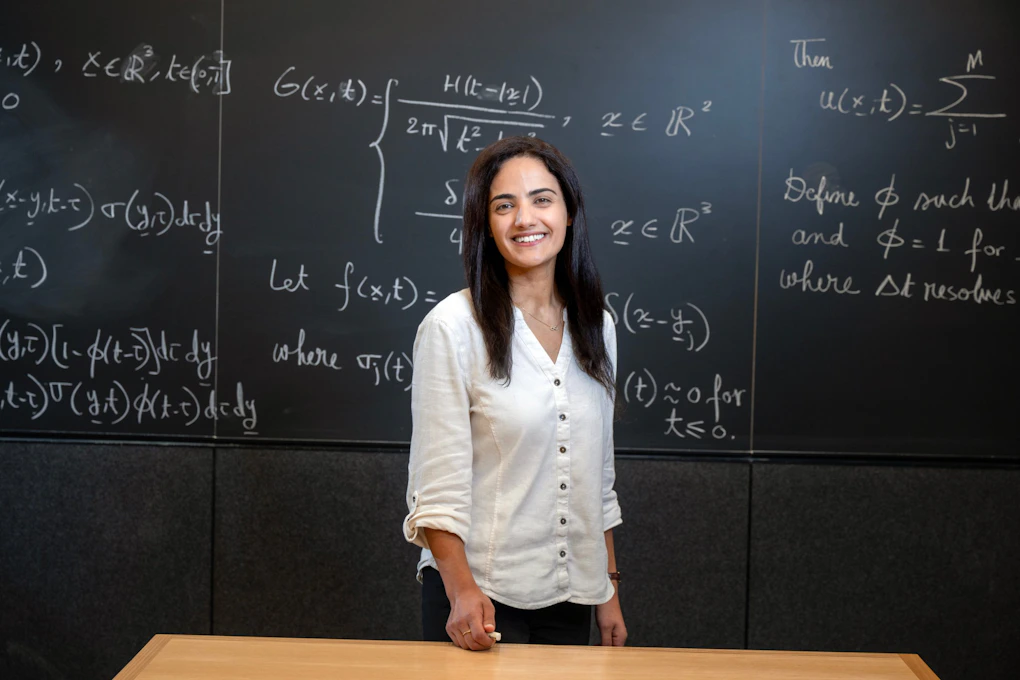
Sound, light and water waves all move through space dynamically, and their behavior can be difficult to predict in advance. Over time, mathematicians have developed equations to capture complex wave dynamics, but solving these equations remains challenging.
Nour Al Hassanieh, who will soon complete a three-year position as a Flatiron Research Fellow, develops computational methods to solve wave equation problems on complex geometries. Al Hassanieh works at the Simons Foundation’s Flatiron Institute and New York University’s Courant Institute. She holds a doctorate in mathematics from Rensselaer Polytechnic Institute, a master’s degree in mathematics from the American University of Beirut and a bachelor’s degree in mathematics from Haigazian University in Beirut.
Al Hassanieh recently spoke with us about her time at the Flatiron Institute’s Center for Computational Mathematics, how her work could advance acoustic engineering and medical imaging and what she plans to do next.
What are wave equations?
Wave equations describe how waves — sound waves, light waves, water waves — move through some medium. The equations track how waves propagate over time.
During my doctorate, I developed algorithms to solve wave equation problems on relatively simple geometries. When I came to the Flatiron Institute, I was interested in designing fast algorithms to solve wave equation problems for more complicated geometries. For the first two years of the fellowship, I was also a math instructor at the Courant Institute; during this final year, I am at Flatiron full-time.
What are the properties of the algorithms you develop to solve these equations?
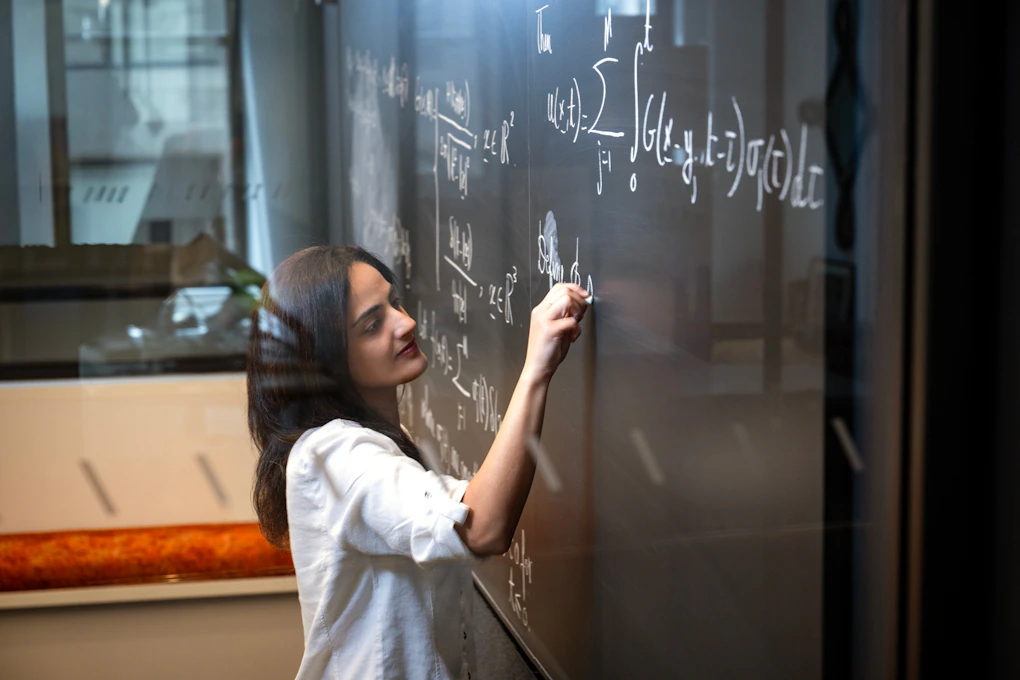
Our goal during the Flatiron fellowship is to develop algorithms that are efficient, accurate and stable — that is, not overly sensitive to small changes in the data.
In mathematics, we have continuous objects with no breaks. For example, a line is one such continuous object.
To a computer, a line is a cluster of points pushed together. To solve wave equation problems with computers, we need to discretize the different parts of the equations — essentially, to express continuous objects as discrete points so they can be represented on a computer. The more discrete points we use, the lower the expected computational error. Sometimes, though, the error the computer introduces when representing numbers, called roundoff error, can compound, yielding wildly inaccurate solutions. A good computation is one that is consistent (meaning that its error decreases steadily with more discrete points) and stable (meaning that the error in the computed solution remains controlled despite roundoff errors).
How far along are you on that path?
I’d say we are quite far along. We are now working on final fine-tuning before presenting this algorithm for solving wave equation problems. With my mentors Alex Barnett and Leslie Greengard, I am working on simulating acoustic wave scattering.
When an acoustic wave travels through space and bounces against an obstacle, the wave is scattered in a way that depends on the obstacle’s shape and its material properties. With fast and accurate simulation of wave scattering, we can infer the shape and type of this obstacle — knowledge that could improve the development of medical imaging tools, for example.
Alex and Leslie’s mentorship has been essential. I’ve learned to write better code and to identify the strengths and weaknesses of different computational approaches. We’ve chosen to use a computational approach known as the boundary integral method to do our work, but other approaches exist that I may explore eventually.
How could engineers utilize the code you’ve developed to build sound systems or medical imaging tools?
Eventually the code I develop will be publicly available in a library for others to use. I use the coding tool MATLAB to write code; this is a proprietary program that some people do not have. That said, many artificial intelligence tools today can translate code from one coding language to another. And the Flatiron Institute has excellent software engineers who help build libraries that support different languages. So I am confident my work will be accessible.
What drew you to this branch of mathematics?
Starting from an education focused on pure mathematics, I was not particularly interested in practical applications of my work.
Then I taught high school mathematics for a few years and noticed that my students were more drawn to practical uses of math. This shifted my own thinking toward applied mathematics.
At the start of my Ph.D., I planned to investigate the mathematical modeling of the growth of cancerous tumors, which researchers can use to develop targeted treatments. Early on in my doctoral work, I attended an excellent talk on wave dynamics and the intricacies of solving wave equations. That set me on my current path, which also has practical applications.
Besides your research at Flatiron, you have been involved in Simons Foundation community outreach initiatives. Please describe those efforts.
I have been involved in some activities with the Science, Society & Culture team at the Simons Foundation. The activities I participated in aim to demystify mathematics and explore its beauty. For example, as part of the Infinite Sums initiative, I presented a general audience talk on my research at the Brooklyn Public Library’s Pi Day Night in the Library event on March 14, 2026.
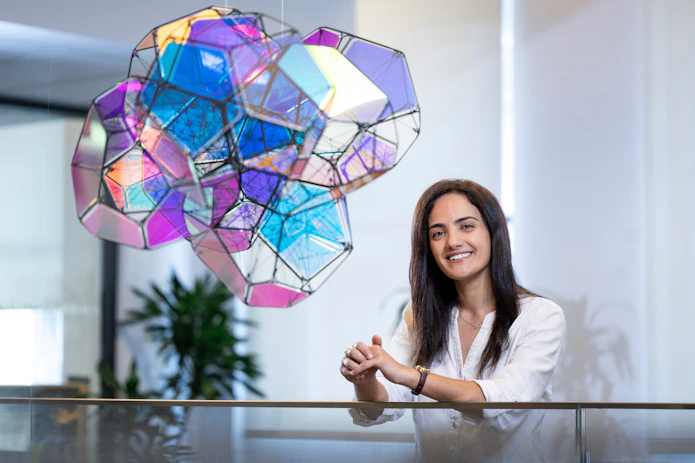
The Science, Society & Culture team also connected me and a few other scientists with artists to inspire a public art project in the Flatiron NoMad District. I also gave a presentation on why I chose mathematics to museum partners of the Simons Foundation as part of the Meaningful Math: Museum and Community Partnerships Program.
What comes next?
This fall, I’ll become an assistant professor at the American University of Beirut. Lebanon is my home, and I have been away for 10 years. It will be good to go home. I look forward to teaching again and to mentoring students.
There will still be many chances to collaborate with my Simons colleagues, whether via weekly webinars or at conferences. In some ways, this is a life’s work: Solving wave equation problems accurately and efficiently is a classic mathematical challenge that has existed for a long time.
Fortunately, it’s a challenge I really enjoy. We tried one method to simulate acoustic scattering at Flatiron, but there are others. What would happen if I tried a different method? How would solving the equations become easier? Or harder? These are fascinating questions that interest me.


