Neuron Stimulation Improves Symptoms in Mouse Model of Huntington’s Disease
Stimulating certain neurons in the brain may help improve Huntington’s disease symptoms, a new study in mice suggests.
Huntington’s is a hereditary neurodegenerative disease with no known cure. It causes nerve cells to decay, disrupting brain circuits. As the disease assaults the brain’s motor system, the neurodegeneration causes a loss of muscle control.
An international team of neuroscientists wondered if they could rebalance these damaged neural circuits. In a mouse model of Huntington’s disease, the researchers stimulated specific brain cells near the damaged ones within the circuits. This stimulation caused the motor cortex to function more normally, enabling the mice to learn new motor skills and improving their behavioral symptoms for days. The researchers report their findings in the July issue of Nature.
The new work points to a potential therapeutic target for Huntington’s disease, says Takaki Komiyama of the University of California, San Diego, who co-led the study and is a member of the Simons Collaboration on the Global Brain.
“We think this is a knob the brain can turn to promote learning, and our intervention is helping the brain do it in a healthy way,” Komiyama says. “Even if it’s not the primary cause [of Huntington’s disease], it’s a good intervention point.”
Komiyama co-led the work with Irina Dudanova of the University of Cologne.
Looking Beyond the Usual Suspects
Huntington’s disease is caused by mutations in the gene encoding a protein called huntingtin, resulting in a misfolded protein. As the disease progresses, mutant huntingtin proteins form clumps inside neurons in the motor system, killing the cells. People with the mutation gradually lose muscle coordination and develop involuntary spasms, speech impairments and cognitive problems.
Most research on Huntington’s disease has focused on protecting the neurons that are directly killed by mutant huntingtin. But Dudanova and her postdoc Sonja Blumenstock suspected that additional neural circuits might play a role in causing the disease’s symptoms.
“In neurodegenerative disorders, not all neurons suffer equally, and not all die,” Dudanova says. “But some are affected in different ways.”
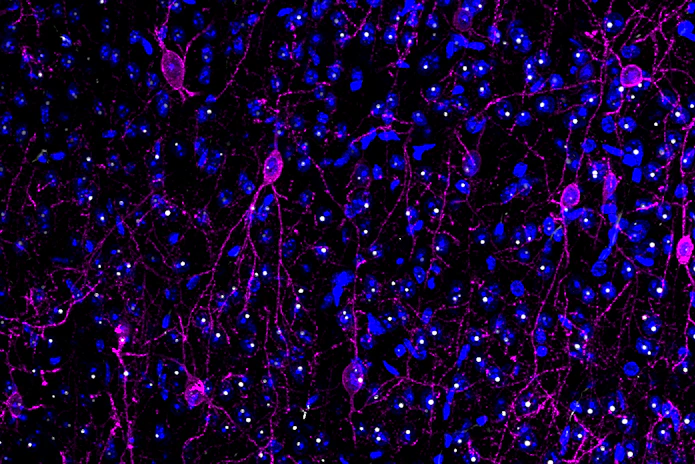
Blumenstock’s previous research in Dudanova’s lab at the Max Planck Institute for Biological Intelligence had homed in on cells called vasoactive intestinal peptide (VIP) neurons — a type of inhibitory neuron that blocks other cells in its circuit from firing. Clumps of huntingtin don’t typically kill VIP neurons. But when the researchers looked at the brains of mice genetically engineered with the same mutation that causes Huntington’s disease in humans, they found that VIP cells produce an unusual collection of proteins and don’t fire in their normal patterns. This suggested that the disease might have a more subtle, indirect effect on VIP neurons’ function.
VIP neurons’ usual role is to help the brain learn new tasks and maintain attention. By regulating a variety of neural circuits, they maintain a ‘learning-permissive’ state in the brain. As Huntington’s disease progresses, some people develop cognitive problems alongside motor deficits, leading the researchers to wonder whether their brains could be stuck in a state that prevents learning. Knowing that VIP neurons are involved in learning, Blumenstock says, “we basically put one and one together and said, maybe if we help these neurons function more normally, we can promote learning again.”
Rewiring the Brain
Blumenstock and Dudanova teamed up with Komiyama’s lab to study VIP neurons in mice with huntingtin mutations. These mice develop movement problems similar to those seen in people: dragging their hind legs, struggling to grip the rungs of a ladder and twitching involuntarily.
To test their hypothesis, the researchers added a light-reactive protein into VIP neurons that triggers them to fire. The researchers could flash a light to activate the VIP neurons, which in turn prevented other neurons in the circuit from firing.
Over the course of three weeks, the researchers trained their mice to walk on the outside of a motorized ladder wheel without losing their balance or slipping between its bars. It’s a difficult task for any mouse to learn, Blumenstock says, but it proved especially hard for those with the huntingtin mutation.
“In neurodegenerative disorders, not all neurons suffer equally and not all die. But some are affected in different ways.”
Irina Dudanova, University of Cologne
However, the researchers found that if they switched on the laser at regular intervals to stimulate VIP neurons, the Huntington’s mice could learn how to walk normally on the wheel. Mice that received this stimulation during learning improved at the task over time, even when the laser was switched off, and their performance rivaled that of mice without the huntingtin mutation. When the researchers looked more closely at the animals’ brain activity, they found that other types of neurons in the motor cortex were firing in a normal pattern as compared to those in animals that hadn’t received stimulation.
Komiyama thinks that restoring VIP neurons’ normal function might allow the brain to compensate for its flagging motor skills by creating new wiring patterns that work more normally despite the disease.
Moving Into Humans
Because the method requires inserting light-reactive proteins into an animal’s brain, it can’t currently be applied to humans with Huntington’s disease. But the researchers say that it might eventually be possible to activate VIP neurons through another method, such as electrical or sonic stimulation.
“For human patients, even a partial rescue [of normal function] would be very good,” Dudanova says.
Since the treatment doesn’t target the cause of Huntington’s disease, it’s not yet clear whether stimulating VIP neurons affects disease progression. Galvanizing healthy brain circuits over time and providing a person with new ways to learn and adapt, Blumenstock says, might slow the disease, and she plans to investigate this in the future.
The researchers also want to test whether combining stimulation with treatments such as gene therapies that directly target huntingtin could improve symptoms further. They will also study whether similar rewiring could have therapeutic potential in other neurodegenerative disorders.
“We’re really hoping this could be a generalizable intervention,” Komiyama says.


