Sofía Landi Builds a Brain Map of What Matters
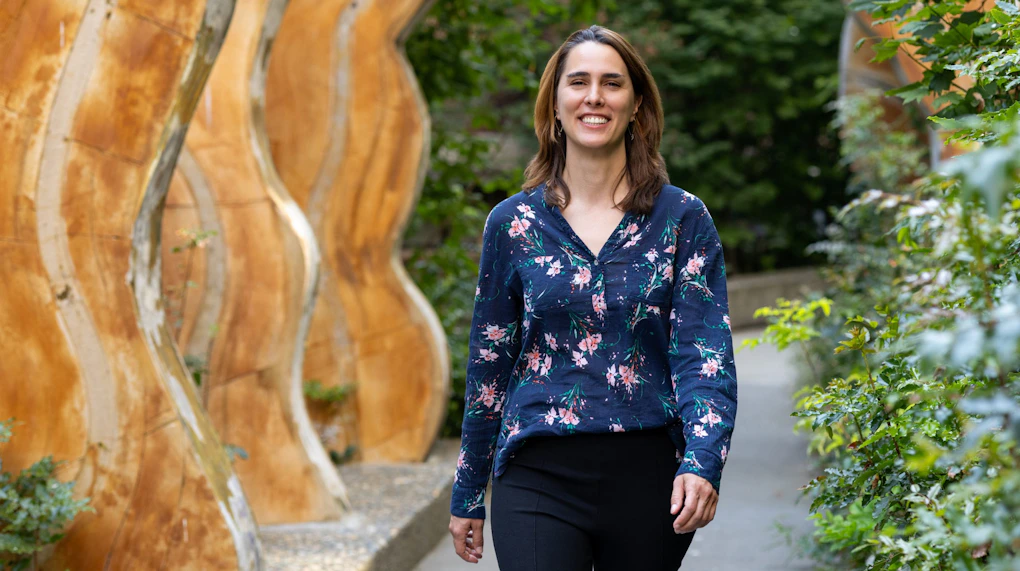
When walking her roommate’s dog in New York City, Sofía Landi, a postdoctoral fellow in the lab of Elizabeth Buffalo at the University of Washington, noticed something funny. One day, the dog came across a slice of pizza on the ground, and on every walk after that, the dog dragged her back to the same street corner.
“He had learned a map of the streets of New York, but he also learned a map of what matters in those streets,” Landi remembers.
Our brains build maps of the world around us all the time through the firing patterns and dynamics of our neurons. But not every detail can make it into those maps. So how does our inner cartographer decide what to prioritize and what to skip?
To answer that question, Landi developed a virtual reality foraging task for monkeys to study how the primate hippocampus encodes value. She found that the hippocampus does not passively map environments. Instead, location-tracking hippocampal “place cells” fire only when it matters for the task. As the monkeys learned to prioritize high-value foraging locations, their neural populations shifted from processing a task separately from its reward to forming an integrated, distinct representation of both the task and its specific value.
“The primate hippocampus is not a static spatial map,” Landi says. “It encodes space when it matters, and value structure emerges with learning in a context-dependent way.”
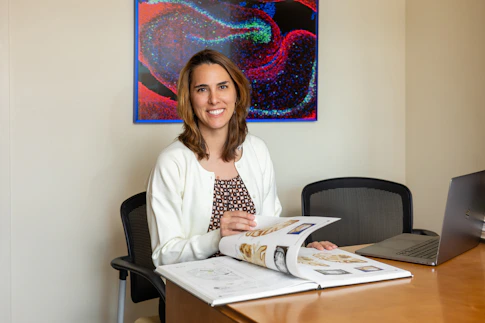
She is using high-resolution Neuropixels probes, which can track hundreds of neurons at once. But knowing how many neurons you are listening to matters as much as knowing where they sit. By identifying electrical signatures that mark specific hippocampal layers, she built a way to place recordings within the circuit’s anatomy, which is a prerequisite for asking how signals move through it.
Landi is a member of the Fellows-to-Faculty program, which supports standout early-career scientists in pursuit of tenure-track or equivalent faculty positions. Her work aligns with the Simons Collaboration on the Global Brain (SCGB), which explores how brain circuitry gives rise to perception and action.
Landi’s award will help her transition to launching her own lab, where she hopes to understand how brain circuits linking vision and memory support our ability to recognize people and attach meaning to what we see. For example, if a participant in a virtual reality environment encounters a character that consistently helps them, does their brain form memories about that character differently than if it’s antagonistic? And does that same pattern hold if the character has an icon instead of a face? This research could eventually help explain how this social memory circuitry breaks down in neurodegenerative diseases such as Alzheimer’s.
“One of the most useful things I got out of the Fellows-to-Faculty community was simply connecting with other people in that same, oddly lonely stretch of the scientific career: finishing a postdoc, staring down a round of faculty applications and then actually starting a lab,” says Landi. Other fellows who were slightly further along in their journey were especially helpful to Landi, she says, often offering what they had learned from their own experiences. “That kind of candid, in-the-trenches advice is hard to get anywhere else.”


