Archives: Events Archives: Events

Views Navigation

Event Views Navigation

Today

2014 MPS Annual Meeting

Thursday, October 23rd – Friday, October 24th, 2014 Download the 2014 Annual Meeting booklet (PDF). The Simons Foundation Division of Mathematics and Physical Sciences (MPS) held its second Annual Meeting on October 23 and 24, 2014. MPS-supported scientists were invited to the foundation to meet, share ideas and hear talks representing the spectrum of MPS-supported...
MoSAIC Math + Art Festival

Columbia University, Columbia Secondary School 425 W 123rd St between Amsterdam & Morningside Ave., New York, NY, United States

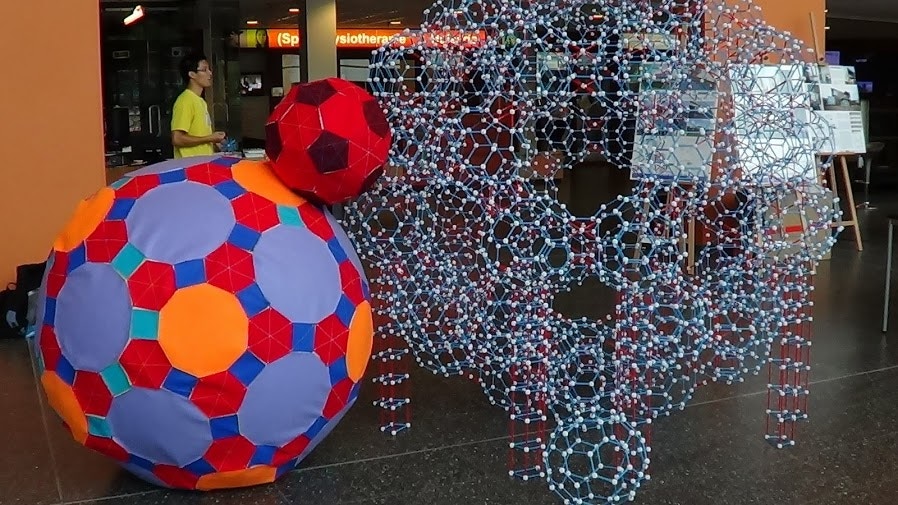
The MoSAIC Festival includes a variety of hands-on workshops, lectures, a mathematical art exhibit, short films and an area for informal exchange. It is designed to be easily accessible to audiences high-school age and up.

MEG/EEG Part 1: Acquisition, Modeling and Localization

Gerald D. Fischbach Auditorium 160 5th Avenue, New York, NY, United States

MEG and EEG Signals and Their Sources: Insights from Physics, Physiology and Anatomy Matti Hamalainen, Massachusetts General Hospital Understanding the biophysics and physiology underlying the generation of detectable extracranial magnetic fields and electric potentials is of prime importance for correct interpretation of magnetoencephalography (MEG) and electroencephalography (EEG) data. Matti Hamalainen will discuss the neural sources of...

Belief Propagation Algorithms with Applications to Cancer Genomics

Gerald D. Fischbach Auditorium 160 5th Avenue, New York, NY, United States

In this talk, Christian Borgs will give an introduction to belief propagation, discuss how the accuracy of belief propagation has been rigorously established, and present recent applications to systems biology.

Topology and Complexity

Topology, the "rubber sheet geometry", studies properties that do not change when objects are pulled and stretched. Accepting somewhat fuzzy input, it is the part of mathematics typically applied when qualitative conclusions are reached. However, it has a quantitative aspect important in understanding singularities, and potentially, high-dimensional noisy data and aspects of large-scale geometry of networks. Prof. Weinberger will discuss a variety of phenomena that arise or are illuminated by tracking of the complexity of geometric constructions.

December 3, 2014: Learning to Move

Basic motor skills such as looking, reaching and walking do not simply appear as the result of maturation. Rather, infants must learn to move. Learning entails discovering new forms of movements to suit the task at hand and using perceptual information to select and modify movements adaptively.

Learning to Move

Gerald D. Fischbach Auditorium 160 5th Avenue, New York, NY, United States

Basic motor skills such as looking, reaching and walking do not simply appear as the result of maturation. Rather, infants must learn to move. Learning entails discovering new forms of movements to suit the task at hand and using perceptual information to select and modify movements adaptively.

Why Prove Theorems?

Since at least the time when it was understood that the circumference of a circle is pi multiplied by its diameter, the applications of mathematics have raced on far ahead of the foundations of the subject itself. By considering a variety of examples, principally from the 19th century, we will explore the tension between mathematics and its applications, and reasons why it remains a valuable and rewarding occupation to develop the necessary framework for existing and “well understood” theories.

MEG/EEG Part 2: Analysis, Application and Interpretation

Gerald D. Fischbach Auditorium 160 5th Avenue, New York, NY, United States

Speakers: Jonathan Simon, University of Maryland Timothy Roberts, Children's Hospital of Philadelphia Jonathan Winawer, New York University   https://vimeo.com/117625451 Signal Analysis Primer and Applications Jonathan Z. Simon, University of Maryland Modern cognitive neuroscientists using electrocorticography (ECoG), MEG and electroencephalography (EEG) are under substantial pressure to use advanced signal processing and analysis techniques, but typically receive...


privacy consent banner

Privacy preference

We use cookies to provide you with the best online experience. By clicking "Accept All," you help us understand how our site is used and enhance its performance. You can change your choice at any time here. To learn more, please visit our Privacy Policy.
Advancing Research in Basic Science and MathematicsSubscribe to our newsletters to receive news & updates

privacy consent banner

Privacy preference

We use cookies to provide you with the best online experience. By clicking "Accept All," you help us understand how our site is used and enhance its performance. You can change your choice at any time here. To learn more, please visit our Privacy Policy.