Gravitational Wave Astronomy

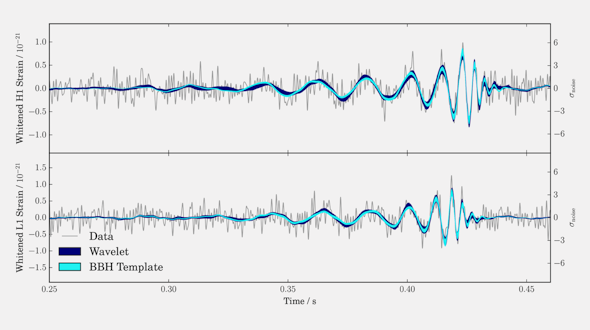
Graphs of recovered gravitational waveforms. The dark band shows estimates for the waveform without assuming a particular source. The light bands show results if we assume it is a binary black hole (BBH) as predicted by general relativity. They match really well

Since the first detection of gravitational waves in 2015, gravitational-wave astronomy has matured into a fast growing field with far reaching implications for physics and astronomy. As of LIGO-Virgo-KAGRA's fourth observing run there are over 300 likely gravitational waves detected to date. We now routinely observe mergers of black holes and neutron stars, which continue to expand our view of the extreme physics in those compact objects, as well as the lives and deaths of the stars from which they formed. Gravitational waves and their counterparts are also a promising tool for cosmology. Our discovery potential continues to grow with improving detectors.

The gravitational-wave astronomy group at the CCA is helping shape this rapidly evolving field, using gravitational waves to probe physics, astrophysics and cosmology. We are involved in the detailed modeling of the formation and emissions (gravitational and otherwise) of sources of gravitational radiation, the development of sophisticated analysis methods for extracting and characterizing gravitational wave signals from noisy detector data streams, and the application of cutting-edge statistical techniques to characterize the population of gravitational wave sources, relating them to existing models and observations of stellar populations. Our interests span all sources of gravitational waves, being LIGO-Virgo-KAGRA, LISA or pulsar-timing sources.

News & Announcements

Leadership

Group Members

Advancing Research in Basic Science and MathematicsSubscribe to Flatiron Institute announcements and other foundation updates

privacy consent banner

Privacy preference

We use cookies to provide you with the best online experience. By clicking "Accept All," you help us understand how our site is used and enhance its performance. You can change your choice at any time here. To learn more, please visit our Privacy Policy.