Pi Day Festivities Highlight the Beauty in Mathematics
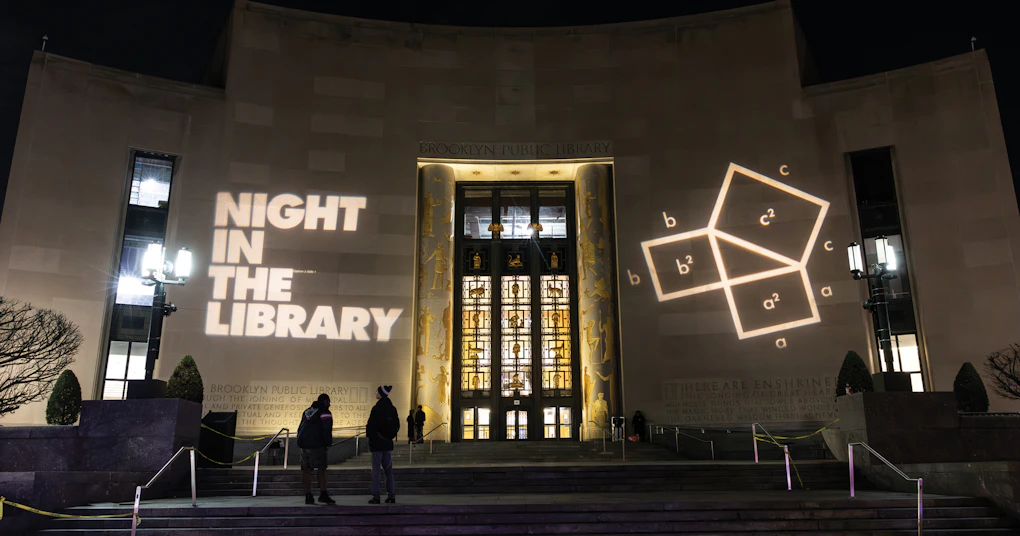
“Mathematicians are fascinated by the same questions that I am: questions of deep patterns, inner landscapes, structures inside truth, and the ecstasy and illumination that come with understanding, all of a sudden, things that have been hidden,” filmmaker Werner Herzog told a crowd of hundreds gathered at the Brooklyn Public Library for its Night in the Library event celebrating mathematics.
The event was produced in partnership with Infinite Sums, a national initiative from the Simons Foundation’s Science, Society & Culture (SSC) division. Infinite Sums aims to broaden the public’s perception of mathematics beyond the practical — not just as a problem in a textbook, but as an ever-evolving source of discovery, inspiration and understanding. Throughout 2026 and beyond, Infinite Sums is partnering with “math ambassadors” at museums, botanical gardens, community centers, libraries and other cultural hubs throughout the country to bring mathematics to life.
“We aren’t trying to change people’s opinion of math — we’re trying to broaden it,” says Simons Foundation Senior Vice President Ivvet Modinou, who leads the SSC division. “We talk about its beauty, how it underpins the universe and all of science. But that is not something you learn in school. You learn equations, and you learn that math is complete. But in fact, a mathematician will tell you that they are still creating new math every day. We are excited to be partnering with so many outstanding organizations to help reveal more of the richness of math.”

Many of these engagement opportunities center around three key dates in 2026: Pi Day (3/14, mirroring the first three digits of the famous irrational number), Infinity Day (8/8, a nod to infinity’s mathematical symbol, ∞) and Fibonacci Day (11/23, in recognition of the Fibonacci sequence, in which each number is the sum of the two preceding it — 0, 1, 1, 2, 3, etc.). The Night in the Library event, held on Pi Day, gave more than 8,000 visitors the opportunity to attend dozens of lectures and activities led by experts across science and the arts (and even ended, fittingly, at 3:14 a.m.).
In one section of the library, mathematician Lucia Perez, one of several speakers from the Simons Foundation’s Flatiron Institute, described how scientists study the universe from Earth by combining careful observation with clever mathematical tools, using “cosmic rulers” such as pulsating stars to measure vast distances. This eventually led to the discovery that the universe is expanding, laying the foundation for the Big Bang theory. More recently, these mathematical tools have helped identify ‘dark energy,’ the mysterious force that propels this expansion.
“All of the understanding that we have about our universe comes from sitting on Earth and being very observant and thoughtful and clever with our math,” says Perez.
Downstairs in the library’s auditorium, jazz musician and mathematician Marcus Garrick Miller led the audience through a musical exercise. He asked the audience for seven numbers that added up to 12 (with duplicates allowed). Each represented a note in a scale: C was 1, D was 2, etc. Choosing from these seven numbers, he created a musical scale, and from that scale, he and his band improvised a song.
“By using this mathematical thinking of trying to find seven numbers that add up to 12, by setting these constraints and then letting our imaginations run wild, we can generate many different scales, all associated with different feelings,” Miller told the crowd.
A lifelong jazz musician who studied mathematics at Harvard University, Miller is passionate about building a bridge to mathematics through music.
“For people who aren’t math people, seeing something they love — like music — connected to math in a meaningful way opens up a whole new curiosity about the world,” he says.

The Night in the Library was one of hundreds of Pi Day events around the country supported by the Infinite Sums initiative.
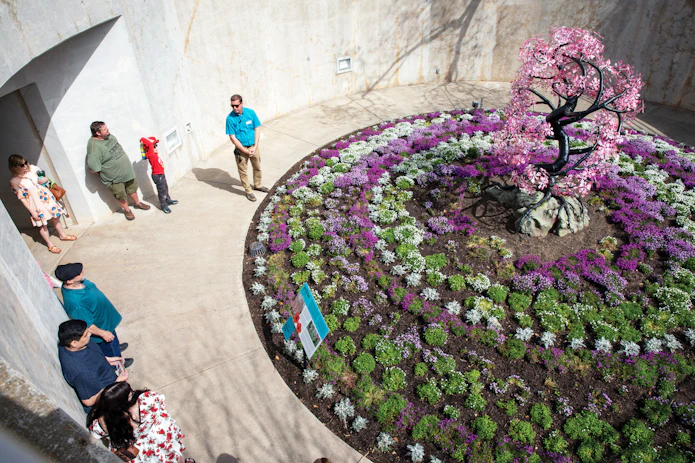
The San Antonio Botanical Garden (SABG) in Texas — along with mathematicians from nearby Trinity University, St. Mary’s University and Southwestern University — illuminated the wonder of mathematics in the natural world, showing how counting tree rings can reveal a tree’s age, how pi factors into sound waves and how mathematics informs garden design.
“There was such incredible energy throughout the day — the number of people who showed up and the enthusiasm they brought with them was amazing,” recalls SABG Chief Mission Officer Andrew Labay.
“One highlight for us was the pi chalk walk, where guests and staff filled the garden entry with colorful digits of pi. It was such a creative, joyful way to experience mathematics together,” adds SABG Vice President of Learning and Interpretation Katie Erickson.
The Virgin Islands Children’s Museum, on St. Thomas in the U.S. Virgin Islands, hosted a Pi Day event featuring talks on how mathematics shows up in everything from marine science to nutrition. This was followed by a workshop using the power of pi to make dresses for bamboula, a West African–derived dance (as well as an associated rhythm and drum).
“At the Virgin Islands Children’s Museum, we celebrate Caribbean culture whenever possible, and this was the perfect way to show how math is woven into our heritage,” says Amber McCammon, the museum’s CEO. “Bamboula is a symbol of freedom and resistance in the Virgin Islands; linking the mathematical constant of a circle’s circumference to the construction of these iconic skirts turned an abstract ratio into a celebration of our ancestors’ ingenuity. It showed that our traditional dance is also a master class in geometry.”
The Pi Day events are just one part of a broader ongoing effort, with Infinite Sums continuing to expand its reach in 2026 and beyond. Whether it’s partnering with filmmakers to tell stories about how mathematics shapes the human experience or connecting artists with scientists to create pieces centered on the theme of symmetry, there will be plenty to explore.
“Math education is often focused on the utility of math, and it’s true that math is practical, but that sells math short,” says SSC Program Director John Tracey. “With Infinite Sums, we really want to surprise people when it comes to what math can be. We want to lean into its elegance and inspire people from there.”