Delving Into the Mathematical Absurdities of Black Holes
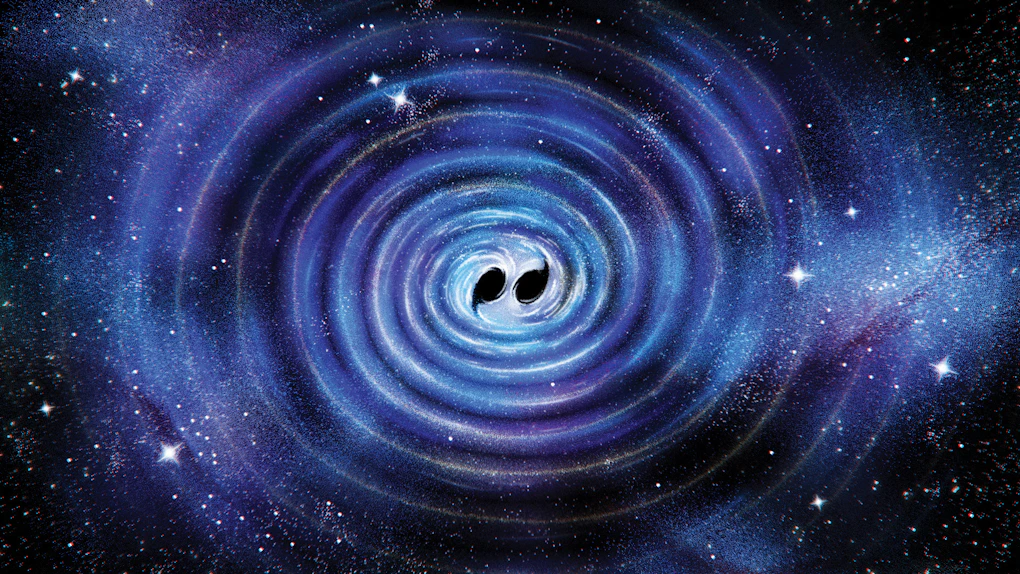
In 1783, more than 200 years before the first direct image of a black hole was obtained in 2019, the British scientist John Michell worked out a series of calculations describing hypothetical stars so massive and dense that light couldn’t escape their gravity, rendering them invisible. This concept was bold, yet so alien in its day that it made few waves among Michell’s colleagues.
It wasn’t until more than a century later, in 1916, that famous names like Karl Schwarzschild and Albert Einstein reintroduced the idea through the theory of general relativity. This describes how massive objects like stars warp the fabric of space-time, creating distortions we experience as gravity. Like Michell, Einstein and Schwarzschild posited that if gravitational pull is strong enough, it becomes inescapable. Further calculations expanded this idea, reinforcing the premise that black holes are at least mathematically feasible. Now, we know that black holes do exist and are surprisingly simple systems whose properties can be described by just a few variables, while also being some of the universe’s most enigmatic objects.
Indeed, black holes remain a source of mystery and fascination for modern astronomers. They’re places where our mathematical understanding of the universe breaks down, seemingly housing a singularity akin to dividing by zero. Researchers at the Flatiron Institute’s Center for Computational Astrophysics (CCA) posit that there’s much to learn in these strange spaces, and that black holes can reveal just as much about the universe overall as they can about themselves. Today, CCA researchers continue to build on the foundation of Einstein’s work as they push black hole research toward new horizons.
“Black holes are interesting in their own right but also are extremely connected to several different areas that researchers here at CCA care about,” says Will Farr, a senior research scientist in the Gravitational Wave Astronomy group at the Flatiron Institute. “Whether you’re studying the entire universe or the formation and evolution of galaxies or stars, black holes have links that are quite important and profound.”
Researchers at the CCA largely focus on two types of black holes, distinguished by their mass relative to that of our own sun. Stellar mass black holes form when stars collapse, creating black holes of up to several hundred solar masses, while supermassive black holes — which form the center of many galaxies, including our own — can top more than 1 billion solar masses as they consume surrounding gases or merge with other black holes.
Farr and Maximiliano Isi, an astrophysicist at the CCA, use gravitational waves to investigate aspects of black hole behavior. Black holes are detectable only when they interact with something else, often a star or another black hole, and produce waves in space-time similar to the sound waves made by striking a bell. Just as the sound can tell you something about the bell, such as whether it’s a church bell or a handbell, these gravitational waves hold information too. If black holes follow Einstein’s predictions, it should be possible to explain patterns in this ringing by analyzing a few foundational properties, including a black hole’s mass and spin.
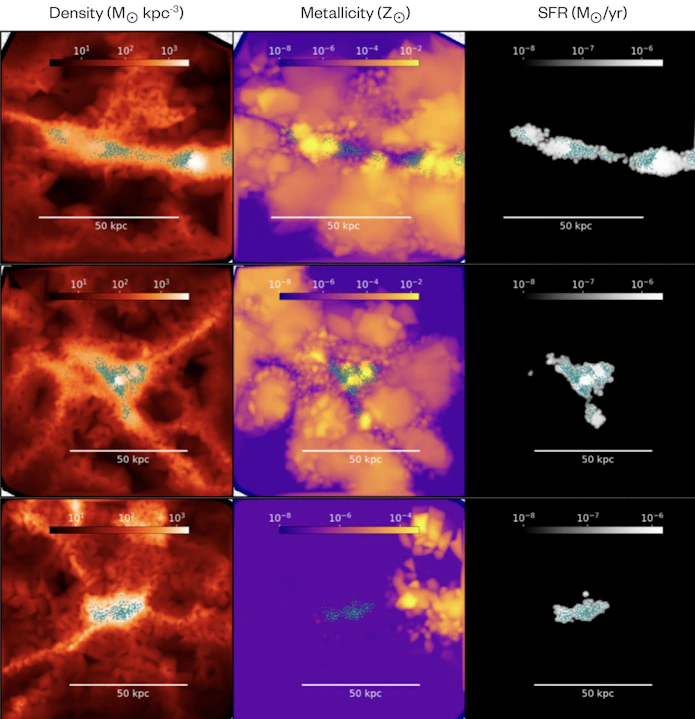
In a recent study, a massive team, including CCA researchers, analyzed such gravitational ‘ringing’ captured by global observatories, which together provided the clearest measurements ever produced. The group found that the waves originated from a suspected merger between two black holes that produced a new one with a mass equivalent to 63 solar masses and a spin rate of 100 revolutions per second. This system is similar to the first merger ever detected, in 2015, allowing researchers to compare observations taken then and now.
“Our tools and instruments are much more precise and powerful, and because of that, we were able to see details we simply couldn’t before,” Isi says, adding that these enhanced capabilities stem in part from painstaking statistical work to increase the quality of information pulled from such distant signals. “By comparing these systems and the overlap in tones, we found that, indeed, these black holes do appear to be simple objects.”
In 2025, Isi and Farr also analyzed gravitational waves from the largest black hole merger ever detected, which created a new, monstrous black hole of 225 solar masses.
This finding was unexpected because the parent black holes were estimated to have masses 137 and 103 times that of our sun. Such black holes should be exceedingly rare, as those masses fall within a theorized black hole mass gap created by nuclear processes inside massive stars. Using mathematical simulations, a team of CCA researchers led by former Flatiron Research Fellow Orr Gottlieb found a possible solution: Magnetic fields generated during black hole formation can sometimes eject enough stellar material to produce a lower-mass black hole that falls within the mass gap range.
CCA Senior Research Scientist Rachel Somerville of the center’s Galaxy Formation group is similarly interested in this question of why black holes sometimes grow to sizes we don’t expect. Supermassive black holes, for example, can grow to be billions of times heavier than our sun, but it takes them billions of years. Yet observations from the James Webb Space Telescope have revealed that supermassive black holes up to 300 million times the mass of our sun existed just 500 million years after the Big Bang.
This is surprising, because if the first ‘seed’ black holes had masses similar to those of the stellar black holes detected through gravitational waves, it would have been difficult for them to grow that large so quickly. That’s because radiation from the superheated gas around the growing black hole tends to slow down or even shut off further growth.
Several hypotheses exist to explain how this might have happened, and Somerville is now using simulations to explore different ideas. According to her work, the way the first black holes formed can make a big difference. Today, the distances between stars are large enough that stars rarely collide, but in the early days of the universe, it was a more cluttered place.
“The early galaxies we observe with James Webb are very dense, and there is evidence that many stars may have formed in dense star clusters. In those super-dense environments, there may have been collisions between stars, and if this happens a bunch of times, you can end up with pretty chunky black holes,” Somerville says. These larger ‘seed’ black holes could have gotten an additional boost if they also grew by merging within their host galaxy.
Amy Secunda, an astrophysicist at the CCA, uses simulations to study how black holes control the growth of galaxies. Most have a supermassive black hole at their center, which is constantly pulling in gas from an accretion disk around its core. “These areas are really energetic and very influential, to the point of changing the way the universe looks,” she says. For example, the gas supermassive black holes accrete fuels powerful outflows that stop new stars from forming.
It’s possible to generate light curves from accretion disks, which emit energy detectable as ultraviolet and visible light. Between advancements in measurement techniques and the ability to simulate light curves mathematically, Secunda says that we’re now swimming in data that need to be analyzed as efficiently as possible. Recently, Secunda has been developing machine learning algorithms capable of sorting through millions of these light curves and teasing out patterns faster than a single person could analyze just one.
Secunda says that while she’s new to machine learning approaches, she’s keen to learn more from her Flatiron Institute colleagues. Researchers studying black holes there now meet monthly to discuss ongoing research and potential new collaborations.
For Isi, the many unanswered questions about black hole observations only add to the excitement, “because it’s such a clear indication that there’s much yet to discover.”